Free tools & guides
GLP-1 Level Chart: How Pokii Models PK
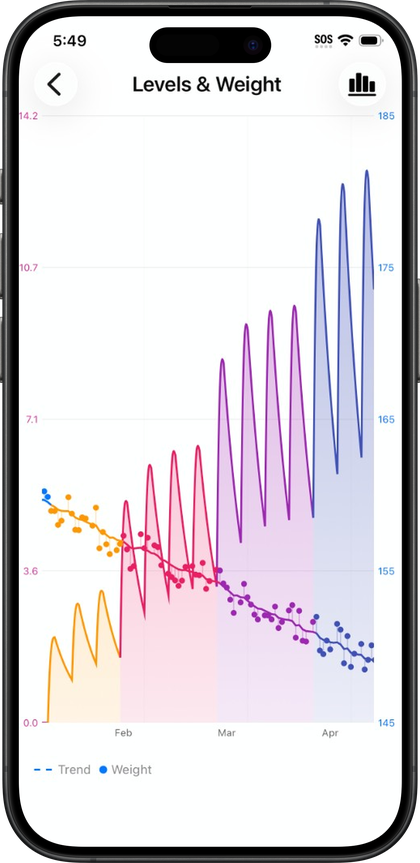
Pokii’s projected medication level chart uses a one-compartment pharmacokinetic model driven by half-life, time to peak (Tmax), and bioavailability—plus your logged doses. This page explains how built-in medications are grouped for that model and what the curve means.
Quick answer
- What you see: An educational curve estimating active drug between logged doses—not a blood test.
- What drives it: Your dose history and built-in defaults for each library entry (half-life, Tmax, bioavailability applied in the app).
- Per Compound mode: Brands that share a molecule (e.g. Mounjaro and Zepbound) use the same underlying profile for tirzepatide.
- Custom meds: You can set your own PK fields when a product isn’t in the library—see custom medications.
- Limits: Not medical advice; investigational drugs use estimates; extended-release products may be simplified in the model.
How Pokii models levels (high level)
Between logged doses, Pokii applies standard PK math to estimate how much medication is likely still active. The chart can show Combined, Per Medication, or Per Compound views; compound grouping uses one modeled profile for all library entries that share a molecule. Shot markers, dose strength, and schedule changes update the curve when you log—they do not read a lab value from Apple Health or anywhere else.
Pokii is a tracking and education tool. It does not provide medical advice, diagnosis, or treatment. If you need to know your actual drug concentration, that requires clinical testing and a conversation with your prescriber—not an app chart.
For how to read the chart in the UI, see projected medication levels and dose plotter / simulated doses.
Built-in library grouping
The table lists each built-in Pokii medication, which molecule it rolls up to in Per Compound view, and whether Pokii treats it as oral or injectable for modeling. For a compounded product or timing that does not match a built-in row, use a custom medication profile.
| Pokii library name | Per Compound group | Route | Modeling notes |
|---|---|---|---|
| Zepbound | Tirzepatide | Injectable | Injectable tirzepatide; one shared modeled curve for Zepbound, Mounjaro, and compounded tirzepatide entries. |
| Mounjaro | Tirzepatide | Injectable | Injectable tirzepatide; one shared modeled curve for Zepbound, Mounjaro, and compounded tirzepatide entries. |
| Ozempic | Semaglutide | Injectable | Injectable semaglutide; one shared modeled curve for Ozempic, Wegovy, and compounded semaglutide entries. |
| Wegovy | Semaglutide | Injectable | Injectable semaglutide; one shared modeled curve for Ozempic, Wegovy, and compounded semaglutide entries. |
| Wegovy Pill | Semaglutide (oral) | Oral | Oral semaglutide; separate absorption profile from injectable semaglutide (Wegovy Pill, Rybelsus). |
| Rybelsus | Semaglutide (oral) | Oral | Oral semaglutide; separate absorption profile from injectable semaglutide (Wegovy Pill, Rybelsus). |
| Foundayo | Orforglipron (oral) | Oral | Oral orforglipron (Foundayo); oral route with its own absorption profile. |
| Saxenda | Liraglutide | Injectable | Injectable liraglutide; shared curve for Saxenda and Victoza. |
| Trulicity | Dulaglutide | Injectable | Injectable dulaglutide (Trulicity). |
| Victoza | Liraglutide | Injectable | Injectable liraglutide; shared curve for Saxenda and Victoza. |
| CagriSema | CagriSema | Injectable | Investigational CagriSema; modeled in-app without a full FDA label. |
| Retatrutide | Retatrutide | Injectable | Investigational retatrutide; modeled from published trial-style summaries. |
| Tirzepatide (Compound) | Tirzepatide | Injectable | Injectable tirzepatide; one shared modeled curve for Zepbound, Mounjaro, and compounded tirzepatide entries. |
| Semaglutide (Compound) | Semaglutide | Injectable | Injectable semaglutide; one shared modeled curve for Ozempic, Wegovy, and compounded semaglutide entries. |
| Bydureon | Exenatide (ER) | Injectable | Extended-release exenatide; simplified single-curve approximation—not a full biphasic ER model. |
| Tanzeum | Albiglutide | Injectable | Injectable albiglutide (Tanzeum, discontinued). |
What the defaults are based on
FDA-labeled products in the library (tirzepatide, injectable and oral semaglutide, liraglutide, dulaglutide, oral orforglipron, and others) use PK-style parameters informed by prescribing information and published labeling, rounded for a stable chart—not for clinical dosing decisions.
Compounded entries (“Tirzepatide (Compound)” and “Semaglutide (Compound)”) share the same modeled profile as branded injectable tirzepatide and semaglutide unless you add a custom medication with pharmacy-specific values.
Retatrutide and CagriSema are investigational in the U.S.; the app uses literature-style estimates where no FDA label exists.
Bydureon (exenatide extended-release) has biphasic release in real life; Pokii’s chart uses a simplified curve and should not be read as a precise ER simulation.
Oral semaglutide is modeled with a different absorption path than weekly injectable semaglutide, while sharing the same molecule once absorbed.
When to use custom PK instead
Use a custom medication profile when your compound, concentration, or route does not match the built-in row—for example a compounded vial with different timing, a product not yet in the library, or a dose form Pokii does not list separately. You control half-life, Tmax, bioavailability, oral vs injectable, and whether the drug appears on the chart at all.
Pokii is a tracking and education tool. It does not provide medical advice, diagnosis, or treatment. Talk with your clinician about dosing, side effects, and any change to your plan.