Free tools & guides
Fiber Tracking for GLP-1 Users in Pokii
Fiber doesn't usually get much attention in day-to-day eating, but it moves up the priority list once GLP-1 therapy is in the picture, mainly because of how these medications interact with digestion. Pokii's nutrition dashboard already tracks fiber alongside your other macros, and pairing that with hydration tracking gives you a fuller picture of the two nutrients most commonly connected to GI comfort on GLP-1 medications.
Why fiber gets extra attention on GLP-1 therapy
GLP-1 medications work in part by slowing gastric emptying and reducing overall GI motility, which is the same mechanism that helps extend fullness after a meal. Clinical literature on delayed gastric emptying with GLP-1 receptor agonists and tirzepatide describes this slowed transit as a well-documented driver of GLP-1-associated constipation, since food and waste simply move through the digestive tract more slowly than before.
General population guidance commonly cited for fiber intake centers on roughly 25 g/day for adult women and 38 g/day for adult men, with an age-adjusted step-down to around 21 g and 30 g/day, respectively, after age 50. Some sources phrase the same guidance as a broader range of about 22–34 g/day depending on age and sex, or use a rule of thumb of roughly 14 g of fiber per 1,000 calories consumed. For context, average U.S. adult fiber intake is commonly cited as well below any of these targets, around 16 g/day, which is a general population shortfall independent of GLP-1 use. Guidance aimed specifically at people on GLP-1 therapy often suggests nudging fiber somewhat above baseline, commonly toward a 25–30 g/day range, combined with adequate fluids and physical activity, as one general approach to offsetting slowed-transit constipation risk.
These figures are general population reference ranges, not personalized medical advice, and individual needs vary by body size, age, sex, activity level, and by conditions such as IBD, IBS, or a history of bariatric surgery, which can change safe fiber guidance considerably. Increasing fiber too quickly can also worsen bloating or discomfort in some people, so general sources note that the balance of soluble and insoluble fiber, and the pace of any increase, is often worth discussing with a doctor or registered dietitian. If constipation is severe, persistent, or accompanied by pain, Pokii's dedicated guide on constipation as a GLP-1 side effect covers the topic in more depth and is a better starting point than fiber intake alone.
Tracking fiber in Pokii's nutrition dashboard
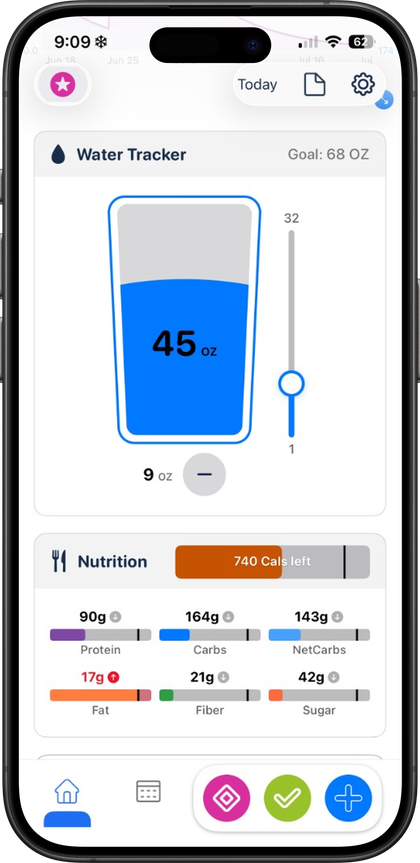
Pokii's nutrition dashboard shows calories, protein, carbs, fat, fiber, sugar, and sodium in one place, sourced from Apple Health, including nutrition data written by Pokii's own AI meal-scan feature. That means fiber sits alongside the other macros you're already watching rather than living in a separate app or a separate mental tally, so a day where fiber is trending low is visible in the same glance as everything else.
For You custom nutrition targets let you set a personal fiber goal rather than relying on the dashboard totals alone, and the combined water and nutrition dashboard module brings fiber and hydration into a single section instead of two separate ones. Pokii itself doesn't set or recommend a specific fiber number on its own initiative; any target you track against in the app comes from you, a clinician, or a registered dietitian, with the dashboard simply reflecting the data as it's logged.
Syncing fiber from Apple Health
Fiber tracking in Pokii runs through Apple Health rather than a separate, disconnected food log. With permission, Pokii reads dietary fiber from HealthKit along with calories, protein, carbohydrates, fat, sugar, and sodium, so if you're already logging meals in another app that writes to Apple Health, that fiber data can flow into Pokii's dashboard automatically. Pokii's own AI photo meal capture, works the same way in reverse: photograph a meal in-app, let the AI estimate its nutrition, including fiber, edit the estimate if needed, and save it, and Pokii writes the full set of macros back to Apple Health so the dashboard totals update.
Because Pokii's dashboard observes HealthKit for changes, fiber and water numbers refresh when related samples are added, whether that entry came from Pokii's own meal scan or from another app writing to the same Health data. That two-way relationship with Apple Health is meant to keep fiber tracking low-friction, since it draws on data you may already be logging elsewhere instead of asking for a second round of manual entry.
Pairing fiber tracking with water intake
Fiber and fluids are frequently discussed together in general GI guidance, and that pairing matters even more in a GLP-1 context, since slowed gastric emptying, appetite suppression, and gastrointestinal side effects can all reduce total fluid intake around the same time fiber needs are getting extra attention. General guidance aimed at offsetting GLP-1-related constipation risk typically frames adequate fiber and adequate fluids as a pair, not as separate, unrelated targets.
Pokii's free water tracker uses glass-based quick add with a daily goal and optional confetti when you hit it, so hydration logging sits right next to fiber and the rest of the nutrition dashboard rather than in a separate corner of the app. Pokii's smart water reminders add interval- and time-window-based nudges with pattern-based messaging, which is directly relevant given that some GLP-1 patient-education sources describe these medications as potentially blunting thirst cues, making it easier to under-drink without noticing. And because Pokii's combined water and nutrition module puts both in one dashboard section, fiber intake and hydration show up together in daily use rather than as two figures you have to mentally add up yourself.
Always follow your prescriber’s instructions for GLP-1 medications. Pokii helps you log and visualize your journey; it does not replace professional care.