Free tools & guides
Water Intake Goals in Pokii
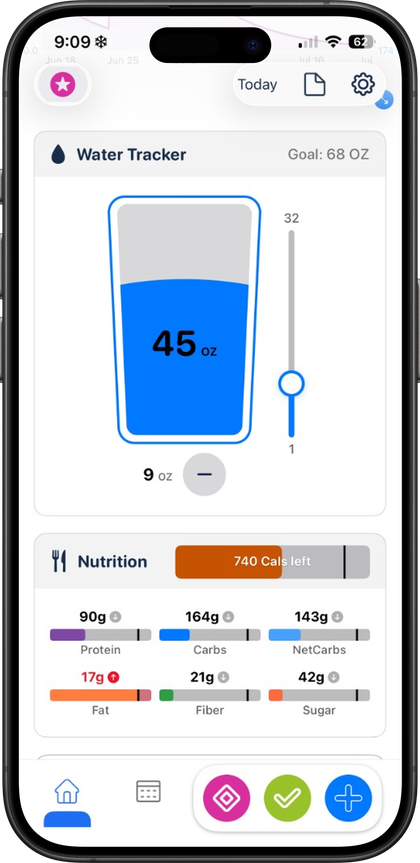
Hydration is one of the easier habits to lose track of on GLP-1 therapy, even though several general-guidance sources point to it as worth extra attention during treatment. Pokii's water tracker gives you a place to set a personal daily goal, get reminded to drink through the day, and see water logged anywhere in Apple Health show up automatically on your dashboard, alongside a small celebration when you hit your number.
Why hydration gets extra attention on GLP-1 therapy
General-population reference figures, most notably the National Academies of Sciences, Engineering, and Medicine's Dietary Reference Intakes, put adequate total water intake at roughly 3.7 liters (about 125 ounces) per day for adult men and roughly 2.7 liters (about 91 ounces) per day for adult women, counting water from all beverages and food combined, with food typically estimated to supply about a fifth of that total. Mayo Clinic reporting cites essentially the same range in cups, roughly 11.5 to 15.5 cups of total daily fluid for the average healthy adult. These figures describe healthy, sedentary adults in temperate climates; needs rise with heat, activity, illness, or extra GI fluid loss. The commonly repeated "eight glasses a day" rule of thumb (about 2 liters) is a simplification of these ranges rather than a formal clinical guideline.
Several patient-education sources describe GLP-1 medications as carrying a somewhat elevated dehydration risk, through a few compounding factors: nausea, vomiting, and diarrhea are common side effects that cause direct fluid and electrolyte loss; appetite suppression reduces overall food intake, and food normally supplies a meaningful share of daily fluid; and some sources describe GLP-1 medications as potentially blunting thirst cues, since hunger and thirst signals overlap in the brain, making it easier to under-drink without noticing. Against that backdrop, a commonly cited general fluid target discussed for people on GLP-1 medications is roughly 2 to 3 liters a day, sitting at or above the general adult range described above.
These are general population reference ranges, not personalized medical or dietary advice, and they shouldn't be treated as a prescription. Actual fluid needs vary by body size, sex, age, activity level, pregnancy or lactation status, and climate — and for people on GLP-1 therapy, co-existing conditions matter too. Kidney disease or a history of kidney stones, heart failure or other conditions requiring fluid restriction, diabetes, GI disorders, a history of bariatric surgery, and electrolyte imbalances arising from GLP-1-related vomiting or diarrhea can all change what a safe daily fluid target actually is. Anyone on GLP-1 therapy, and especially anyone with these or other relevant health conditions, should get a personal fluid target from a doctor or registered dietitian rather than relying on general-population figures alone. Pokii is a tracking and education tool — it does not provide medical advice, diagnosis, or treatment.
Setting a personal water goal in Pokii
Rather than prescribing a number, Pokii gives you a water tracker built around whatever daily goal you land on with your own research and, ideally, a conversation with your doctor or dietitian. The tracker uses glass-based quick add, so logging a drink is a couple of taps rather than typing in ounces or milliliters, and it's available in Pokii. Once your daily goal is set, the tracker keeps a running total for the day so you can see at a glance how close you are, and it includes an optional confetti celebration when you reach it. Because the goal lives in Pokii rather than being calculated for you, it's meant to hold whatever figure fits your situation — whether that's a general-guidance range like the ones above, a number from a dietitian, or something adjusted for a health condition your doctor is managing.
Smart notifications that nudge you to drink
Setting a goal only helps if the day doesn't get away from you, which is part of why Pokii offers smart water reminders. Instead of a single generic daily alert, these reminders use interval- and time-window-based scheduling with pattern-based messaging, so nudges are spread across the day rather than arriving all at once or only when you happen to open the app. That kind of steady, spaced-out prompting is directly relevant to the blunted-thirst-cue mechanism described above: if GLP-1 therapy is making it easier to go long stretches without feeling thirsty, a reminder that shows up on its own schedule can catch gaps that relying on thirst alone might miss. The reminders sit alongside the water tracker itself, so a nudge leads straight into the same glass-based quick-add flow you'd use any other time.
Syncing water from Apple Health and celebrating your goal
Pokii's water tracking is built on top of Apple Health rather than existing as an isolated log. With permission, Pokii reads dietary water from Apple Health and writes the water you log in-app back to Health, and the dashboard is set up to refresh automatically when related HealthKit water samples change. In practice, that means water you log through another app or a connected device that writes to Apple Health can show up in Pokii's daily total too, not just water added directly in the app — the two stay in sync rather than tracking two separate numbers. For You water and nutrition also collapse into a single combined dashboard module instead of the separate water and nutrition sections shown on Free, making the whole daily hydration-and-food picture visible in one place.
The moment you actually hit your daily water goal is where Pokii's confetti comes in. It's part of the app's broader configurable-confetti feature, which also celebrates things like logged shots and check-ins, with particle count and burst behavior you can adjust — or turn off entirely — in settings. It's a small touch, but pairing a concrete, reachable goal with an equally concrete signal that you've hit it is a straightforward way to keep a habit like hydration from quietly slipping during a period when, as the guidance above suggests, it's easier than usual to under-drink without noticing.
Pokii is a tracking and education tool. It does not provide medical advice, diagnosis, or treatment. Talk with your clinician about dosing, side effects, and any change to your plan.