Free tools & guides
Protein Goals with Pokii and Apple Health
Protein comes up constantly in GLP-1 conversations, and for good reason: appetite suppression can make it hard to eat enough of anything, protein included. This page walks through the general reasoning behind protein-focused guidance during GLP-1-assisted weight loss, then shows how Pokii's nutrition dashboard, personal macro targets, and Apple Health sync can help someone keep an eye on their own numbers day to day.
Why protein gets extra attention on GLP-1 medications
Standard general-population protein guidance, often summarized as roughly 0.8 grams per kilogram of body weight per day, is frequently described as insufficient during intentional, rapid weight loss, including weight loss driven by GLP-1 medications. The concern isn't protein for its own sake; it's that inadequate protein during a fast caloric deficit raises the risk of losing lean muscle mass along with fat.
Commonly cited general ranges for people intentionally losing weight, including those on GLP-1 therapy, cluster around 1.2 to 1.6 grams of protein per kilogram of body weight per day, roughly 0.55 to 0.73 grams per pound. Some sources reference lean body mass instead (about 1.5 grams per kilogram of lean mass), and others use a more conservative band based on ideal body weight. That spread reflects genuine variation in how different professional sources frame the same underlying idea, not one settled number. A related, commonly repeated framing breaks the daily total into per-meal terms: roughly 25 to 40 grams of protein per meal across three to four eating occasions, since the muscle-building response to a given meal is thought to plateau above that range.
The GLP-1-specific rationale is straightforward: appetite suppression combined with a rapid caloric deficit increases the chance that a meaningful share of weight lost is muscle rather than fat, unless protein intake (and typically resistance exercise) is prioritized. This is part of why dietitian involvement is often described as valuable specifically for people on GLP-1 therapy, to help protect muscle mass while the medication is suppressing appetite.
None of this is personalized medical advice, and it isn't a Pokii-generated recommendation. These are general population reference ranges compiled from public health and dietitian-authored sources, and individual needs vary by body size, sex, age, activity level, and by health conditions such as kidney disease, where protein targets can need significant adjustment under medical supervision. Anyone on GLP-1 therapy should get a personal protein target from a doctor or registered dietitian rather than relying on general figures alone. Pokii itself does not set or suggest a numeric protein target; it's a tracking and education tool, not a source of medical advice.
Setting a personal target in Pokii's nutrition dashboard
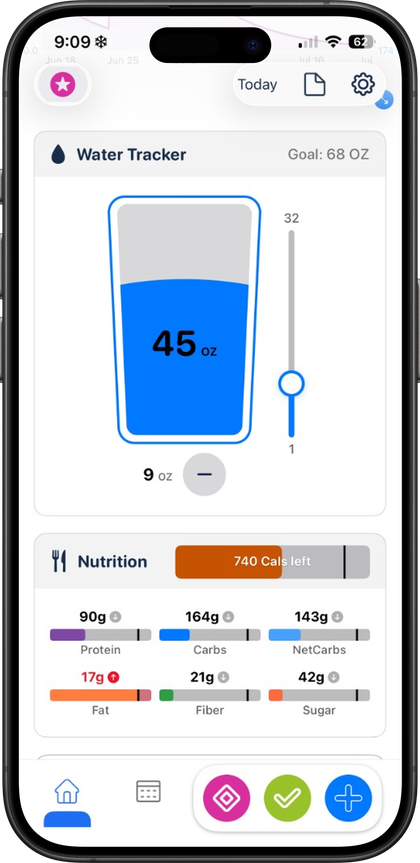
Once someone has a protein number from their own doctor or dietitian, or simply a personal goal they want to track toward, Pokii's nutrition dashboard is where that target lives day to day. The nutrition dashboard already shows calories, protein, carbs, fat, fiber, sugar, and sodium for the day, pulled from Apple Health.
Custom macro targets are. Instead of just seeing raw protein totals with no reference point, a subscriber can set personal nutrition targets in Pokii, including a protein goal, so the dashboard reflects progress against that specific number rather than a generic default. Pokii also offers a combined water and nutrition dashboard module, putting protein tracking alongside hydration tracking in one section instead of two, which is convenient given how often hydration and appetite come up together during GLP-1 therapy.
Because the target is something the person (or their dietitian) defines, Pokii's role is to make the number visible and trackable, not to prescribe it. The dashboard can be reordered in Pokii, and modules can be shown, hidden, or combined in Pokii, so protein tracking can sit wherever it's most useful in a person's daily view.
Syncing protein automatically from Apple Health
Pokii's nutrition figures aren't manually re-entered; they're read from Apple Health with permission. That includes dietary protein along with carbohydrates, fat, fiber, sugar, sodium, and calories, plus water. If protein is logged in another app that writes to Apple Health, or through Apple's own nutrition entry, Pokii's dashboard reflects that automatically because dashboard nutrition and water sections refresh when the related HealthKit samples change.
Pokii also has its own path for adding nutrition data directly: Pokii's AI photo meal capture lets someone photograph a meal in-app, get an AI-estimated nutrition breakdown (including protein), edit those numbers before saving if they don't look right, and have the result written back to Apple Health. That write includes the full set of nutrition macros, so a meal logged through Pokii's scanner shows up in the dashboard totals the same way a meal logged through Apple Health directly would.
This two-way relationship with HealthKit means protein tracking doesn't require picking one single app. Someone can log meals through Pokii's scanner, another nutrition app, or Apple's own tools, and as long as it's written to Apple Health, Pokii's dashboard totals for the day stay current without extra manual entry.
Spotting low-protein days alongside appetite and side effects
A single day's protein total is useful, but the more actionable view is often the pattern over time, especially paired with how appetite is behaving. Pokii's daily check-in includes an appetite tracking slider alongside optional side-effect logging with intensity per effect, separate from the nutrition dashboard but visible in the same daily hub. Looking at a day where the nutrition dashboard shows a noticeably low protein total next to a check-in logged with low appetite or GI-related side effects can help someone, and their care team if they choose to share that data, connect how they were feeling with what they were able to eat.
The dashboard's "Today's log" section brings shots, check-ins, weight, and food scans together on a single date-scoped timeline, so a low-protein day and a rough appetite day aren't scattered across different screens. That combined view is also what feeds Pokii's PDF progress reports, which can include appetite, mood, side effects, and daily log detail alongside the rest of a person's tracked data, making a low-protein stretch easier to describe in a conversation with a doctor or dietitian than trying to recall it from memory.
Pokii doesn't flag a day as "too low" against any built-in protein threshold; there's no numeric target baked into the app beyond what a user sets for themselves. What it does provide is the raw material for noticing the pattern: a daily protein number from Apple Health, a personal target for comparison in Pokii, and appetite and side-effect context logged in the same place, so general guidance about protein during GLP-1 therapy has something concrete to check against.
Always follow your prescriber’s instructions for GLP-1 medications. Pokii helps you log and visualize your journey; it does not replace professional care.