Trackers by medication
Zepbound Tracker App
Tracking Zepbound on iPhone or iPad: Pokii includes Zepbound in its built-in library, logs weekly shots with reminders and injection-site rotation, and shows an educational projected tirzepatide level curve between doses (not lab results). Below: label context on dosing and devices, common side effects, and every Pokii feature that applies to Zepbound.
Quick answer
- Cadence: Zepbound is once weekly; Pokii supports interval or weekday schedules, overdue/shot-day banners, and widgets.
- In the app: Zepbound is preloaded; compound tirzepatide and custom PK profiles are available if your pharmacy product differs.
- Between shots: Projected levels chart (Per Compound groups Zepbound with other tirzepatide brands); daily check-ins for side effects, appetite, and mood.
- Practical: Injection-site map, pen warm-up timer, progress photos, PDF reports for visits.
- Not medical advice: Pokii records what you and your prescriber decided—it does not set doses or read labs.
What Zepbound is and what it's FDA-approved for
Zepbound is a once-weekly injectable GIP/GLP-1 receptor agonist made by Eli Lilly. As of this writing, it carries two FDA-approved adult indications. The first, and original, approval covers chronic weight management for adults with obesity (a BMI of 30 or higher) or with overweight (a BMI of 27 or higher) plus at least one weight-related health condition, used alongside a reduced-calorie diet and increased physical activity. The second indication, added in December 2024, covers moderate-to-severe obstructive sleep apnea (OSA) in adults with obesity, specifically those with an apnea-hypopnea index of 15 events per hour or higher, again as an adjunct to diet and physical activity. According to Lilly, this made Zepbound the first prescription medicine approved specifically for moderate-to-severe OSA in adults with obesity. The label frames Zepbound as part of comprehensive OSA care alongside options like PAP therapy, oral appliances, or surgery — not as a replacement for them.
Both indications share the same underlying drug and injection routine, which is part of why a single tracking approach works whether someone is using Zepbound for weight management, OSA, or both. What differs between the two indications is mainly which maintenance doses are labeled for use, covered below.
Dosing, titration, and the newer multi-dose pen
The label describes Zepbound as a once-weekly subcutaneous injection that can be administered at any time of day, with or without food. According to the current prescribing information, the starting dose is 2.5 mg once weekly for four weeks; the label is explicit that 2.5 mg is a treatment-initiation dose only and is not an approved maintenance dose. From there, the label describes titration in 2.5 mg increments after at least four weeks on the current dose, moving through 2.5 mg, 5 mg, 7.5 mg, 10 mg, 12.5 mg, and up to a maximum of 15 mg, with each step held for a minimum of four weeks before any further increase. Labeled maintenance doses are 5 mg, 10 mg, or 15 mg for the weight-management indication, while the OSA-with-obesity indication is labeled for 10 mg or 15 mg maintenance only (5 mg is not a labeled maintenance dose for OSA). For a missed dose, the label describes administering it as soon as possible within four days of the missed dose, or skipping it and resuming the normal weekly schedule if more than four days have passed. The label also notes Zepbound may reduce the effectiveness of oral hormonal contraceptives due to delayed gastric emptying, and describes using a non-oral or barrier method for four weeks after starting and for four weeks after each dose increase. None of this is a recommendation — an individual's actual starting dose, titration pace, and maintenance dose are set by a prescriber, and this is simply a description of what the current label specifies.
On the device side, Zepbound is currently available in three formats, each offered across the same six dose strengths: a single-dose prefilled auto-injector pen, a single-dose prefilled vial available through LillyDirect Pharmacy, and a newer multi-dose KwikPen for single-patient use that holds four doses — a full month's supply — in one device. Reporting indicates the FDA approved this multi-dose KwikPen around February 2026, and it began shipping later that year. It's a change in device format, not a change in dosing frequency: regardless of which device is used, Zepbound is still injected once per week.
Common side effects, and staying on schedule between doses
The most commonly reported side effects of Zepbound are gastrointestinal, and tend to show up most noticeably when starting the medication or after a dose increase. Drug-reference sources cite nausea in up to roughly 29% of patients, diarrhea in up to roughly 23%, and vomiting in up to roughly 13%, with constipation, abdominal discomfort, indigestion, injection-site reactions, fatigue, hypersensitivity reactions, belching, hair loss, and reflux also reported. Severe gastrointestinal reactions were reported more often with Zepbound than placebo in pooled clinical trial data, and Zepbound is not recommended for people with severe gastroparesis. This is a general summary, not a complete list of every warning or risk on the label, and anyone using or considering Zepbound should review the full prescribing information and medication guide with a healthcare provider.
Because side effects and energy levels tend to shift around dose changes, and because titration steps are spaced weeks apart, it's easy to lose track of exactly where you are in the schedule — or to forget whether today's fatigue lines up with a dose increase from a few weeks back. Pokii's dashboard includes overdue and shot-day banners that appear when a dose is due or late, with a deeplink to reschedule, so shot day doesn't get missed in the middle of a busy week. Pokii's daily check-in also supports optional side-effect logging with an intensity rating per effect, alongside appetite and mood tracking — useful for noticing patterns, like GI symptoms clustering around a dose increase, without needing to keep a separate note. On the non-scale side, Pokii's progress photos feature gives a dated, weight-context carousel to look back on — viewing existing photos is available in Pokii, and you can capture new progress photos over time. Between the shot-day banners keeping the injection schedule visible and the photo carousel showing change that a scale alone won't capture, the two features work together to keep the bigger picture in view over a months-long titration.
What Pokii tracks for Zepbound specifically
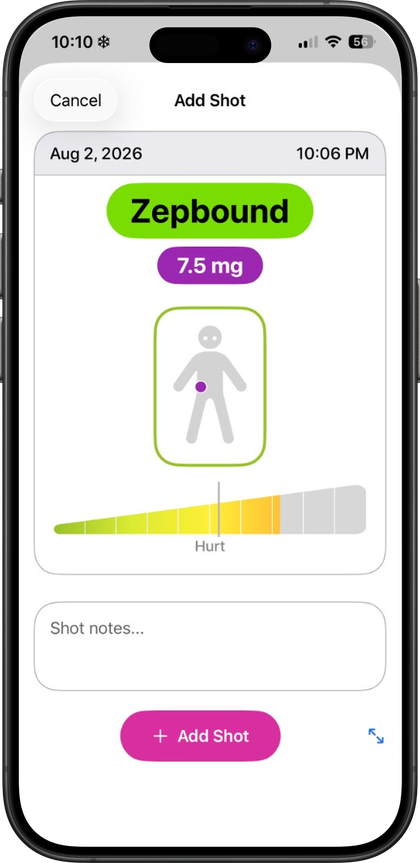
Zepbound is one of the built-in medications in Pokii's library, grouped alongside other GLP-1/GIP branded and compound entries by pharmacokinetics, so it's ready to select without manual setup. Shot tracking lets users log each injectable dose with date, time, medicine, dose, and notes, with full edit history. The injection site body map shows a front/back view with rotation settings and a suggested next site for injectable medications like Zepbound, also in Pokii. Because Zepbound pens are typically stored cold and need to warm up before injecting, Pokii includes a room-temperature timer with presets and a countdown alarm, relevant to pen-based administration. Flexible shot schedules support interval- or weekday-based reminders to match Zepbound's once-weekly cadence.
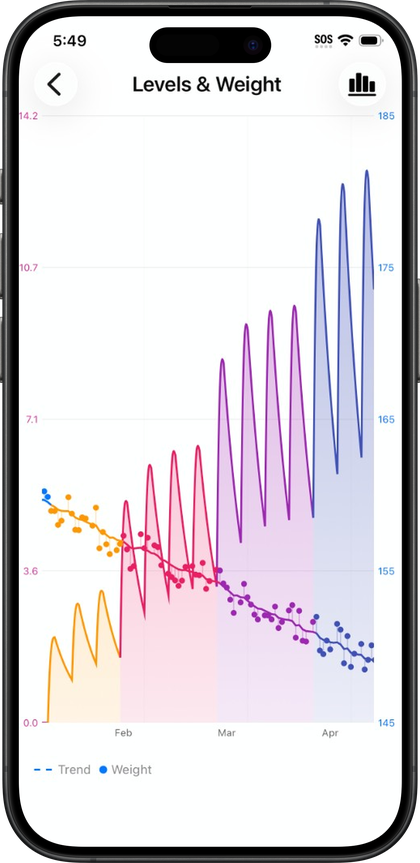
For a broader view between doses, Pokii's projected medication levels chart models an educational pharmacokinetic curve — Pokii's own documentation is explicit that this reflects an estimated model, not lab results. You can track Zepbound alongside another medication during a formulation switch, with custom dose colors, dose simulation on the scheduler, full per-dose dosage history, and PDF progress reports that can include Zepbound dose data. On the home screen, Pokii's widgets add a Shot Progress view showing cycle progress and the next shot at a glance, plus the full Next Shot chart widget. Throughout, Pokii's own disclaimer is direct about scope: it is a tracking and education tool that does not provide medical advice, diagnosis, or treatment, and it does not set dosing recommendations, adjudicate titration schedules, or prescribe medication — it tracks the doses a user and their prescriber have already decided on.
Always follow your prescriber’s instructions for GLP-1 medications. Pokii helps you log and visualize your journey; it does not replace professional care.