Trackers by medication
Wegovy Tracker App
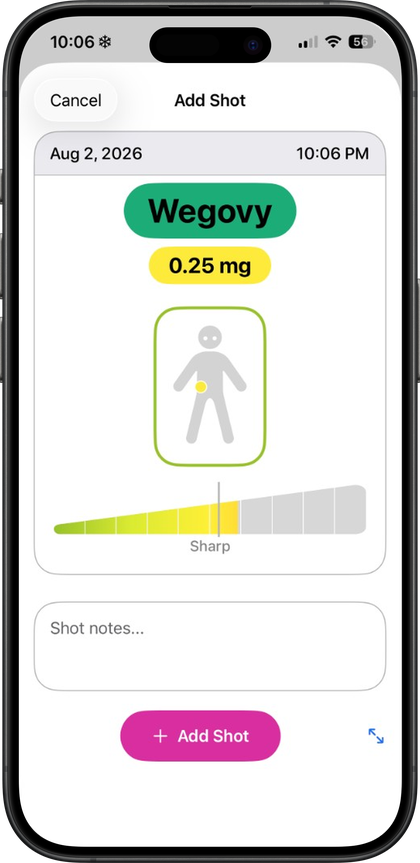
Wegovy tracker for iPhone and iPad: Pokii includes Wegovy (injectable pen) and Wegovy Pill in its built-in medication library. Log every dose with reminders, injection-site rotation, daily check-ins, and a projected semaglutide level chart between weekly shots — one private timeline for pen or tablet.
Pokii does not provide medical advice, diagnosis, or treatment. Wegovy dosing, titration, and side effects are decisions for you and your licensed prescriber — not for an app.
Quick answer
- Both formulations: Wegovy FlexTouch pen (weekly) and Wegovy Pill (daily) are preloaded; switch formulations without losing history.
- Weekly pen workflow: Shot log with site map, room-temperature timer, overdue/shot-day banners, and widgets.
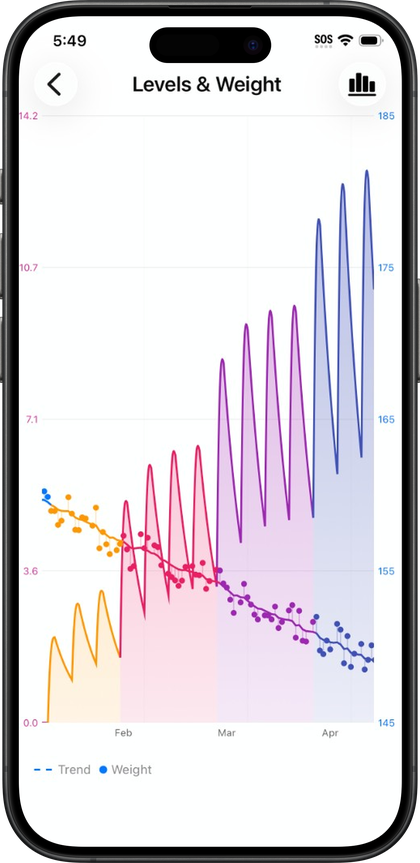
- Between doses: Educational projected semaglutide curve (Per Compound groups Wegovy with Ozempic/Rybelsus by molecule).
- Side effects: Daily check-in with rated nausea, fatigue, and custom entries tied to dose timing on the calendar.
- For visits: PDF progress reports with shots, levels, weight, side effects, and notes.
What Wegovy is — and what the trials showed
Wegovy is Novo Nordisk's brand of semaglutide, a GLP-1 receptor agonist available as a once-weekly injectable pen and a once-daily oral tablet. As of mid-2026 it is FDA-approved for chronic weight management, cardiovascular risk reduction in adults with established heart disease and obesity/overweight, and MASH with moderate-to-advanced liver fibrosis (injectable). It carries a boxed warning for thyroid C-cell tumors in rodent studies and is contraindicated with personal/family history of medullary thyroid carcinoma or MEN 2.
In STEP-1, semaglutide 2.4 mg produced 14.9% mean weight loss at 68 weeks (n=1,961) versus 2.4% with placebo — the pivotal trial behind Wegovy's obesity indication. That is label-context efficacy, not a prediction for any individual.
March 2026 brought Wegovy HD at 7.2 mg for adults needing more loss than 2.4 mg provided, after at least four weeks at 2.4 mg. The oral tablet was FDA-approved December 2025 (25 mg maintenance dose after escalation).
Dosing schedule, as labeled — not as advice
Injectable pen: Label escalation typically starts 0.25 mg once weekly, increasing roughly every four weeks through 0.5 mg, 1 mg, 1.7 mg, and 2.4 mg maintenance (or 7.2 mg HD when indicated). Missed-dose rules: take if the next dose is more than two days away; otherwise skip and resume schedule; missing two or more consecutive doses may require restarting escalation per manufacturer materials.
Oral tablet: Separate daily schedule — 1.5 mg starting dose, escalating about every 30 days toward 25 mg maintenance, taken on an empty stomach with ≤4 oz water and ≥30 minutes before food or other oral meds.
Pens store refrigerated (36–46°F) or room temp up to 86°F for 28 days. Pokii's room-temperature timer counts down pen warming on shot day.
Side effects worth logging in month one
Wegovy's label lists nausea, diarrhea, vomiting, constipation, abdominal pain, headache, and fatigue among the most common effects. Nausea often peaks after starting or increasing a dose — commonly cited at ~44% in semaglutide obesity trials — then eases for many people over one to few weeks.
Because symptoms cluster around titration steps spaced weeks apart, a dated log beats memory. Pokii's check-in rates each side effect for intensity, with appetite and mood sliders and notes showing relative-to-last hints. The projected level chart (educational model, not lab work) sits on the same timeline so you can see whether nausea lines up with a recent increase or the tail of a weekly cycle.
What Pokii tracks for Wegovy
- Shot/oral log with full edit history, per-medicine reminders, and simulated doses on the scheduler
- Injection site map (pen only) with rotation suggestions and optional pain rating
- Projected levels in Combined, Per Medication, or Per Compound mode (semaglutide grouped across Wegovy, Ozempic, Rybelsus)
- Weight, meals, water on Today's log; nutrition label scanning writes to Apple Health
- PDF progress reports choosing sections for clinician visits
Frequently asked questions
Is there a Wegovy tracker app? Yes — dedicated GLP-1 trackers like Pokii log doses, sites, titration history, side effects, and projected levels. Generic pill reminders usually miss injection rotation and PK context.
Does Pokii work with Wegovy Pill? Yes. Oral doses log on the same timeline without injection-site fields.
Can I switch from pen to pill in Pokii? Log each formulation as built-in Wegovy or Wegovy Pill; Per Compound view keeps semaglutide history grouped by molecule if you also used Ozempic.
Is the level chart a blood test? No. Pokii's curve is an educational pharmacokinetic estimate — useful for timing and prescriber conversations, not a lab result.
Does Pokii tell me what dose to take? No. Pokii records doses you and your prescriber already decided on; it does not recommend titration or treatment changes.