Side effect guides
Zepbound Side Effects
Zepbound (tirzepatide) is a once-weekly injectable GIP/GLP-1 receptor agonist approved for chronic weight management and, separately, for moderate-to-severe obstructive sleep apnea in adults with obesity. Like other medicines in this class, it comes with a well-documented side-effect profile that tends to show up most noticeably when starting treatment or moving up a dose. This page summarizes what's commonly reported and why paying attention to how those effects change over time, especially during titration, can be useful context to bring to a prescriber. It is not medical advice, and it does not replace the official Prescribing Information, the Medication Guide, or a conversation with the healthcare provider managing your treatment.
Zepbound's known side-effect profile
Across the drug-label and reference sources reviewed for this page, Zepbound's most frequently reported adverse reactions are gastrointestinal. Nausea has been reported in up to roughly 29% of patients in some sources, diarrhea in up to roughly 23%, and vomiting in up to roughly 13%. Constipation, abdominal pain or discomfort, dyspepsia (indigestion), eructation (belching), and gastroesophageal reflux are also commonly listed. Beyond the GI tract, injection-site reactions, fatigue, hypersensitivity reactions, and hair loss (alopecia) appear among reported effects in drug-reference sources as well.
A consistent pattern in the sourced material is that these effects tend to be most noticeable around treatment initiation and around each dose increase, rather than being constant at the same intensity throughout treatment. Zepbound's labeled titration moves in 2.5 mg increments — 2.5 mg, 5 mg, 7.5 mg, 10 mg, 12.5 mg, up to a 15 mg maximum — with each step held for at least four weeks before the next increase. That structure means a person's GI symptoms may naturally ebb and flow in a rhythm tied to the titration schedule rather than trending in one steady direction, which is part of why looking at side effects in the context of dose and timing, rather than in isolation, tends to be more informative.
Reported side effects also appear broadly similar between Zepbound's two approved uses — weight management and moderate-to-severe obstructive sleep apnea with obesity — according to the sourced material, suggesting the GI-predominant pattern isn't specific to one indication.
This summary reflects commonly cited effects from drug-reference sources and Lilly's own dosing materials; it is not an exhaustive list of every reaction, warning, or contraindication on the current label.
Serious risks worth knowing about
Most people who experience side effects on Zepbound experience the common GI ones described above, but the sourced material also flags some risks that are worth understanding even though they affect a smaller share of patients. In pooled data from the SURMOUNT-1 and SURMOUNT-2 trials, cited on Lilly's HCP dosing page, severe gastrointestinal adverse reactions occurred more often with Zepbound than with placebo: about 1.7% at the 5 mg dose, 2.5% at 10 mg, and 3.1% at 15 mg, compared with about 1.0% on placebo. Zepbound is not recommended for patients with severe gastroparesis, a condition involving delayed stomach emptying, since the medication itself also slows gastric emptying as part of how it works.
Because significant GI symptoms like vomiting or diarrhea can lead to dehydration, some sources note a theoretical connection between dehydration and acute kidney injury risk — a reason clinicians sometimes emphasize hydration during periods of active GI side effects, particularly around dose increases.
The label also carries a boxed warning related to thyroid C-cell tumors observed in rodent studies, a warning shared across this drug class; this page does not attempt to summarize that warning in full, since it involves risk factors and monitoring guidance best reviewed directly in the Medication Guide with a prescriber. Separately, because Zepbound can delay gastric emptying, the label advises that it may reduce the effectiveness of oral hormonal contraceptives, with guidance to use a non-oral or barrier method for four weeks after starting and for four weeks after each dose increase.
None of this is a complete accounting of every warning or contraindication on the current Zepbound label. Anyone using or considering Zepbound should review the full Prescribing Information and Medication Guide with their healthcare provider, and bring up new or worsening symptoms rather than trying to self-assess their seriousness.
Why severity trends across titration matter
Because GI side effects on Zepbound tend to cluster around treatment start and each subsequent dose increase — with roughly four weeks held at each step before the next one — a single bad day doesn't say much on its own. What tends to be more useful is seeing whether nausea, diarrhea, or other effects that show up after a dose increase are settling down over the following days and weeks as the body adjusts, the way the general pattern described in Zepbound's sourced material would suggest, or whether they're staying elevated or getting worse as a dose stabilizes.
That distinction — a temporary spike after a step-up versus a sustained or worsening pattern at a supposedly stable dose — is exactly the kind of thing that's hard to reconstruct from memory weeks later, but much clearer when severity is logged close to when it happens and lined up against the dates doses were actually taken. Seeing side-effect severity plotted against the titration calendar, rather than recalled after the fact, is what turns "I think the nausea has been worse lately" into something concrete enough to describe accurately at a follow-up appointment.
What Pokii supports
Pokii is a GLP-1 shot tracker and wellness companion for iPhone and iPad, and Zepbound is one of its built-in medications. It is a tracking and education tool — it does not provide medical advice, diagnosis, or treatment, and its projected medication-level charts are educational models, not lab results.
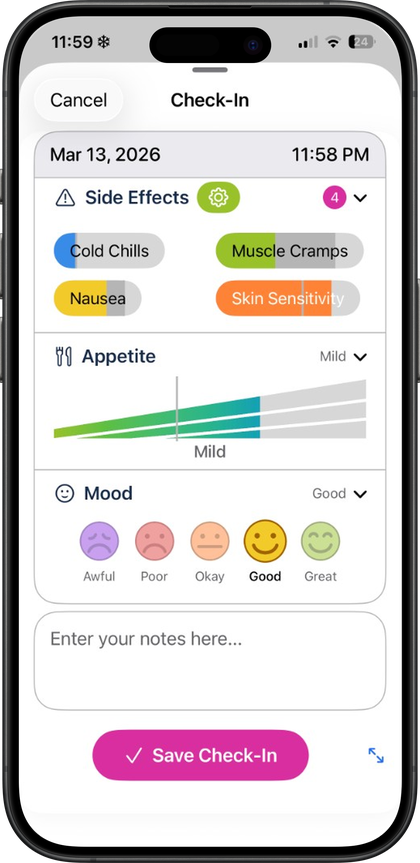
Pokii's daily check-in includes optional side-effect logging with an intensity rating per effect, alongside appetite and mood tracking, so effects like nausea or GI discomfort can be recorded as they happen rather than reconstructed later. Severity and notes per effect are tied to dose timing in your history, which is what lets those severity trends line up against the actual dates and strengths of doses logged. You can also manage a custom side effects list, so the check-in reflects the effects that are actually relevant to your treatment.
The Calendar tab shows shots, check-ins, and other logged entries together in a month or list view, so a titration step-up and the check-ins logged around it sit on the same timeline — useful for seeing whether a rough patch lines up with a recent dose increase or looks separate from it. Shot reminders, set per medicine from your schedule, and a daily check-in reminder that skips itself once you've already checked in that day, help keep that record consistent enough to be useful, since gaps in logging make it harder to tell a real trend from a coincidence.
Side-effect logging is available in Pokii, and it's user-entered wellness tracking rather than a clinical side-effect database tied to Zepbound's label — it's meant to give you and your prescriber a clearer, dated record of what you've noticed, not to interpret or diagnose it for you.
Always follow your prescriber’s instructions for GLP-1 medications. Pokii helps you log and visualize your journey; it does not replace professional care.