Side effect guides
Semaglutide Side Effects
Semaglutide is the GLP-1 receptor agonist molecule behind several FDA-approved brand-name medications, including Ozempic, Ozempic tablets, Wegovy, the Wegovy pill, and Rybelsus, as well as compounded versions prepared by licensed pharmacies. Because all of these products share the same active molecule, they also share a broadly similar side-effect profile, even though doses, routes, and specific formulations differ. This page looks specifically at what's known about semaglutide's side effects, from the common gastrointestinal ones to the rarer, more serious risks noted in FDA labeling, and at how Pokii's tracking tools can help you keep a clearer picture of your own experience over time. This is general information, not medical advice; always talk to your prescriber about any side effect you're experiencing.
Semaglutide's side-effect profile: gastrointestinal by far the most common
Across all of semaglutide's branded forms, the most frequently reported adverse effects are gastrointestinal: nausea, vomiting, diarrhea, constipation, and abdominal pain or discomfort. This pattern is consistent across the class because it stems from how the molecule works. Semaglutide mimics the GLP-1 incretin hormone, which slows gastric emptying, increases insulin secretion, and reduces appetite, and a slower-moving digestive system is also more prone to nausea and other GI upset.
These side effects also tend to track with dose. In trial data, roughly 61% of people on Wegovy's standard 2.4 mg maintenance dose reported GI-type effects, compared with roughly 71% at the newer, higher 7.2 mg dose (Wegovy HD). That same higher-dose Wegovy also reported a notable rate, around 23% in trial data, of dysesthesia, an altered skin sensation such as burning, tingling, or increased sensitivity. This dose-response pattern is one reason semaglutide's branded forms use a gradual titration schedule, starting at a low dose and stepping up over weeks, primarily to improve gastrointestinal tolerability rather than because lower doses are ineffective.
Because this GI-predominant profile comes from the semaglutide molecule itself rather than from any one product's formulation, it shows up across injectable forms (Ozempic, Wegovy, Wegovy HD) and oral forms (Rybelsus, the Ozempic tablet, and the Wegovy pill) alike, and it's the profile that would be expected of compounded semaglutide as well, since compounded products are prepared with the same active molecule. Route and dose still matter for the details, but the underlying pattern of nausea, vomiting, diarrhea, constipation, and abdominal discomfort as the leading complaints is a class-wide characteristic, not something unique to a single brand.
Serious risks and the FDA boxed warning
All semaglutide products carry an FDA boxed warning, the agency's most serious labeling designation, for thyroid C-cell tumor risk based on findings in rodent studies. Semaglutide is contraindicated for anyone with a personal or family history of medullary thyroid carcinoma or Multiple Endocrine Neoplasia syndrome type 2. It's worth noting explicitly that whether semaglutide causes thyroid C-cell tumors, including medullary thyroid carcinoma, in humans has not been established. The warning reflects the animal-study finding and the FDA's resulting precaution, not a confirmed human risk.
Beyond the boxed warning, other labeled risks and precautions across the semaglutide class include pancreatitis, gallbladder problems such as cholelithiasis and cholecystitis, acute kidney injury (often secondary to dehydration brought on by GI symptoms like vomiting or diarrhea), diabetic retinopathy complications (specifically noted for Ozempic in people with type 2 diabetes), hypoglycemia (particularly when combined with insulin or sulfonylureas), and hypersensitivity reactions. This is general product-labeling information, not a complete list and not medical advice. Anyone taking or considering semaglutide should review the current full prescribing information for their specific product and discuss individual risk factors with a prescriber.
Why nutrition and water intake come up alongside GI side effects
Because semaglutide's most common side effects are gastrointestinal, and because some of the more serious labeled risks, such as acute kidney injury, can be connected to GI-related dehydration, keeping general context around what and how much you're eating and drinking is a natural part of understanding your own side-effect pattern. This isn't a treatment for those side effects, but it is useful context. Tracking daily water intake and nutrition totals alongside symptoms can help surface patterns worth discussing with a prescriber, such as whether nausea tends to cluster around certain meals or whether GI symptoms coincide with lower water intake on a given day.
None of this changes the underlying facts about semaglutide's side-effect profile described above. Nutrition and hydration tracking is about giving yourself, and your care team, more complete context around what you're experiencing. It is not a way to prevent or treat boxed-warning-level risks, which require a prescriber's involvement.
How Pokii helps you track semaglutide side effects
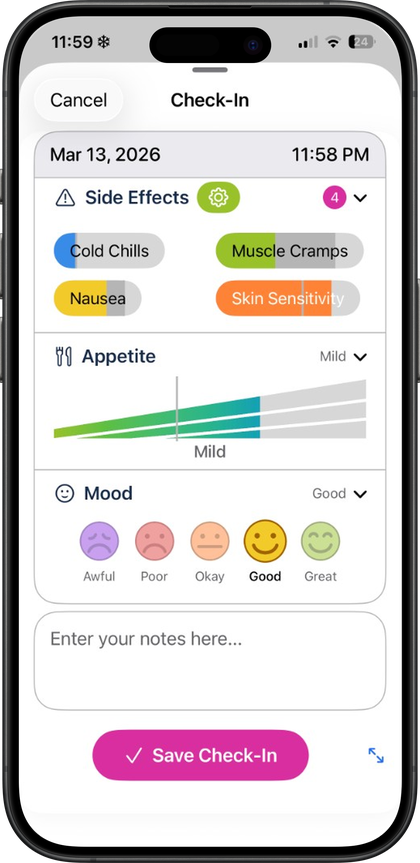
Pokii is a GLP-1 shot tracker and wellness companion for iPhone and iPad. Its built-in medication library includes Wegovy, the Wegovy Pill, Ozempic, Rybelsus, and a dedicated Semaglutide (Compound) entry for compounded or generic semaglutide tracking, so whether you're on a specific brand or a compounded version, you can log doses under the right entry. Pokii's daily check-in includes optional side-effect tracking with a severity slider and notes per effect, plus separate appetite and mood sliders, and you can customize which side effects appear in your check-in list. Side-effect entries tie to dose timing in your history and can be included in PDF progress reports, which can be useful to bring to a follow-up appointment.
On the nutrition and hydration side, Pokii's nutrition dashboard pulls calories, protein, carbs, fat, fiber, sugar, and sodium from Apple Health, including from Pokii's own meal-scanning feature, so you can see those totals alongside your side-effect log. Pokii also includes smart, pattern-based water reminders and a combined water-and-nutrition dashboard module for a single unified view. You can track multiple medications at once, which is relevant if you're switching between semaglutide products, for example from Rybelsus to an Ozempic tablet, or logging a compounded semaglutide product alongside a branded one, and want your side-effect and dosing history to carry across that change. As with all of Pokii's tools, this is meant for tracking and education: Pokii does not provide medical advice, diagnosis, or treatment, and projected medication levels shown on its charts are educational models, not lab results.
Pokii is a tracking and education tool. It does not provide medical advice, diagnosis, or treatment. Talk with your clinician about dosing, side effects, and any change to your plan.