Side effect guides
GLP-1 Side Effects Tracking
GLP-1 receptor agonist and GIP/GLP-1 dual-agonist medications are associated with a well-documented set of side effects, and most of what's reported across the class is gastrointestinal and dose-related. This page is a general, class-wide overview drawn from FDA prescribing information and other published sources — it is education, not medical advice specific to any one drug or person. Side effects vary by medication, dose, and individual, so the best source for what to expect on your specific prescription is always your prescriber and the official prescribing information for that product. Knowing the common patterns, the rarer risks, and which symptoms warrant a call to your prescriber can make it easier to track what you're experiencing and have a more informed conversation about your treatment.
The most common side effects, and why they happen
Gastrointestinal effects are, by a wide margin, the most commonly reported side effects across the GLP-1 class. Nausea is the single most frequently reported effect, with published estimates commonly ranging from roughly 15 to 44 percent of patients depending on the specific medication, dose, and study population. Vomiting is commonly reported alongside nausea, with published ranges of roughly 5 to 24 percent. Diarrhea is also a commonly reported GI effect, and some agents — semaglutide in particular, per comparative analyses — are associated with relatively higher diarrhea rates than others in the class. Constipation is commonly reported as well, with published ranges of roughly 10 to 24 percent. Decreased appetite is different from the others in that it's considered an expected, on-target effect of these medications rather than an incidental side effect, though it's sometimes accompanied by early satiety or a reduced interest in food.
These effects are typically dose-dependent and most pronounced during initial treatment and dose increases, often easing over time as the body adjusts. Two overlapping mechanisms are generally understood to drive them. Peripherally, GLP-1 medications slow gastric emptying — food moves out of the stomach more slowly, the gastric fundus relaxes, gastric compliance increases, and contractility in the stomach wall is inhibited while pyloric tone increases. This delayed emptying is considered a major contributor to nausea, bloating, and reflux-type symptoms, especially during dose escalation. Centrally, GLP-1 receptors are also present in the brain, including hypothalamic pathways involved in hunger and satiety, and research suggests this central signaling drives much of the appetite suppression associated with the drug class, potentially independent of the slowed digestion itself.
Rates vary meaningfully by specific drug and dose. Comparative analyses have reported tirzepatide associated with relatively higher nausea and diarrhea rates, dulaglutide and lixisenatide with relatively lower rates, and exenatide with a relatively higher vomiting rate. These figures should be read as class-wide patterns rather than a promise of what any one person or medication will produce.
Rarer but serious risks worth knowing about
Alongside the common GI symptoms, official labeling and published research describe a smaller set of less common but more serious risks associated with the GLP-1 class. Pancreatitis is one of them: sudden, severe abdominal pain — sometimes radiating to the back, with or without fever, chills, nausea, vomiting, or lightheadedness — can, rarely, reflect this condition, and prescribing information states that GLP-1 medications should be discontinued promptly if pancreatitis is suspected.
Gallbladder disease is another. Labeling for the class notes reports of gallstones (cholelithiasis) and gallbladder inflammation (cholecystitis), with FDA data citing cholelithiasis in roughly 1.5 percent and 0.4 percent of patients across two studied Ozempic doses. This type of issue is typically signaled by right upper abdominal pain, sometimes with fever, or by yellowing of the skin or eyes. Separately, labeling for the class also references reports of ileus, or bowel obstruction, which can present as severe constipation, bloating, or an inability to pass stool or gas.
Severe allergic reactions — swelling of the face, lips, tongue, or throat, difficulty breathing or swallowing, or a severe rash — are also possible and warrant urgent attention. Finally, the GLP-1 and GIP/GLP-1 class carries an FDA boxed warning about thyroid C-cell tumors, based on findings in rodent studies; human clinical trials to date have not confirmed a case of drug-induced medullary thyroid carcinoma, but the warning and associated symptom-monitoring guidance — watching for a lump or swelling in the neck, hoarseness, trouble swallowing, or shortness of breath — remain part of official labeling. None of this is meant to be alarming: these events are uncommon, and they're listed here so they're recognizable if they do occur.
When to contact a prescriber
Contact your prescriber promptly if you experience severe or persistent abdominal pain, particularly sudden, severe stomach pain that may radiate to the back, with or without fever, chills, nausea, vomiting, or lightheadedness. The same applies if you're unable to keep down fluids or have persistent vomiting or diarrhea, since these raise the risk of dehydration and, per patient guidance, can lead to reduced kidney function in some patients — watch for a marked decrease in urination, unusual thirst, dizziness or lightheadedness, or dark urine as signs of dehydration.
You should also reach out promptly for right upper abdominal pain, especially with fever, or yellowing of the skin or eyes; for severe constipation, bloating, or an inability to pass stool or gas; or for a lump or swelling in the neck, hoarseness, trouble swallowing, or shortness of breath. Signs of a severe allergic reaction — swelling of the face, lips, tongue, or throat, difficulty breathing or swallowing, or a severe rash — warrant urgent medical attention.
Across these sources, the consistent guidance is the same: contact your prescriber promptly if any of the above occurs, or seek urgent or emergency care for severe breathing difficulty, allergic reaction, or severe unrelenting abdominal pain. Don't try to self-diagnose or wait it out — these are patterns worth having a clinician evaluate directly, not symptoms to manage on your own.
What Pokii supports for side-effect tracking
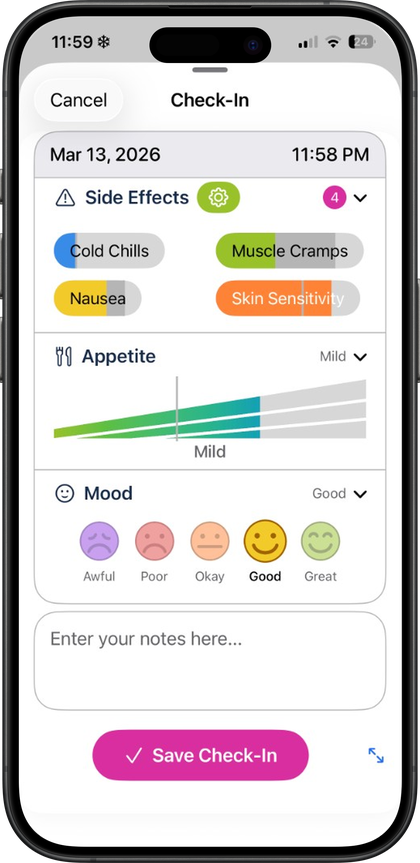
Pokii is a tracking and education tool — it does not provide medical advice, diagnosis, or treatment. What it does do is give you a consistent way to record how you're feeling alongside your doses, so patterns are easier to see and easier to describe to your prescriber. The Daily check-in, available in Pokii, lets you log optional side effects with an intensity or severity rating for each one, alongside appetite and mood sliders and free-text notes, with relative-to-last hints for context. The Custom side effects list lets you manage which effects appear in your check-ins and their visibility, so the list matches what you're actually experiencing.
Every side-effect entry carries its own severity rating and notes, and these tie to dose timing in the app's history view and in PDF reports, so you can review symptoms alongside your shot and dose timeline rather than as an isolated log. The Calendar tab and the Today's log section on the dashboard surface check-ins together with shots, weight, and other entries on a single, date-scoped timeline, making it easier to spot whether a symptom tends to cluster around dose days or dose increases. Injectable shots also support an optional injection-site pain slider, tracked separately from general side-effect check-ins, which can likewise appear in PDF reports. As with everything else in Pokii, none of this constitutes medical advice, diagnosis, or treatment — it's a structured way to capture what you're experiencing so you and your prescriber have better information to work with.
Pokii is a tracking and education tool. It does not provide medical advice, diagnosis, or treatment. Talk with your clinician about dosing, side effects, and any change to your plan.