Side effect guides
Fatigue on GLP-1: Mood and Sleep Context
Feeling more tired than usual after starting a GLP-1 medication is something people bring up, and it's worth understanding in context rather than worrying it's abnormal or ignoring it outright. Fatigue does show up in clinical data for these medications, but it isn't the headline effect the way nausea or digestive changes are, and it isn't the same experience for everyone. This page lays out how often fatigue is actually reported, what's commonly discussed as a possible contributor, general guidance on when it's worth raising with a prescriber, and how Pokii's check-in tools can help someone keep a clearer record of what they're noticing, without trying to explain or diagnose why it's happening.
How often fatigue actually shows up on GLP-1s
Fatigue is a documented side effect of GLP-1 medications, but it sits well behind gastrointestinal symptoms like nausea, vomiting, diarrhea, and constipation in how often it's reported and how prominently it appears in official prescribing information. It shouldn't be described as a common side effect on the same tier as those GI symptoms — the data points to something more secondary and dose-dependent.
For Wegovy, fatigue was reported by about 11% of people in clinical trials, compared with 5% of people in the placebo group. That gap matters, but it also means fatigue was reported fairly often even without the medication, which suggests the effect isn't overwhelmingly or uniquely drug-driven for most people who experience it. For Ozempic, fatigue was reported by fewer than 5% of people, and for Rybelsus, the oral form of semaglutide used for diabetes, fatigue wasn't reported in trials at all.
Patient-facing comparisons from health systems tend to reflect this same ordering: digestive symptoms are listed as the headline effects, while fatigue is typically mentioned afterward, grouped with things like headaches or low blood sugar rather than called out on its own. Reported fatigue also appears to track with dose — higher semaglutide doses, like Wegovy's maintenance dose, are associated with a higher reported rate than the lower doses typically used for Ozempic. None of this means fatigue isn't real. It means the evidence supports treating it as a secondary, dose-related effect rather than a universal one, and framing it as broadly "common" across every GLP-1 would overstate what the data shows.
Contributing factors people commonly discuss
When fatigue does come up, several plausible, non-exclusive factors are commonly discussed in medical and consumer-health sources. These are offered as reasons someone might feel more tired, not as a settled explanation for any individual's experience, and this page isn't attempting to diagnose the cause of any reader's fatigue.
Reduced caloric intake is one of the most frequently mentioned factors. GLP-1 medications slow gastric emptying and increase fullness signals, which often leads to eating noticeably less, and simply taking in less fuel is a plausible driver of lower energy. Dehydration is another one raised repeatedly — nausea, vomiting, and diarrhea can lead to fluid and electrolyte loss, and that loss is specifically called out as a possible contributor to feeling tired. Rapid or significant weight loss is discussed as well, with some sources pointing to a kind of temporary metabolic adjustment, as the body shifts toward burning stored fat, that can feel like low energy for a stretch.
The adjustment period itself comes up often too. Multiple sources describe fatigue as most likely to appear when a dose is first started or increased, and note that it tends to ease once someone has been stable on a maintenance dose for a while. Disrupted sleep is mentioned as a compounding factor as well — GI symptoms and dehydration can interfere with sleep quality, adding to daytime tiredness. Again, these are presented as plausible, commonly discussed possibilities, not a verified explanation for what any one person is going through.
When fatigue is worth flagging to your prescriber
Sources are fairly consistent in framing persistent or severe fatigue as worth a conversation with a prescriber, especially when it shows up alongside other symptoms, but they don't offer precise, universal thresholds for exactly when that conversation should happen — and this page isn't going to invent one either.
In general, fatigue that doesn't ease as you move past the initial dose-titration period is worth mentioning at a routine check-in. Fatigue that gets in the way of daily functioning — for example, making it hard to complete routine tasks — is called out specifically as a reason to seek care rather than wait it out. Fatigue alongside signs commonly associated with dehydration, like unusual thirst or noticeably reduced urination, is a combination worth discussing with a healthcare provider rather than managing alone. And fatigue alongside severe abdominal pain, or alongside symptoms sometimes associated with low blood sugar for people also taking insulin or other glucose-lowering medications, is flagged as a reason to seek prompt medical attention rather than something to sit with.
Pokii is a tracking and education tool, not a source of medical advice, diagnosis, or treatment, so any decision about when your fatigue warrants a call to your prescriber should be made with your care team, using this general framing as context rather than a rulebook.
What Pokii tracks around fatigue, mood, and appetite
Pokii doesn't try to explain why someone is fatigued, but its daily check-in and history tools are built to help someone organize what they're noticing so it's easier to describe during a prescriber visit.
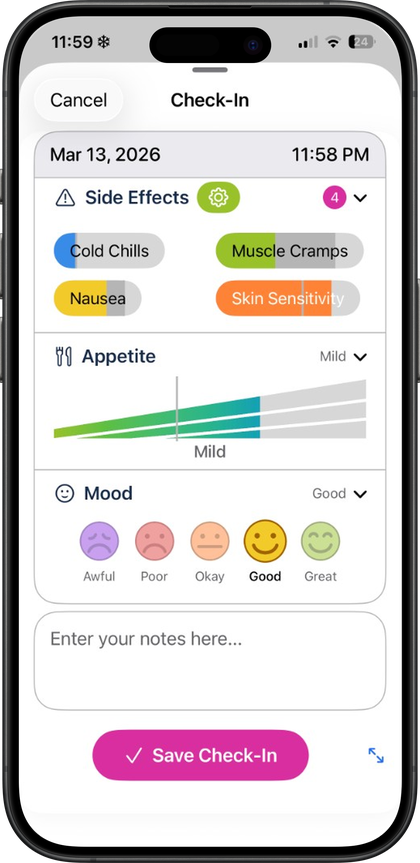
The daily check-in includes dedicated mood and appetite sliders alongside optional side effects with an intensity rating for each one, plus a notes field and hints comparing today's entry to the last one. Because the side effects list is customizable, someone can add fatigue or tiredness as one of the effects they track directly alongside mood and appetite, rather than relying only on generic tags. Side effect entries carry severity ratings and notes and tie to dose timing in Pokii's history and PDF reports, which supports looking at whether fatigue clusters around dose days or shifts as a dose changes over time. Because appetite lives in the same daily check-in as mood and side effects, appetite and fatigue notes sit side by side across days — useful context given how often reduced intake comes up as a possible contributing factor. The dashboard's Today's log section and the Calendar tab's month and list views bring check-ins, shots, and weight together on one timeline, and Pokii's configurable PDF reports can include side effects, appetite, mood, notes, and daily log data to bring into a prescriber conversation.
It's worth being direct about what Pokii doesn't do here: it does not read or track sleep, heart rate, or activity data. Those are explicitly excluded from its Apple Health authorization, so Pokii can't correlate fatigue against sleep quality or activity levels the way it can with mood, appetite, and self-reported severity. What it offers instead is a consistent, structured way to log how you're feeling day to day — mood, appetite, and side-effect severity over time — so that if fatigue is something you're noticing, you have a clearer record to bring to the person best positioned to help you make sense of it.
Always follow your prescriber’s instructions for GLP-1 medications. Pokii helps you log and visualize your journey; it does not replace professional care.