Side effect guides
Oral Wegovy Side Effects
The Wegovy pill (oral semaglutide) is the first oral GLP-1 approved for chronic weight management, and like its injectable sibling it comes with a side-effect profile worth understanding before you start. This page focuses specifically on what oral Wegovy can feel like day to day, what taking it correctly (or incorrectly) can mean for tolerability, the more serious risks listed on the FDA label, and how Pokii's tracking tools can help you keep a clear record for yourself and your prescriber. Nothing here is medical advice; it's a plain-language summary of the FDA-approved label, and any questions about your own symptoms belong with your prescriber or pharmacist.
The known side-effect profile
According to the FDA-approved prescribing information for Wegovy tablets, the adverse reactions reported in at least 5% of patients are gastrointestinal-heavy: nausea, diarrhea, vomiting, constipation, abdominal pain, dyspepsia (indigestion), abdominal distension, eructation (burping), flatulence, gastroenteritis, and gastroesophageal reflux disease. Beyond the GI list, the label also lists headache, fatigue, dizziness, nasopharyngitis, and hypoglycemia in patients with type 2 diabetes. In other words, the pill's side-effect pattern looks broadly similar in character to what's long been reported for once-weekly injectable Wegovy: mostly digestive-system effects tied to how semaglutide slows gastric emptying and affects appetite signaling.
Whether the oral form is meaningfully easier or harder to tolerate than the injection isn't something the underlying label documentation used for this page directly compares side by side. What the label does note is procedural: if the 25 mg oral maintenance dose isn't tolerated, switching to the once-weekly 1.7 mg injection may be considered, and the label separately spells out defined protocols for moving between tablet and injection in either direction. That built-in "off-ramp" suggests tolerability is something prescribers actively manage on a per-person basis with either form, rather than a fixed, universal difference between pill and pen. If you're deciding between forms or struggling with side effects on one, that's a conversation for your prescriber, not something to self-manage based on general side-effect lists.
Taking it correctly matters for both effect and tolerability
Oral semaglutide's absorption is sensitive to how and when it's taken, and the label's administration instructions exist for a reason: getting them wrong can affect both how well the medication is absorbed and how your stomach reacts to it. The instructions are specific. Take one tablet by mouth, once daily, first thing in the morning, on an empty stomach, with no more than 4 ounces of plain water — no coffee, tea, juice, or other liquids. Swallow the tablet whole; don't split, crush, chew, or dissolve it. Then wait at least 30 minutes before eating any food, drinking anything else, or taking other oral medications.
Dosing also follows a titration schedule rather than starting at the maintenance dose: 1.5 mg once daily for the first 30 days, 4 mg for days 31–60, 9 mg for days 61–90, and 25 mg once daily from day 91 onward as the maintenance dose. If a given step isn't well tolerated, the label allows delaying escalation to the next dose rather than pushing through on schedule. Only one tablet should be taken per day, and a missed dose is simply skipped — the next dose is taken the following day as normal, without doubling up. Because timing, hydration, and fasting state all interact with how much of the dose actually gets absorbed, inconsistent timing or taking it with food isn't just a minor slip — it's plausibly connected to both reduced effectiveness and a rockier GI experience, which is one more reason a consistent daily routine matters with this particular medication.
Serious risks worth knowing about
Beyond the common, mostly-GI side effects, the FDA label carries a boxed warning — the FDA's most prominent warning category — for the risk of thyroid C-cell tumors, based on findings in rodent studies; whether this risk translates to humans hasn't been established. Because of this, Wegovy tablets (like the injection) are contraindicated for anyone with a personal or family history of medullary thyroid carcinoma or Multiple Endocrine Neoplasia syndrome type 2, as well as for anyone with a known hypersensitivity to semaglutide or to the tablet or injection excipients.
The label also lists a number of warnings and precautions beyond the boxed warning: acute pancreatitis, acute gallbladder disease, hypoglycemia (particularly when combined with insulin or insulin secretagogues), acute kidney injury related to volume depletion (which can follow significant GI fluid losses from vomiting or diarrhea), severe gastrointestinal adverse reactions, hypersensitivity reactions including anaphylaxis and angioedema, complications related to diabetic retinopathy, increased heart rate, and a risk of pulmonary aspiration during anesthesia or deep sedation. None of this is meant to be alarming on its own — these are standard label disclosures, and most people taking the medication will not experience the rarer or more serious items on this list — but they're worth knowing about, and worth mentioning to any care provider (including anesthesiologists or surgeons) before a procedure. Concomitant use of Wegovy tablets or injection with other semaglutide-containing products or any other GLP-1 receptor agonist is not recommended.
What Pokii tracks for oral Wegovy
Pokii lists "Wegovy Pill" as its own entry in the built-in medication library, separate from injectable Wegovy, so you don't need to set up a custom medication or configure pharmacokinetic fields to start logging it — that's only needed for medications outside Pokii's library. During onboarding, Pokii asks whether you're on an injectable, oral, or not-yet-decided medication, and oral dosing in the app is streamlined accordingly: because there's no injection site or needle involved, oral doses skip the injection-site body map and pain slider that injectable shots use, while still logging date, time, medicine, dose, and notes with full edit history, same as any injectable shot.
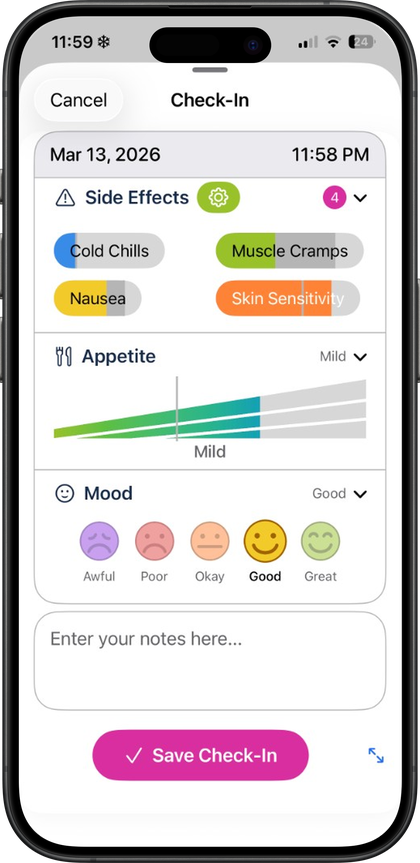
For the day-to-day side-effect picture described above, Pokii's daily check-in covers side effects with an intensity rating per effect, plus dedicated appetite and mood sliders and a free-text notes field — useful for noting GI symptoms alongside how appetite is trending on a given day, since appetite suppression and digestive side effects often move together with GLP-1 medications. Side-effect entries carry severity and notes and are tied to dose timing in your history, so patterns relative to when you took a dose (and whether you followed the fasting/water instructions) become easier to see over time. For clinician visits, You can generate a configurable PDF report that can include side effects, appetite, mood, and notes alongside dose history — a compact way to bring an organized symptom record to a prescriber rather than trying to recall a few months of mornings from memory. As with all of Pokii's tracking features, this is an education and record-keeping tool: projected medication levels are educational models, not lab results, and Pokii does not provide medical advice, diagnosis, or treatment.
Pokii is a tracking and education tool. It does not provide medical advice, diagnosis, or treatment. Talk with your clinician about dosing, side effects, and any change to your plan.