Side effect guides
Wegovy Side Effects Tracker
Wegovy (semaglutide) carries a well-documented side-effect profile that shows up in Novo Nordisk's own prescribing and safety information, and most of what people report falls into a predictable, mostly gastrointestinal pattern tied closely to dose changes. This page focuses specifically on that side-effect picture and on how tracking symptoms over time can help you and your prescriber tell a normal adjustment period from something worth a call. It is informational only, not medical advice, and it does not replace your prescriber's or pharmacist's guidance or the FDA-approved label for your specific prescription.
Wegovy's common side effects and why dosing ramps up slowly
The most frequently reported side effects with Wegovy, per the current Important Safety Information on the manufacturer's site, are gastrointestinal: nausea, diarrhea, vomiting, constipation, abdominal pain, upset stomach or dyspepsia, bloating, belching, and gas. Beyond the GI symptoms, people also commonly report headache, fatigue, dizziness, heartburn, and "stomach flu"-type gastroenteritis symptoms. People with type 2 diabetes taking Wegovy may also experience low blood sugar. Depending on which indication a given Wegovy page covers, it also lists hair loss or changes in skin sensation (on the weight-management and cardiovascular-risk pages) or runny nose and sore throat (on the MASH indication page) among reported effects.
This side-effect pattern is a direct reason Wegovy is not started at its target dose. The standard injection schedule starts at 0.25 mg once weekly and steps up roughly every four weeks — through 0.5 mg, 1 mg, 1.7 mg, and 2.4 mg, with a higher 7.2 mg "Wegovy HD" option available after at least four weeks at 2.4 mg for some patients — specifically to reduce the risk of gastrointestinal side effects as the body adjusts. If a given dose isn't tolerated well, manufacturer materials describe delaying the next step by about four weeks rather than pushing ahead on schedule. The oral tablet follows a similar logic on a different scale, escalating roughly every 30 days from a 1.5 mg starting dose toward a 25 mg daily maintenance dose. Because side effects are so closely linked to each step up, many people notice a familiar cycle: a flare of GI symptoms in the days after a dose increase, followed by tapering off before the next increase. It's worth noting that Wegovy HD's phase III data, as reported in trade press, showed a notably higher rate of dysesthesia (altered skin sensation) at around 22%, versus about 6% at the 2.4 mg dose — a reminder that side-effect rates aren't uniform across every strength.
Serious risks worth knowing about
Alongside the common, usually self-limited GI effects, Wegovy's label and safety information disclose a set of less common but more serious risks. Wegovy carries a boxed warning about thyroid C-cell tumors observed in rodent studies, with human relevance not established; because of this, it's contraindicated for anyone with a personal or family history of medullary thyroid carcinoma or Multiple Endocrine Neoplasia syndrome type 2. Other disclosed risks include pancreatitis, gallbladder problems including gallstones, increased hypoglycemia risk (particularly when combined with insulin or sulfonylurea medications), dehydration and kidney problems that can result from significant GI fluid loss, severe stomach problems, serious allergic reactions, vision changes in people with type 2 diabetes, and increased resting heart rate. There's also a noted aspiration risk during procedures requiring anesthesia or sedation, related to how GLP-1 medications slow stomach emptying. On the MASH-specific indication page, Novo Nordisk also discloses depression or suicidal thoughts as a risk to be aware of, with guidance to watch for new or worsening changes in mood or behavior.
None of this is a reason for alarm on its own — the common-versus-serious distinction is exactly why side-effect tracking is useful rather than something to dread. But it's also why persistent, severe, or unusual symptoms (such as intense abdominal pain that doesn't resolve, signs of an allergic reaction, or mood changes) are worth flagging to a prescriber rather than assuming they're "just" part of titration.
Why comparing entries over time matters
A single bad day of nausea doesn't tell you much on its own. What matters more is the trend: is a symptom that showed up after your last dose increase fading over the following week, staying flat, or getting worse? Because side effects are so tightly linked to the titration schedule, the most useful question after a dose change usually isn't "how do I feel right now" but "how does this compare with how I felt after my last dose." Logging severity at the same points in your cycle — the day of the shot, a few days later, and right before the next one — turns a vague impression into a pattern you can actually describe to a prescriber: whether a given symptom is a predictable, fading part of adjusting to a new dose, or something that's building rather than settling. That kind of before-and-after comparison is also what makes a symptom log genuinely useful at an appointment, instead of trying to reconstruct the last month from memory in the waiting room.
How Pokii helps you track Wegovy side effects
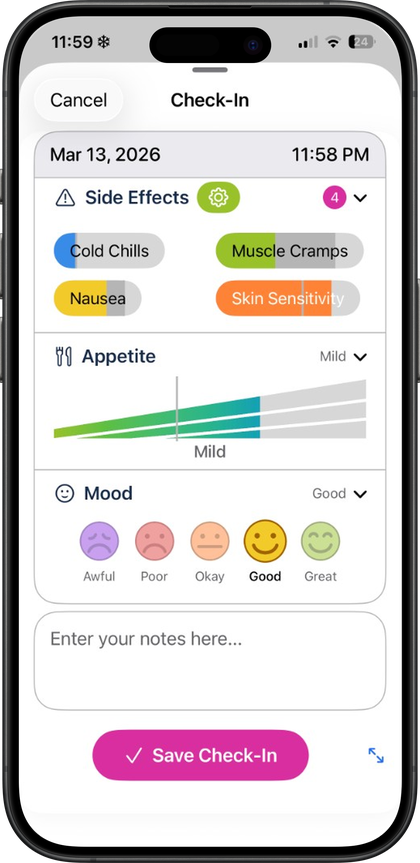
Pokii's daily check-in includes a side-effects section with severity per effect, alongside appetite, mood, and notes, and it's built to show relative-to-last hints — so instead of just recording that you felt nauseated today, you can see how that compares with your last entry and start noticing whether a symptom is trending up or down around your dose schedule. You also control which effects actually appear in your check-ins through Pokii's custom side effects list, so your log reflects what you're actually watching for — GI symptoms during early titration, skin sensation changes, or anything else worth tracking — rather than a generic, one-size-fits-all checklist.
Because Pokii ties side-effect entries to dose timing in your history, your log lines up naturally with when you stepped up from 0.5 mg to 1 mg, or from 2.4 mg toward Wegovy HD, making it easier to see whether a symptom cluster follows the titration pattern described above. When it's time for an appointment, Pokii's configurable PDF progress reports can include your logged side effects, along with shots, doses, and notes, so you can hand your prescriber a real record instead of trying to summarize weeks of symptoms from memory. As with all of Pokii's built-in medications, this is a tracking and education tool — it does not provide medical advice, diagnosis, or treatment, and it isn't a substitute for reporting concerning symptoms to your prescriber.
Always follow your prescriber’s instructions for GLP-1 medications. Pokii helps you log and visualize your journey; it does not replace professional care.