Side effect guides
Mounjaro Side Effects
Mounjaro (tirzepatide) is FDA-approved to improve glycemic control in adults and, as of a recent label update, pediatric patients 10 and older with type 2 diabetes, and its prescribing information documents a specific, well-characterized side-effect profile. This page walks through what's actually listed on the label — the common gastrointestinal effects most people notice, and the less common but more serious risks worth understanding — plus how logging symptoms against your weekly shot timeline can help you and your care team spot patterns. None of this is medical advice; it's a plain-language summary of labeled information, meant to sit alongside your prescriber's guidance, not replace it.
Mounjaro's common side-effect profile
Per the FDA label, the most common adverse reactions to Mounjaro — reported in 5% or more of patients in clinical trials — are nausea, diarrhea, decreased appetite, vomiting, constipation, dyspepsia (indigestion), and abdominal pain. In other words, the side-effect profile is overwhelmingly gastrointestinal. That pattern is consistent with how the medication works: it's designed to slow gastric emptying and affect appetite signaling, so it makes sense that the digestive system is where most people feel it first.
These GI symptoms don't affect everyone, and when they do occur they vary a lot in intensity from person to person and week to week. Some people notice mild nausea for a day or two after a dose and little else; others find constipation or appetite changes are the more persistent issue. Because the list above covers seven distinct symptoms rather than one, it's worth tracking more than just "did I feel sick" — appetite decrease, bowel changes, and stomach discomfort can show up independently or together, and knowing which ones you tend to get (and when) is more useful than a single yes/no impression.
Serious risks worth knowing about
Beyond the common GI effects, Mounjaro's label carries a boxed warning — the FDA's most serious label category — for the risk of thyroid C-cell tumors, based on findings in rodent studies; whether this risk translates to humans has not been established. Because of this, Mounjaro is contraindicated for anyone with a personal or family history of medullary thyroid carcinoma or Multiple Endocrine Neoplasia syndrome type 2, which is exactly the kind of history a prescriber needs to know before starting treatment.
The label also lists several other warnings and precautions that, while less common than the everyday GI symptoms, are more serious when they occur: acute pancreatitis; hypoglycemia when Mounjaro is combined with insulin or an insulin-stimulating medication; serious hypersensitivity reactions such as anaphylaxis or angioedema; acute kidney injury linked to volume depletion (often from significant vomiting or diarrhea); severe gastrointestinal reactions, which is why the label advises against use in people with severe gastroparesis; potential worsening of diabetic retinopathy in patients who already have it; acute gallbladder disease; and, added in a more recent label update, a risk of pulmonary aspiration during general anesthesia or deep sedation. This list summarizes labeled warnings rather than replacing them — the full prescribing information is the authoritative source, and any of these symptoms or a relevant medical history is a conversation for your prescriber, not something to self-manage.
Why aligning symptoms with your shot timeline helps
Tirzepatide, the active ingredient in Mounjaro, is a dual GIP and GLP-1 receptor agonist — it activates two different gut-hormone pathways rather than one, which is part of why its effects on appetite and digestion can feel more pronounced for some people than with single-pathway medications. It's also dosed on a titration schedule: treatment typically starts at 2.5 mg once weekly (a dose meant for tolerability, not glycemic control), steps up to 5 mg after four weeks, and can continue rising in 2.5 mg increments after at least four weeks on a given dose, up to a labeled maximum of 15 mg weekly for adults or 10 mg for pediatric patients 10 and older.
That step-up structure matters for side effects because GI symptoms often cluster around dose changes — a jump from 5 mg to 7.5 mg, for instance, may bring a few rougher days that settle down before the next increase. Without a timeline to compare against, it's easy to lose track of whether nausea this week is "new," "the usual few days after stepping up," or something worth flagging. Because Mounjaro is injected once weekly, at any time of day, with or without food, and rotated across the abdomen, thigh, or upper arm, the shot itself is a natural anchor point — logging what dose you took, when, and where, next to how you felt in the days after, turns scattered symptoms into a pattern you can actually describe.
What Pokii tracks alongside your Mounjaro shots
Mounjaro is one of Pokii's built-in medications, so shots get logged with date, time, dose, and notes, plus full edit history and a per-shot injection site body map with rotation suggestions — all in Pokii, since Mounjaro is injectable rather than oral. A room-temperature timer preset is also available on the shot-day flow for pens that need to warm up before injecting.
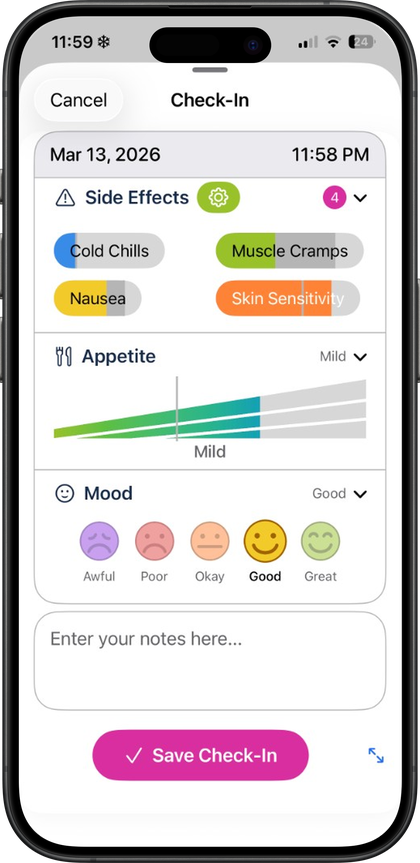
For the symptom side, Pokii's daily check-in lets you log side effects with a severity rating and notes per effect, alongside separate appetite and mood tracking — and you can customize which side effects appear in your check-ins so the list matches what you're actually experiencing. Because check-ins and shots both land on the same dashboard timeline, with shot markers and medication-change flags on the projected-level chart, it's straightforward to look back and see how a symptom lined up with a recent dose or a step-up in titration, rather than trying to recall it from memory.
Pokii also reads dietary fiber, along with calories, protein, carbs, fat, sugar, and sodium, from Apple Health, so fiber intake sits on the same nutrition dashboard as everything else — useful context given how often constipation and other digestive changes come up with GLP-1/GIP medications. side effects, appetite, mood, and notes can be included in configurable PDF progress reports, which is a convenient way to bring a symptom-and-dose history to an appointment. Throughout, Pokii's projected medication levels are an educational model, not lab results, and the app does not provide medical advice, diagnosis, or treatment — it's built to help you organize and share what you're noticing, with your prescriber staying in charge of interpreting it.
Always follow your prescriber’s instructions for GLP-1 medications. Pokii helps you log and visualize your journey; it does not replace professional care.