GLP-1 tracker
Zepbound Injection Sites and Rotation
Zepbound is injected once a week, which means a typical year on the medication adds up to roughly fifty separate decisions about where to inject next, usually made from memory alone. Pokii's injection site body map, last-site highlighting, and shot history are built around exactly that rhythm: a single weekly dose that benefits from a rotated site but is easy to lose track of between one week's shot and the next. This page focuses on how those features apply specifically to a Zepbound routine, from logging where a dose went to reviewing the pattern months later.
Zepbound's weekly injection pattern
Zepbound (tirzepatide) is administered as a once-weekly subcutaneous injection, at any time of day, with or without food. It's currently available from the manufacturer in three device formats built around that same weekly cadence: a single-dose prefilled pen, a single-dose prefilled vial, and a multi-dose KwikPen that holds four weekly doses in one device. Whichever format is prescribed, the underlying schedule doesn't change — one injection, once a week, at one of six dose strengths as titration proceeds. If a dose is missed, guidance calls for taking it as soon as possible within four days of the missed dose, or skipping it and resuming the regular weekly schedule if more than four days have passed.
That fixed weekly touchpoint is different from medications dosed daily or multiple times a week: there's exactly one site decision to make per cycle, not several spread across the same few days. Manufacturer instructions for injectable GLP-1 and GIP medications as a class generally call for changing the specific spot used from one injection to the next rather than reusing the same point repeatedly; Pokii's injection site reactions guide covers that guidance and the reasoning behind it in more detail. What matters for a Zepbound routine specifically is that with only one shot a week, each rotation decision carries more weight, and it's also easier to build a simple habit around, since there's no need to track multiple injections happening close together.
How Pokii's body map fits a single weekly shot
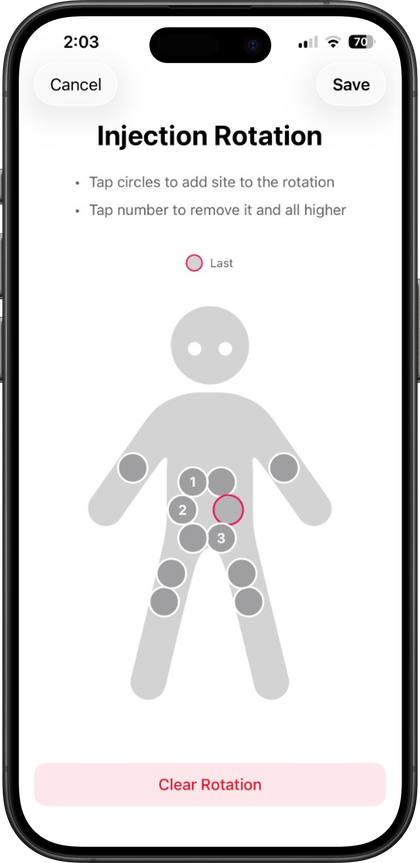
Pokii's injection site body map applies to injectable medications like Zepbound. When you log a shot, alongside the date, time, medication, and dose, you can mark where you injected on a front or back view of the body. The next time you go to log a dose, Pokii highlights that last site so it's visually obvious before you pick a new one, rather than leaving you to recall whether last week's shot went into your left side or your right. Rotation settings let you shape how that highlighting and suggestion behave, and an optional auto-prompt can ask you to select a site automatically whenever you log a shot, which is useful on a weekly cadence where the logging moment doesn't come around often enough to become fully automatic on its own.
Because Zepbound is often the only GLP-1 someone is tracking at once, the body map fits that routine directly — site tracking, rotation settings, and the suggested next site are all part of the same logging flow. The body map also pairs with an optional pain slider on every injectable log, so if a particular site tends to feel more uncomfortable than others across a few weeks of Zepbound doses, that pattern becomes something you can see tied to a specific spot on the map rather than a vague impression.
Shot history and reviewing your rotation pattern over time
A single weekly shot is easy to track in the moment and just as easy to lose the thread of a few months in, which is where Pokii's shot history comes in. Every logged shot, including the site, keeps a full edit history, so correcting a mistaken site entry days later doesn't erase the original record. That day's Zepbound entry also appears in the dashboard's Today's log section alongside anything else logged that day, and the Calendar tab's month and list views let you look back across weeks or months of shots at once, rather than only ever seeing the most recent one.
Reviewing that history is where a rotation pattern actually becomes visible: instead of trusting that you've been spreading doses out evenly, you can look back at a stretch of weekly Zepbound entries and see whether one area has quietly been used more than others. Injection sites and pain ratings can also be included in configurable PDF progress reports alongside shot dates, doses, and side-effect notes, turning a few months of weekly entries into something that's easy to review yourself or bring to a prescriber if a particular site seems to be reacting more than the rest.
As with everything in Pokii, this is a tracking and education tool. It does not provide medical advice, diagnosis, or treatment, and it doesn't replace the Instructions for Use that come with a Zepbound prescription or guidance from a prescriber about dosing, titration, or how to handle a specific reaction.
Always follow your prescriber’s instructions for GLP-1 medications. Pokii helps you log and visualize your journey; it does not replace professional care.