GLP-1 tracker
GLP-1 Appetite Tracker
Appetite is one of the first things people notice changing after starting a GLP-1 medication, and it tends to shift again with each dose adjustment or refill. Pokii's appetite tracker gives that day-to-day sense of hunger a place to live alongside the rest of a GLP-1 journey, turning a vague feeling into something you can look back on and compare over time.
Why appetite is worth tracking on GLP-1 therapy
GLP-1 medications are widely known for their effect on appetite, and that effect is often one of the more noticeable parts of starting treatment or changing a dose. Appetite can vary from day to day and from week to week, influenced by where someone is in their dosing cycle, recent meals, or simply how they're feeling. Writing it down as it happens, rather than trying to recall it later, gives a clearer picture of how appetite has actually moved over the course of treatment.
Pokii treats appetite as part of the same daily record as shots, weight, and side effects rather than as a separate log. That keeps everything about a GLP-1 journey in one place instead of scattered across notes apps or memory.
The daily appetite slider
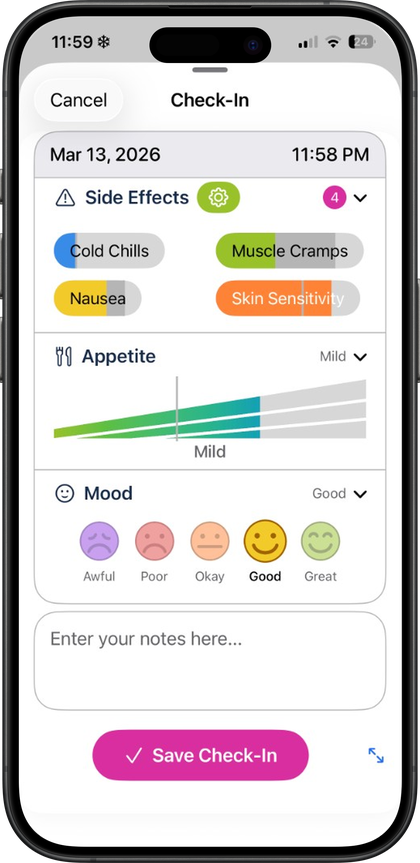
Appetite tracking in Pokii lives inside the daily check-in, alongside optional side effects, mood, and notes. Rather than picking from a short list of preset descriptions, appetite is logged with a dedicated slider, so it can reflect something closer to how a person actually feels that day rather than being flattened into a handful of fixed categories.
The check-in is optional and quick to fill in, and the appetite slider is just one part of it. Pokii's rating scale settings let the scales used in check-ins be adjusted, so the way appetite (and other check-in items) is presented can be customized to fit how someone prefers to log. Once submitted, that day's appetite entry becomes part of the unified "Today's log" timeline on the dashboard, sitting next to that day's shot, weight entry, or food scan, and it also shows up on the calendar alongside other check-ins for the day it was logged.
A daily check-in reminder can prompt the check-in at a set time, and it's automatically skipped for days a check-in has already been completed, so the appetite slider doesn't need to be filled in more than once per day.
Relative-to-last-entry trend hints
A single appetite rating on its own doesn't say much. What matters more is the direction it's moving relative to the entry before it. That's why Pokii's daily check-in includes relative-to-last hints: when logging appetite, the check-in shows how the new entry compares to the previous one, so the emphasis is on the trend rather than one isolated number.
That framing turns appetite tracking into a running story instead of a snapshot. Looking back through the calendar or Today's log timeline, entries build into a picture of whether appetite has been trending down, holding steady, or picking back up, which lines up naturally with where someone is in their dosing schedule. Because every appetite entry is tied to the day it was logged, it's also easy to see it in context with that day's shot, weight check-in, or side effects, rather than trying to reconstruct the timing from memory afterward.
That same appetite history can be included in configurable PDF progress reports—you can include appetite alongside weight, shots, side effects, and mood—so the trend can be shared or reviewed outside the app if it's useful to have on hand.
Pairing appetite with mood check-ins
Appetite doesn't exist in isolation, and Pokii's daily check-in pairs its appetite slider with a dedicated mood slider in the same entry. Logging both together, rather than as separate unconnected data points, makes it easier to notice when the two move together, or when they don't, over the course of a GLP-1 journey.
The same daily check-in also includes optional notes and side-effect tracking, with a customizable list of which side effects appear. Combined, that means a single check-in can capture appetite, mood, any side effects worth noting, and a free-text note, all logged for the same day and viewable together in the calendar and Today's log timeline. That fuller context is often more useful than appetite numbers alone, since it keeps the reasons behind a change in appetite closer at hand rather than leaving them to be pieced together later.
As with the rest of Pokii, this is a tracking and education tool: it's meant to make patterns in appetite, mood, and other check-in data easier to see and record, not to interpret them or offer medical guidance.
Pokii is a tracking and education tool. It does not provide medical advice, diagnosis, or treatment. Talk with your clinician about dosing, side effects, and any change to your plan.