GLP-1 tracker
GLP-1 Side Effect Tracker
Tracking how a GLP-1 medication affects you day to day works better when the list of what you're logging matches what you're actually experiencing, not a fixed checklist built for someone else's dose plan. Pokii's side-effect tracker lives inside the Daily check-in: a customizable list of effects, a severity rating for each one logged, and a view of how the current entry compares to the last one, so patterns are easier to see over the course of a dose cycle instead of getting lost between separate notes and memory.
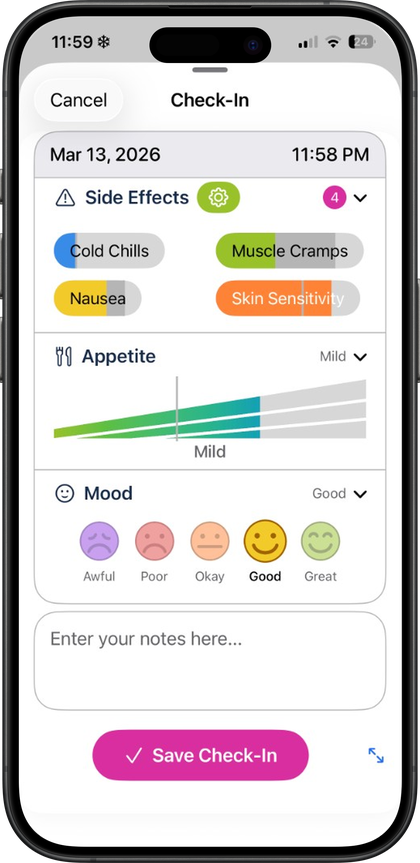
A side-effect list built around what you're feeling
Pokii's Custom side effects list lets you manage which effects show up in the Daily check-in and how visible each one is, so the list reflects what's actually relevant to a given medication or dose stage rather than a generic set that applies to everyone. Effects can be added as they come up and left out once they're no longer part of the picture, so the check-in stays short and specific instead of turning into a long form to scroll through every day.
Appetite and mood have their own dedicated sliders in the Daily check-in, separate from the general side-effect list, since those are tracked as distinct signals rather than folded into generic tags. Alongside the effect list and those sliders, each check-in also has a free-text notes field, so context that doesn't fit a rating — timing relative to a meal, or anything else worth remembering — can sit next to the numbers rather than getting lost.
Severity sliders and notes on every entry
Each side effect logged in a check-in carries its own severity rating and an optional note, and Pokii's Rating scale settings let you customize how those check-in scales are presented, so the rating style fits how you think about intensity. That per-effect detail ties to dose timing in both the in-app history view and, in Pokii, in configurable PDF reports, so a pattern shows up alongside the shot and dose timeline it happened around rather than as an isolated entry disconnected from what caused it.
For injectable shots specifically, Pokii also offers a separate, optional injection-site pain slider on the shot log itself, distinct from the general side-effect check-in, and that pain rating can likewise be included in PDF reports. Keeping site pain separate from the broader side-effect list means each kind of entry — how the shot site feels versus how the rest of the day felt — stays specific instead of blending into one general rating.
Comparing to your last entry
The Daily check-in surfaces relative-to-last hints as you log, giving a quick sense of whether a given effect is trending up, holding steady, or easing off compared with the previous entry, rather than requiring a manual scroll back through history to remember what last week looked like. That comparison sits alongside the Today's log section on the dashboard and the Calendar tab, both of which bring check-ins together with shots, weight, and other entries on a single date-scoped timeline, so it's easier to notice whether an effect tends to cluster around dose days or dose increases rather than showing up at random.
Because every entry keeps its own severity rating and timestamp, looking back across several check-ins builds a simple before-and-after picture over a dose cycle: whether something that showed up after a dose increase has settled by the next one, or whether it's been consistent since the first log. That kind of side-by-side view is the point of tracking severity over time rather than just noting that an effect happened once.
When something feels bigger than tracking
Pokii is a tracking and education tool — it does not provide medical advice, diagnosis, or treatment, and nothing in the side-effect tracker is designed to tell you whether a symptom is serious or what to do about it. Its job is to make a consistent record of what's being logged and how it compares over time, so that record is easier to bring to a conversation with a prescriber rather than trying to reconstruct it from memory.
If something feels severe, sudden, or concerning, that's a conversation for a prescriber, not something an app can weigh in on. Pokii's GLP-1 side effects guide, along with the medication-specific side-effect pages for drugs like Ozempic, Wegovy, Zepbound, Mounjaro, semaglutide, and tirzepatide, cover what's commonly reported across the class, the less common but more serious risks, and when to reach out to a prescriber — that clinical detail lives there rather than being repeated here, since this page is about how the tracking tool itself works.
Always follow your prescriber’s instructions for GLP-1 medications. Pokii helps you log and visualize your journey; it does not replace professional care.