Alternatives
WeightWatchers GLP-1 Alternative Tracker
WeightWatchers' GLP-1 Success Program and Pokii solve different problems, even though people searching for a "WeightWatchers GLP-1 alternative" are often looking for one thing: a better way to track shots. WeightWatchers is a 60-plus-year diet and coaching brand that acquired the telehealth company Sequence in April 2023 and rebuilt it into WeightWatchers Clinic, or WW Med+, a service that gets you a prescription, coaches you through the program, and lets you log injections, dose, site, and side effects as one piece of a much larger app. Pokii is the opposite shape: a single-purpose iPhone and iPad tracker with no prescribing, no coaching staff, and no subscription commitment, built specifically for the mechanics of dosing, projected medication levels, and side-effect tracking. Neither one fully replaces the other, and depending on where you are in your GLP-1 journey, you may want both.
What WeightWatchers is genuinely good at
WeightWatchers' biggest advantage is structural: WW Med+ is a full telehealth path, not just a logging screen. Members go through an eligibility quiz, a consult with a licensed clinician, a prescription with an insurance coordinator who handles pre-authorizations and refills, and delivery through pharmacy partnerships with Eli Lilly and Novo Nordisk channels. Pokii has no clinical function at all and says so directly in its own disclaimer: it is a tracking and education tool that does not provide medical advice, diagnosis, or treatment. If you need a prescription and don't already have one, that gap is real and WeightWatchers is built to close it.
The coaching and community layer is similarly substantial. WW pairs members with registered dietitians, fitness specialists, and GLP-1-trained coaches, runs live and virtual Workshops, and hosts Connect, its social platform with a dedicated GLP-1 Success Program group. WW also reports internal, company-funded findings that members who engage with the program at least four days a week lose more weight over 12 months than less-engaged members, plus a six-month, WW-funded trial (n=180) on quality-of-life and side-effect management — worth noting as WW's own reported data rather than independent research, but a genuine part of the pitch.
Beyond GLP-1 specifically, WeightWatchers carries a broad wellness surface: its long-running Points nutrition system, 12,000-plus recipes, on-demand strength training through the Lifted Method, sleep tracking, and integrations with more than 60 third-party activity devices and apps. It also ships on both iOS and Android, so household or family use isn't limited to one platform. None of that is marketing gloss — it's the accumulated product of a company that's been doing behavior-change coaching since 1963, and it's a fair reason some members stay.
Two different jobs: coaching-and-prescribing versus tracking
Here's the honest framing: WeightWatchers prescribes and coaches, Pokii tracks. WW's GLP-1 Success Program does let you log injections — including medication, dose, and site — along with side effects, weight, activity, and nutrition targets, and that's real overlap with what Pokii does. But it's one "Advanced tracking" bullet inside a much bigger program built around clinicians, coaches, and a paid membership, not a purpose-built dosing tool. If you already have a prescription — through WeightWatchers Med+ or anywhere else — and you specifically want a focused, private way to log shots, weight, and side effects without a subscription program wrapped around it, that's a different job, and it's the one Pokii is built for.
This isn't necessarily an either/or decision. Someone who needs a clinician, insurance help, and a coach might reasonably keep their WW Med+ membership for the prescribing and coaching relationship while using Pokii day to day for the more granular tracking work described below — the two aren't mutually exclusive, and plenty of people already run a coaching app alongside a separate tracker for the details their coaching app treats as secondary.
Where Pokii goes deeper on the tracking job itself
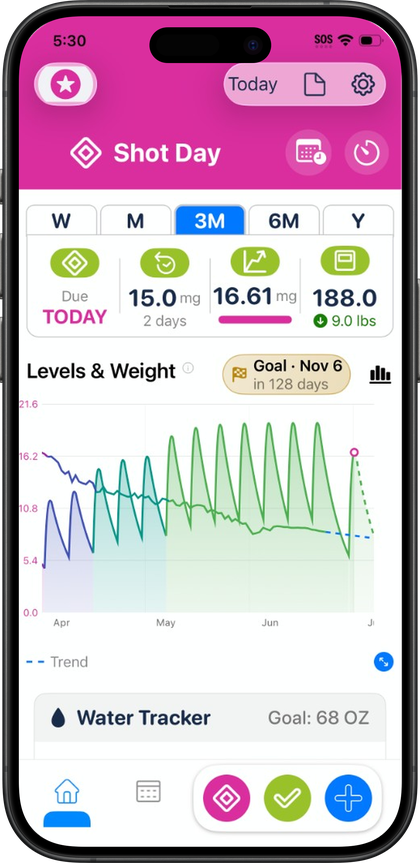
Pokii's feature set is narrower than WeightWatchers' overall app, but within dose tracking specifically it goes further than what WW publicly describes. Pokii's projected medication level chart — an educational pharmacokinetic curve modeling how much medication is estimated to be active between doses — is available in Pokii, along with combined, per-medication, and per-compound display modes, pan/zoom and full-screen charting, and draggable tooltips. WeightWatchers' pages describe injection and side-effect logging plus a separate Weight Health Score and AI Body Scan, but nothing describing a medication-level curve for members to view.
Pokii also includes a shot scheduler with simulated-dose previews that lets you see how a planned dose would affect your projected chart before you log it, custom medications with configurable half-life, Tmax, and bioavailability, and a built-in library of 16 medications that includes compounded tirzepatide and semaglutide alongside branded options like Zepbound, Wegovy, Mounjaro, and Ozempic — useful if you're on a compounded or less common formulation that a prescribing app's fixed medication list may not anticipate. On the practical side, Pokii has a room-temperature timer with presets and an alarm for warming a pen before injecting, a Shot Progress home screen widget in Pokii and a full medication-level chart widget in Pokii, and per-medicine shot reminders. WeightWatchers' public materials don't describe equivalents for any of these.
Day-to-day check-ins are also more granular in Pokii: side effects with per-effect intensity, appetite and mood sliders with relative-to-last-check-in hints, and a customizable list of which side effects even show up for you. Pokii also includes an injection site body map with rotation suggestions and an optional auto-prompt when logging, unlimited active medications, weight trend lines with projected goal dates, lean body mass overlay from Apple Health, and a configurable PDF report that can include projected levels, weight, shots, injection sites, pain, side effects, appetite, mood, and body measurements in one document — something WeightWatchers' pages don't describe an equivalent for.
Cost, commitment, and moving your data
The pricing models are structurally different. WeightWatchers Med+ plans typically run $25–$49 for the first month, then $74/month if you commit to a 12-month plan, up to $149/month month-to-month with no commitment — and medication cost is billed separately on top of that. Reviews aggregated by Forbes Health note a recurring complaint pattern of members disputing surprise billing after not realizing they'd signed up for a 12-month term. Pokii is a free download on the App Store with shot tracking, the projected-level chart, weight check-ins, the medication library, and side-effect check-ins built in; optional App Store subscriptions support the app, without a multi-month commitment structure like WeightWatchers Med+.
If you're currently on WeightWatchers and thinking about switching, it's worth knowing that WeightWatchers doesn't appear to offer a self-serve, in-app data export. Its privacy statement confirms you can request your personal data "in a structured, commonly used and machine-readable format," but that's described as a privacy-rights request process, not a one-click export button, and the specific file format isn't published anywhere WW documents. Pokii can't claim to import a WeightWatchers export because that format has never been confirmed — Pokii's own import options are a Pokii JSON backup/restore, Shotsy JSON import, and header-based CSV import, and its export is a JSON file generated via the share sheet, not CSV. Realistically, moving from WeightWatchers to Pokii today means manually re-entering your shot and dose history rather than a guaranteed one-tap migration.
The honest recommendation: if you don't yet have a prescription, or you want a clinician, insurance coordination, and a coaching community around your GLP-1 program, WeightWatchers Med+ is solving a problem Pokii doesn't touch. If you already have a prescription from anywhere and want a free, private, detail-oriented way to track doses, projected levels, and side effects without a subscription program attached, Pokii is built specifically for that job — and nothing stops you from using both at once.
Always follow your prescriber’s instructions for GLP-1 medications. Pokii helps you log and visualize your journey; it does not replace professional care.