Alternatives
Noom GLP-1 Alternative: Pokii
Noom isn't really a GLP-1 tracking app you can compare feature-for-feature with Pokii. It's a psychology-based weight-loss coaching platform, Noom Weight, that has grown a telehealth prescribing arm called Noom Med and, on top of that, a bundled GLP-1 Companion toolkit for people already on medication. Pokii is a single-purpose iPhone and iPad app for logging shots, doses, and the day-to-day details of a GLP-1 routine. This guide treats them as what they actually are: a coaching-plus-prescribing subscription versus a dedicated dose tracker, not two competitors chasing the same feature checklist.
What Noom Med and the GLP-1 Companion are genuinely good at
Noom's original product, Noom Weight, is built around daily CBT-based psychology lessons, weekly human coach check-ins, and a large peer community — real behavioral tools that go well beyond anything a tracker like Pokii attempts. Noom Med adds actual prescribing: an intake survey, a licensed clinician who can prescribe GLP-1s or other weight-loss medication, and shipped medication for eligible patients.
For people already in a Noom Med program, the bundled GLP-1 Companion adds SmartDose Guidance, which Noom describes as intelligent med tracking and dosing "guided by the app to support clinician-led treatment," along with AI nutrition guidance with protein and macro targets and photo meal logging, a Muscle Defense workout library aimed at preserving lean mass during rapid weight loss, an AI-driven Body Scan that estimates body composition from a phone camera, a Success kit of side-effect support content, and glucose forecasting. Noom also publishes its own engagement data — members in its higher-engagement quartile reportedly lose more weight and stay in the program roughly 2.2x longer, though that's Noom's own analysis of its member base rather than an independent study. Noom also ships on both iOS and Android, with exercise sync to Apple Watch, Fitbit, and Garmin, reaching people Pokii's iPhone- and iPad-only app doesn't.
None of that is trivial. Muscle-preservation coaching and a body-composition scan are genuinely useful for someone on a GLP-1, and Pokii has no direct equivalent — its closest feature is a chart overlay that reads an existing lean-body-mass value from Apple Health rather than estimating composition itself.
The honest category difference: coaching and prescribing vs. dose tracking
Noom is sold as three linked programs: Noom Weight for behavior change, Noom Med as the clinical and telehealth layer that evaluates and prescribes, and GLP-1 Companion as the add-on bundled in for members already on medication through Noom Med. All three assume an ongoing subscription relationship with Noom as your coaching provider and, for Noom Med, your prescribing provider.
Pokii isn't a coaching platform and doesn't try to be one — it has no lessons, no coach check-ins, no community. It's also not a telehealth service: Pokii is explicit that it "does not provide medical advice, diagnosis, or treatment," and its projected medication levels are described as educational models, not lab results. It assumes you already have a prescription from wherever you get one — a doctor, a med spa, Noom Med, or anywhere else — and just want a private, focused place to log it.
That makes the honest comparison less about which app has more features and more about which job you need done. Someone who wants structured behavior-change lessons, a human coach, and a path to an actual prescription is looking for something Pokii was never built to be. Someone who already has a prescription and wants a fast way to log a shot, track injection-site rotation, and watch a level chart without paying for coaching they don't need is looking for something a Noom Med subscription doesn't offer on its own. Plenty of people reasonably want both — Noom for the clinical relationship and coaching, Pokii for daily logging — and there's no conflict running them side by side.
Where Pokii differs specifically for the tracking job
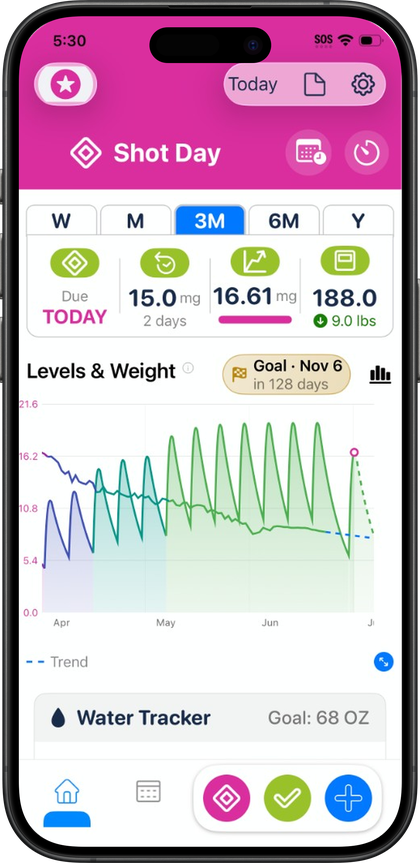
For the narrow job of logging and visualizing a GLP-1 routine, Pokii and Noom's own materials diverge in ways worth naming plainly. Noom's medication-administration FAQ describes dosing support as delivered through chat with your clinician and a printed instruction booklet, not an in-app injection log. There's no evidence in Noom's public materials of an in-app body map, site-rotation suggestions, or a per-shot pain rating; SmartDose Guidance is described only in general terms as intelligent med tracking and dosing, with no documentation of what the underlying log screen actually captures. Pokii has both an injection-site body map — front and back, with rotation settings and a suggested next site — and a per-shot pain slider, and both are free.
Charting shows a similar gap. Nothing in Noom's marketing or support pages describes a projected medication-level curve, half-life or Tmax modeling, or a days-on-dose view; SmartDose is presented as a clinician-managed titration protocol, not a user-facing chart. Pokii's projected-level chart is free for every user, plotting an educational PK-style curve between doses with combined, per-medication, and per-compound display modes. Pokii also includes custom medications with your own half-life, Tmax, and bioavailability fields, a dose simulator that previews shots on the chart before you log them, and customizable dose coloring. Pokii also generates a configurable PDF report covering shots, levels, weight, injection sites, pain, side effects, and more — something Noom's public materials don't describe an equivalent to. None of this makes Pokii a replacement for Noom's coaching or prescribing; it's simply the more detailed tool for the specific job of watching your dose history and levels over time.
Cost, migration, and who should use which
Noom's pricing is tiered, and once you need the GLP-1 layer, it isn't cheap. Noom Weight alone starts around $17.42 a month on a 12-month plan. Noom Med adds a separate, higher tier on top: Noom GLP-1Rx starts at $129 a month before rising to $279, Microdose GLP-1Rx starts at $79 rising to $199, Proactive Health Microdose GLP-1Rx runs $149 a month with an at-home biomarker kit, and telehealth for branded medications you fill through your own pharmacy starts at $39 a month plus the cost of the medication itself. The GLP-1 Companion toolkit is bundled at no extra charge, but only for members already paying for an eligible Noom Med plan. Pokii is a dedicated dose tracker with injection-site map, pain tracking, check-ins, projected level chart, unlimited medications, custom PK fields, dose simulation, and PDF reports — priced as an App Store app rather than a clinical program, because it isn't funding a clinician or a prescribing relationship.
If you're leaving Noom, know there's no clean migration path. Noom's own support process treats data export as a manual privacy request, fulfilled within 30 days rather than an instant in-app download, and Noom doesn't document whether that export includes structured dose or injection data at all — it appears to cover weight, food, and exercise logs. Pokii supports importing Pokii JSON backups, Shotsy JSON exports, and header-based CSV files, but there's no verified way to import a Noom export directly, so treat any move as manual re-entry rather than an automated one.
Put simply: if you need an actual prescription, structured coaching, or muscle-preservation programming, that's Noom Med's job, not Pokii's. If you already have a prescription from anywhere and want a dedicated, private place to log every shot, track injection sites and pain, and watch a real level chart without paying for coaching you don't need, that's what Pokii was built for. Plenty of people end up using both.
Always follow your prescriber’s instructions for GLP-1 medications. Pokii helps you log and visualize your journey; it does not replace professional care.