Alternatives
Glapp Alternative: Pokii Shot Tracker
Glapp vs Pokii: Glapp spans iPhone, Android, web, and Apple Watch, with peer/clinical benchmarking and vial inventory. Pokii is on iPhone and iPad today (Android coming soon)—deeper injection-site + Per Compound charts, custom PK meds, PDF progress reports, built-in food logging, no ads/public feed. No confirmed Glapp export to Pokii; switching is a fresh start (Pokii imports Shotsy JSON, not Glapp).
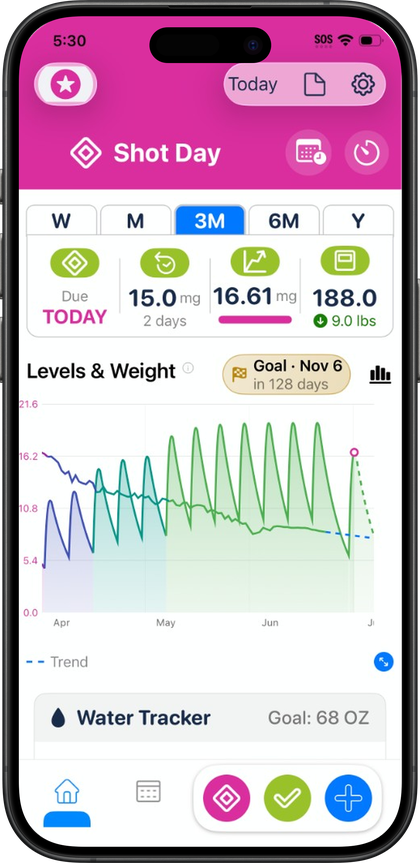
Quick answer
- Stay on Glapp if: You need Android, web, or Watch, use peer/trial benchmarking, or track vial/pen inventory.
- Consider Pokii if: You’re on iPhone/iPad, want configurable PDFs, custom half-life/Tmax meds, or a no-community privacy model.
- Pricing note: Glapp Max subscription exists—verify what’s free on current store listings before you decide.
- Migration: No verified Glapp export format; Pokii has no Glapp importer.
What Glapp is genuinely good at
Glapp's biggest structural advantage is reach. It has a native iPhone/iPad app with an Apple Watch companion listed on the App Store, a Google Play app for Android, and a browser-based web app at glapp.io that syncs to the same account. That's real cross-platform coverage that a single-platform iOS app can't match, and it shows in the reception: Glapp sits at 4.7 stars across 656 ratings on the App Store and 4.5 stars across roughly 289 reviews on Google Play, with reviewers generally positive about usability and the depth of insight the app provides.
The feature set backs that reach up. Glapp's medication-level curve models a rise, peak, and fade pattern for semaglutide and tirzepatide, framed around a "shot phases" concept meant to help users anticipate hunger, cravings, and side-effect windows across the weekly cycle. It also offers peer and clinical-trial benchmarking, letting users compare their own weight-loss and dose response against both clinical trial data and other Glapp users on the same medication and dose, a feature reviewers call out favorably and repeatedly. On the practical side, Glapp tracks vial and pen inventory, including concentration, volume, and beyond-use-date, with automatic deduction as doses are logged. It rounds this out with a "Wisdom" AI search feature for GLP-1 questions, and daily check-ins covering side effects, cravings, mood, energy, bowel movements, sleep quality, and food-noise or hunger-level ratings tied to dose timing. This is a mature, well-built product, and if peer/clinical-trial comparison or vial-level inventory tracking matters to you, it's a real reason to consider it.
Where Pokii differs
Pokii is built for iPhone and iPad. Glapp also ships on Android, the web, and Apple Watch—choose based on where you actually log doses.
Where Pokii focuses instead is depth on iOS. Its injection site body map shows front and back views with rotation settings, a suggested next site, and an optional pain slider on injectable logs that can appear directly in PDF reports; Glapp also markets shot-site rotation, so this is closer to parity than a clear edge, though Glapp's public descriptions don't mention a pain-severity slider specifically. On the chart side, Pokii's multi-medicine charts can display levels combined, per medication, or per compound, grouping branded medications that share the same active molecule, and You can define fully custom medications with their own half-life, Tmax, and bioavailability, then choose whether to show them on the chart. Glapp's marketing describes built-in medications and custom doses, but nothing in its public materials describes that level of custom pharmacokinetic modeling. Pokii's PDF reports are also built to be configurable rather than fixed: you choose which sections to include—projected levels, weight, target weight, shots, injection sites, pain, side effects, appetite, mood, notes, daily log entries, body measurements, and stats cards—before generating a report. Glapp advertises weekly progress reports and in-app summaries, but no exportable, section-by-section configurable PDF format was found in its public materials, so this is best understood as a difference in mechanism rather than a confirmed Glapp gap.
A few other differences worth naming plainly. Pokii's meal-photo scanning lets users photograph a meal, get AI-estimated nutrition, edit it, and write the resulting macros directly into Apple Health so dashboard totals update; nothing equivalent to that photo-to-macro pipeline turned up in Glapp's public descriptions, whose closest analog is self-reported food-noise and hunger-level tracking, a different mechanism entirely. Pokii's product design includes no ads and no public social feed; Glapp's peer-comparison feature implies some cross-user data aggregation, and while Glapp states that logged data stays private unless a user chooses to share it, how the underlying peer-comparison dataset is built or anonymized isn't detailed publicly.
Glapp's new paid tier, honestly
Glapp recently introduced a subscription tier called Glapp Max, priced at $4.99 weekly, $9.99 monthly, or $39.99 annually. Multiple Google Play reviews from June 2026 describe previously-free features moving behind this new paid tier, with visible frustration from longtime users. In response, the developer replied to one such review on June 20, 2026, stating that the no-cost Glapp tier still retains "more than 95% of Glapp's features" — worth noting that this is the developer's own characterization, not something independently verified, and the exact list of which features moved behind Glapp Max wasn't confirmed in this research. If you're evaluating Glapp today, it's reasonable to check current App Store or Play Store listings and reviews for the latest specifics before assuming a feature you've read about is still free.
By comparison, Pokii's feature set has been stable, with shot tracking, the projected level chart, injection site map, daily check-ins, unlimited active medications, custom PK medications, PDF reports, and AI meal scanning. There's no evidence of a comparable recent removal of previously-free Pokii features.
Migration reality: you're starting fresh
If you're currently on Glapp and considering a switch, it's important to be direct about this: no confirmed way to export your data out of Glapp was found. Glapp's App Store description, Google Play description, glapp.io homepage, and App Store version history don't mention a CSV, JSON, or PDF export feature, and Google Play's data-safety disclosure only confirms that you can request your data be deleted, with no mention of downloading it. Some of Glapp's legal and support pages couldn't be fully checked because they're rendered dynamically in a way that prevented reading their full text, so it's possible an export option exists there that simply wasn't surfaced by this research. That should be read as unverified, not as proof one doesn't exist.
What is confirmed is the opposite direction: Glapp can import data, including a documented case of a user importing their history from Shotsy into Glapp, matching a changelog entry about importing previous shots during onboarding. That tells us Glapp can take data in, not that it can send your data back out.
Pokii's own import options are a Pokii JSON backup, iCloud restore, Shotsy JSON import, and header-based CSV import. Switching from Glapp today means re-entering history unless you have another export Pokii recognizes; Pokii JSON export is via the share sheet.
Given that, the honest guidance is this: if you're on iPhone or iPad (or planning to use Pokii when Android ships), want injection-site depth, multi-medicine charts, built-in food logging, and configurable PDF progress reports without ads or a public feed, and you're willing to re-enter history, Pokii is a strong switch. If you need Android, web, or Watch today, or specifically use Glapp's peer/clinical-trial comparison or vial inventory tracking, staying on Glapp keeps features Pokii does not focus on—just go in aware of the Glapp Max tier so you know what's still free before you commit.
Always follow your prescriber’s instructions for GLP-1 medications. Pokii helps you log and visualize your journey; it does not replace professional care.