Alternatives
Cronometer Alternative for GLP-1
Cronometer is one of the most detailed nutrition trackers available, and a lot of GLP-1 users land there for exactly that reason: protein targets, micronutrient gaps, and lab-verified food data matter more once appetite drops and every bite counts. What Cronometer was never built for is the medication side of a GLP-1 routine. There's no dose log, no medication library, no injection-site map, and no chart of how a dose is expected to build and taper in the body. This page compares the two honestly, as a detailed food and micronutrient tracker on one side and a dedicated GLP-1 dose tracker on the other, rather than pretending they compete feature for feature.
Where Cronometer earns its reputation
Cronometer's core strength is micronutrient depth. Its own marketing describes tracking somewhere between 84 and 95+ vitamins and minerals depending on which page you read, and while the exact number is inconsistent even across Cronometer's own site and App Store listing, the underlying point holds: this is a tool built for people who care about more than calories and macros. That's paired with a food database Cronometer describes as over one million lab-analyzed or verified entries, rather than a database built mostly from crowd-sourced entries, which matters if you're trying to trust the numbers behind a "high protein, low sugar" day.
Logging options go beyond typing in foods. Barcode scanning is available on Cronometer's no-cost plan, and the paid Gold tier adds photo logging and voice logging, including through Siri. Cronometer also reaches well beyond food: exercise, weight, sleep, mood, lab work, digestion (it has a Bristol Stool Chart option), and unlimited custom biometrics on Gold are all part of the same app. On the integration side, it connects with Apple Health, Fitbit, Garmin, Oura, Whoop, Withings, Dexcom, Polar, Suunto, Google Health Connect, and Keto-Mojo, and it's available on Web, iOS, and Android, with an Apple Watch app (watchOS 7.0+) on top of the phone and tablet apps. Reputation-wise, the App Store listing shows 4.8 stars across roughly 95,000 ratings, and Cronometer's homepage claims 15 million users along with press mentions from outlets like Healthline and Women's Health.
Notably, Cronometer without Gold is genuinely usable rather than a stripped demo: unlimited food logging, custom macro and micronutrient targets, the barcode scanner, custom foods and recipes, and device sync are all included for free. The main limits without Gold are ads, a 7-day window on reports and charts, and the Gold-only extras like photo/voice logging and unlimited custom biometrics.
The honest gap: nothing built for GLP-1 dosing
None of that touches medication tracking, and it isn't supposed to. Cronometer has no equivalent to logging an injection or oral dose with a date, time, medicine, and amount. There's no built-in list of GLP-1 medications to pick from, no way to see a projected curve of how a dose is expected to rise and fall in your system between injections, and no injection-site map to help rotate shot locations or track pain per site. Its check-in tools for mood and other biometrics are generic and not structured around a medication schedule the way a shot-tracking app's daily check-in would be. Cronometer does offer "Print Reports" on Gold for sharing nutrition data with a dietitian or doctor, but that's a nutrition report, not something that pulls together doses, injection sites, pain, side effects, and weight into one view of a GLP-1 journey. In short, there's nothing dishonest to point out here: Cronometer simply isn't a GLP-1 app, and its own marketing and feature pages never claim to be.
Where Pokii picks up: dose tracking as the core product
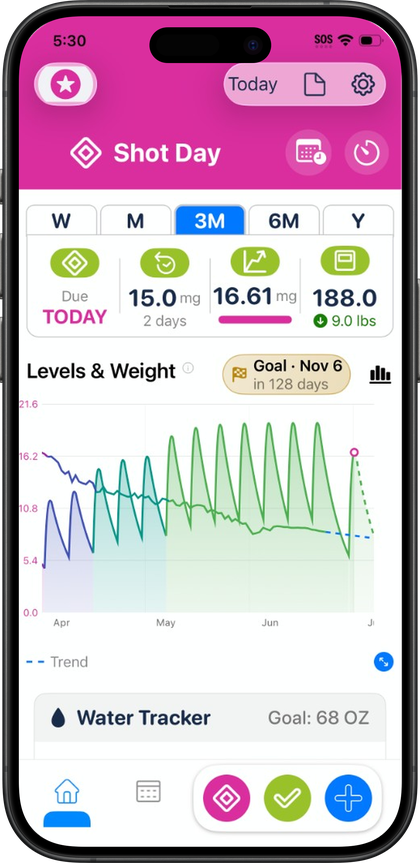
This is the part of the routine Pokii is actually built around. Shot tracking, logging an injectable or oral dose with date, time, medicine, dose, and notes, with full edit history, is built into Pokii from the start. Pokii ships with a built-in medication library covering Zepbound, Wegovy, Wegovy Pill, Foundayo, Mounjaro, Ozempic, Retatrutide, Saxenda, Rybelsus, Victoza, Trulicity, CagriSema, Bydureon, Tanzeum, and compounded tirzepatide and semaglutide, so there's no need to set up a generic entry for a GLP-1 medication the way there would be in Cronometer.
The projected medication levels chart, an educational curve of how a dose is expected to build and taper between injections (Combined, Per Medication, or Per Compound view), is also in Pokii, with a standard curve; custom medications with your own half-life, Tmax, and bioavailability fields, along with dose simulation on the scheduler, are available in Pokii too. There's also an injection site body map with front and back views, rotation suggestions, and an optional prompt when logging a shot, plus an optional pain slider per injectable dose, both in Pokii. A room-temperature timer with presets and an alarm helps with the practical step of letting a cold pen warm up before injecting.
Day to day, Pokii's check-in system logs side effects with intensity per effect, appetite, and mood, with relative-to-last-check-in hints, and a customizable list of which side effects even show up. All of this, plus shots, injection sites, pain, weight, and target-weight progress, can be pulled into a configurable PDF progress report for clinician visits. Pokii also includes built-in food logging—nutrition label scanning (recommended) and meal capture when needed, with AI macros on Today's log beside shots, with totals flowing through Apple Health. Cronometer's strength is micronutrient depth and a lab-verified food database—valuable if you track dozens of vitamins and minerals daily, which is a different job than GLP-1 dose and level tracking in one app.
Migration reality, and running both together
Cronometer does support CSV export, confirmed in its own Help Center: from Account Settings you can export a date-ranged CSV of diary entries, exercises, biometrics, notes, and nutrition summaries, including an option to break results out by meal group. What that export doesn't contain is medication dose records, because Cronometer never tracked GLP-1 doses in the first place. Pokii's import options are a Pokii JSON backup, an iCloud restore, Shotsy JSON, and a header-based CSV import built around shot and dose data, not food-diary or biometric columns. There's no realistic path to import a Cronometer export into Pokii's dose history, because there's nothing on the dose side to import.
The practical upshot is that switching from Cronometer doesn't mean bringing dose history with you—it means starting your shot log fresh in Pokii while deciding what to do with Cronometer food data. If Cronometer entries sync to Apple Health, Pokii's dashboard can still show those macro totals alongside Pokii-captured meals. Many GLP-1 users use Pokii alone for shots, levels, and built-in food logging; Cronometer remains relevant when micronutrient detail is the primary goal, not because Pokii lacks in-app meals.
Pokii is a tracking and education tool. It does not provide medical advice, diagnosis, or treatment. Talk with your clinician about dosing, side effects, and any change to your plan.