Alternatives
MacroFactor Alternative with Pokii
MacroFactor and Pokii solve different problems, and the honest way to compare them is to say so up front. MacroFactor, built by Stronger By Science, is an adaptive nutrition-coaching app that adjusts your calorie and macro targets week to week based on what you actually eat and how your weight actually moves. Pokii is a dedicated GLP-1 dose tracker with built-in nutrition and weight support. If you're on Zepbound, Wegovy, Mounjaro, Ozempic, or a compounded semaglutide or tirzepatide and you searched for a MacroFactor alternative expecting to find another food-logging app, what you actually need to know is narrower and more useful: MacroFactor has no medication tracking at all, and that gap is exactly where Pokii is built to sit.
What MacroFactor genuinely does well
MacroFactor's core pitch is its adaptive expenditure algorithm. Rather than assigning you a static calorie target from a Mifflin-St Jeor-style formula, it reverse-derives your energy expenditure from your logged intake and your observed weight change, then recalculates your calorie and macro targets during weekly check-ins as your metabolism shifts. That's a meaningfully different approach from a fixed-number diet app, and it's the feature the app is actually known for.
Alongside that, MacroFactor markets a Weight Trend insight that smooths out the day-to-day noise of scale weight into a clearer trend line, which matters a lot for anyone whose weight bounces around from water retention, sodium, or cycle timing. The food-logging side is also genuinely deep: a large, screened food database, barcode scanning, custom foods and recipes, copy/paste logging, a timeline-style food log rather than fixed meal slots, and AI photo-based food logging where you can snap a picture of a meal to start an entry. The app also tracks micronutrients and habits, includes a period tracker, and pulls expenditure inputs from Apple Health, Google Fit, or Fitbit. Its design philosophy is deliberately non-punitive: the algorithm still adjusts your targets the next week regardless of how closely you hit them, with no red-number warnings for going over. MacroFactor ships on both iOS and Android, unlike Pokii, and has a sister app, MacroFactor Workouts, for strength training. It runs $11.99 a month, $47.99 every six months, or $71.99 a year, with a 7-day free trial and no permanently free option.
None of that is a strawman. If what you want is an evidence-based, algorithm-driven macro coach with a serious food diary, MacroFactor is a credible, well-reviewed option in that category, and it isn't trying to be anything else.
The honest gap: MacroFactor was never built to track a medication
Here's the part that matters most for GLP-1 users evaluating it: MacroFactor has no medication library, no shot or injection logging, no injection-site map, and no pharmacokinetic dose-level charting. There's nothing in its App Store listing, its website, or its help documentation describing how to log an injection, an oral GLP-1 dose, or any medication whatsoever. No official MacroFactor content addresses semaglutide, tirzepatide, or injectable weight-loss medications directly either. Some GLP-1 users do use MacroFactor, but they use it purely for food logging and weight-trend smoothing, tracking their doses somewhere else entirely. That's not a criticism of MacroFactor; it simply wasn't designed around a medication cycle, so this isn't a feature it's missing so much as a category it's not in.
That distinction is the whole reason this comparison exists. If you came here hoping MacroFactor could replace a shot tracker, it can't, and it was never trying to.
Where Pokii covers that specific gap
Pokii's core purpose is the piece MacroFactor doesn't touch: shot tracking. You log medicine, dose, date and time, and notes, with full edit history, drawing from a built-in library of 16 branded and compound GLP-1/GIP medications, including Zepbound, Wegovy, Wegovy Pill, Foundayo, Mounjaro, Ozempic, Retatrutide, Saxenda, Rybelsus, Victoza, Trulicity, CagriSema, Bydureon, Tanzeum, and compounded tirzepatide and semaglutide.
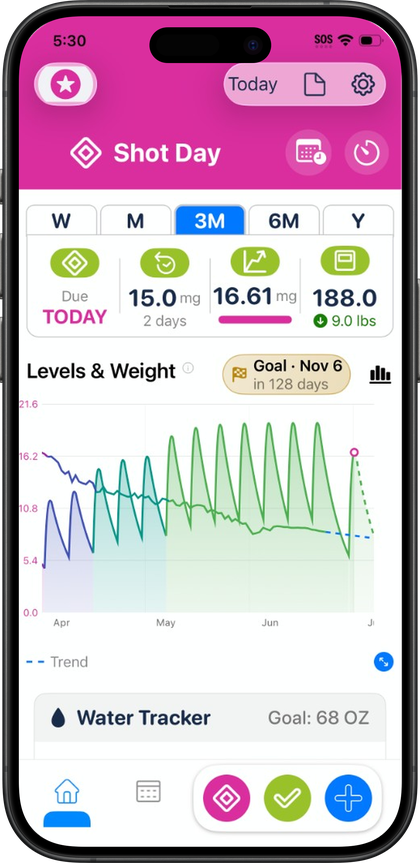
Around that, Pokii builds the tooling MacroFactor has no equivalent for: a projected medication-levels chart, built into Pokii, that models pharmacokinetic curves between doses in Combined, Per Medication, or Per Compound display modes; an injection-site body map with rotation suggestions; a shot scheduler that lets you preview simulated future doses on the chart before you log them; and a daily check-in for side effects, appetite, mood, and notes that's dose-aware, with hints relative to your last shot. This is where the catalog description of Pokii pairing weight trend overlay with medication projections becomes concrete rather than abstract: Pokii's weight trend line (smoothed and projected in Pokii, alongside a target weight and estimated goal date) sits on the same timeline as your dose history and projected medication levels, so you can see weight movement in the context of your actual injection cadence. MacroFactor's weight trend, by contrast, has no dose data to sit next to, because it never collects any. Pokii also adds things a pure nutrition app has no reason to build: a room-temperature timer for warming a pen before injecting, and configurable PDF progress reports that can include projected levels, weight, shots, injection sites, pain, side effects, appetite, and mood in one document for a provider visit.
It's worth being equally honest about where MacroFactor still wins. Pokii's nutrition targets are settings you define yourself; nothing in Pokii recalculates your macros automatically from a rolling model of your intake versus your weight trend the way MacroFactor's algorithm does. Pokii's nutrition dashboard is also built around Apple Health rather than being a standalone food diary: it reads nutrition and water data you've logged elsewhere and writes back from built-in label and meal scanning (nutrition label scanning is what Pokii recommends for accuracy), with no general free-text food log or competitor-style barcode database of its own. Pokii is built for iPhone and iPad; MacroFactor covers both major mobile platforms.
Migration reality, and who should actually use what
If you're already on MacroFactor and considering a move, be clear-eyed about what transfers. MacroFactor's own Data Management settings offer a Data Export with two modes: a Granular Export of individual spreadsheets by data type, and a Quick Export that bundles expenditure, weight trend, scale weight, calories, macros, and primary nutrition targets into one spreadsheet over a date range you choose. MacroFactor's help documentation calls this output a spreadsheet but doesn't specify whether it's a CSV or another format, and it doesn't publish an exact column schema.
Pokii's import side supports a Pokii JSON backup restore, an iCloud restore, a dedicated Shotsy JSON import, and a generic header-based CSV import. There is no dedicated MacroFactor importer. In theory, Pokii's generic CSV import might accept a MacroFactor spreadsheet export if that export turns out to be CSV-formatted and its column headers happen to line up with what Pokii's importer expects, but that compatibility has not been verified, and nothing confirms Pokii's CSV import was built or tested against MacroFactor's specific output. More fundamentally, even a clean transfer would only carry over weight and nutrition-target history, because MacroFactor never captured medication or dose data in the first place; there's no shot history to migrate regardless of file format. Pokii also has no CSV export of its own, only a Pokii JSON backup via the share sheet, so there's no supported round trip back to MacroFactor either.
Practically, MacroFactor is an adaptive macro coaching app, not a GLP-1 tracker—it never captured dose history. Pokii includes built-in food logging on the same timeline as shots, so you don't need MacroFactor for meals unless you specifically want its expenditure algorithm and coaching loop. If adaptive targets and a cross-platform food diary are the main goal, MacroFactor remains a strong choice. If dose logging, injection-site map, projected medication levels, and weight read against shot history matter, that's Pokii—and running both is optional, not required.
Always follow your prescriber’s instructions for GLP-1 medications. Pokii helps you log and visualize your journey; it does not replace professional care.