Alternatives
Lose It Alternative with GLP-1 Shot Tracking
Lose It! is one of the biggest names in calorie tracking, and it's genuinely good at that job — but it has no medication or GLP-1 tracking of any kind. This page isn't a feature-for-feature fight, because the two apps aren't really built for the same job: Lose It! is a food logger, and Pokii is a dedicated GLP-1 tracker with built-in food logging on the same timeline as shots. If you're on a GLP-1 medication and only using Lose It!, here's what you're getting, what's missing, and what it would take to cover the gap.
What Lose It! is genuinely good at
Lose It!'s food database is a real strength. Its App Store listing states a global food database of over 56 million items and recipes, and the app claims to have helped more than 57 million users lose a combined 150 million-plus pounds — that's a mature, established product with a lot of data behind it. It also backs that up with a strong App Store reputation: roughly 4.8 stars from about 767,000 ratings at last check.
Logging flexibility is another genuine advantage. Lose It! supports barcode scanning, AI photo logging (its "Snap It" feature), and AI voice logging, where you can say something like "I had 2 eggs, toast with butter and jam" and have it interpreted into a logged meal. Lose It! also covers macro tracking, intermittent fasting schedules, and broader health goals including blood pressure, glucose, cholesterol, body measurements, and sleep cycles, and it syncs with Fitbit, Misfit, Garmin, Withings, Google Fit, and Apple HealthKit.
Lose It! includes a native Apple Watch app (the App Store listing requires watchOS 8.7 or later) and social features such as friends and support groups. Pokii is on iPhone and iPad today (Android coming soon) with a private, dose-first log, built-in food capture, and no public social feed. If a 56-million-item database, voice logging, watch support, and community matter most, Lose It! leads that lane; Pokii leads GLP-1 shot tracking, projected levels, built-in food on Today's log, and visit-ready PDFs.
The honest gap: zero GLP-1 tracking
Here's the part that matters if you're on a GLP-1 medication: Lose It!'s App Store description never mentions GLP-1, injections, or medication scheduling anywhere. Its entire feature set is food, exercise, and weight-goal oriented. That means if Lose It! is the only app you're using, there is no dose history, no injection-site record, and no timeline of your medication anywhere in your data — not because Lose It! does it badly, but because it doesn't attempt it at all.
Concretely, that leaves several holes for anyone managing a GLP-1 regimen. There's no way to log a shot with date, time, medicine, and dose. There's no medication library to select a specific GLP-1 or GIP drug from. There's no projected medication-level charting to see roughly where you are between doses. There's no injection site map to rotate sites and avoid overusing one spot, and no way to log injection pain. There's no side-effect, appetite, or mood check-in tied to when you actually took a dose, so if you want to correlate how you're feeling with your medication timeline, Lose It! simply has nowhere to put that data. And there's no shot reminder, no room-temperature pen timer, and no shot-day banner — all things a calorie tracker has no reason to include, but that leave a real logistical gap for GLP-1 users relying on it alone.
Where Pokii covers that gap
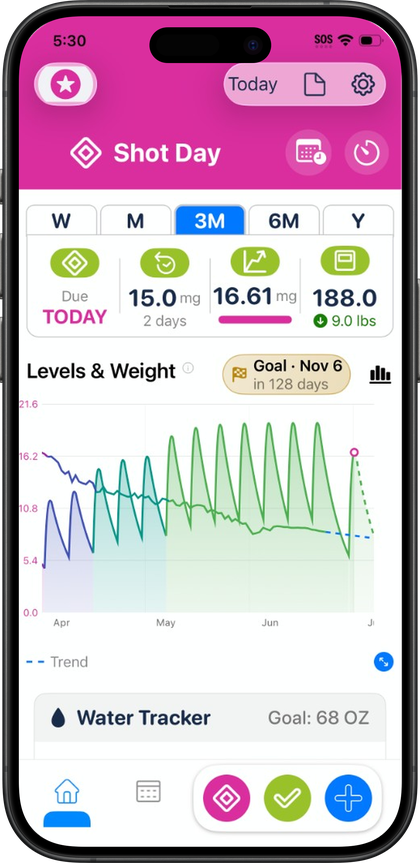
This is exactly the territory Pokii is built for. Shot tracking is core and free: you log injectable and oral doses with date, time, medicine, dose, and notes, with full edit history, pulled from a built-in medication library covering GLP-1 and GIP drugs including Zepbound, Wegovy (and Wegovy Pill), Foundayo, Mounjaro, Ozempic, compound tirzepatide and semaglutide, Retatrutide, Saxenda, Rybelsus, Victoza, Trulicity, CagriSema, Bydureon, and Tanzeum.
On top of logging, Pokii charts a projected medication-level curve — an educational model, not a lab result — with combined, per-medication, and per-compound display modes in Pokii, including custom dose colors and simulated dose previews before you log a shot. Injectable doses get a front/back injection site body map with rotation suggestions and an optional pain slider; oral medications skip that since it doesn't apply. A daily check-in module tracks side effects with intensity, appetite, and mood, with notes shown relative to your last entry, so how you're feeling actually sits next to your dose timeline instead of nowhere. Shot logistics are covered too: per-medicine shot reminders, a room-temperature timer with presets and an alarm before injecting a warmed pen, and overdue or shot-day banners on the dashboard. Pokii also includes a configurable PDF report built specifically around shots, injection sites, pain, side effects, appetite, mood, and weight — something to hand to a provider, in a format Lose It!'s own exports don't touch.
Pokii's dashboard puts shots, check-ins, weight, and food scans on one Today's log timeline; a water tracker with glass-based quick add, smart pattern-based reminders, and a combined water-and-nutrition dashboard module; and home screen widgets including Shot Progress and the Next Shot medication-level chart widget. Lose It! still wins on sheer database size and voice logging; Pokii wins when you want doses, levels, and meals in one GLP-1 app, with nutrition also readable from Apple Health when other apps write there.
Migration reality: there's nothing GLP-1 to bring over
If you're weighing a move, the honest answer is that Lose It! has an export, but it was never built to carry medication data, so there's nothing shot-related to migrate in the first place. Lose It!'s export is web-only, through loseit.com's Insights → Weekly CSV download, not available from the mobile app itself — and per community reporting, it covers logged food, nutrition, and weight-type summaries. The exact current column layout wasn't independently confirmed for this comparison, so treat the specifics as directionally accurate rather than guaranteed.
Pokii does support CSV import, converting header-based CSV files into its own backup format, alongside Pokii JSON backup, iCloud restore, and Shotsy JSON import. But that importer is built around shot-and-dose-style records, and it hasn't been verified against Lose It!'s specific CSV export format — so a working weight-data import from Lose It! into Pokii isn't a confirmed path today, even though both files technically involve CSV. What is certain is this: your shot and dose history has no migration path from Lose It!, not because of a format mismatch Pokii could fix, but because Lose It! never captured that data to begin with. There's simply nothing GLP-1-specific to export.
In practice, this makes the decision fairly simple. If you value Lose It!'s food database depth, its logging methods, or its Apple Watch app, and you're not on a GLP-1 medication, Lose It! alone is a reasonable, well-built choice. If you are on a GLP-1 medication and want your shots, injection sites, side effects, dose timeline, and in-app food logging in one place, that's Pokii. Some people still pair Lose It! with Pokii when they want Lose It's voice log or 56M-item search on top of Pokii's medication depth—but many GLP-1 users find Pokii's built-in scanner enough for meals. Either way, don't expect a one-click migration for anything dose-related — there's nothing on Lose It!'s side to bring over.
Pokii is a tracking and education tool. It does not provide medical advice, diagnosis, or treatment. Talk with your clinician about dosing, side effects, and any change to your plan.