Alternatives
Shotsy Alternative: Pokii for iOS
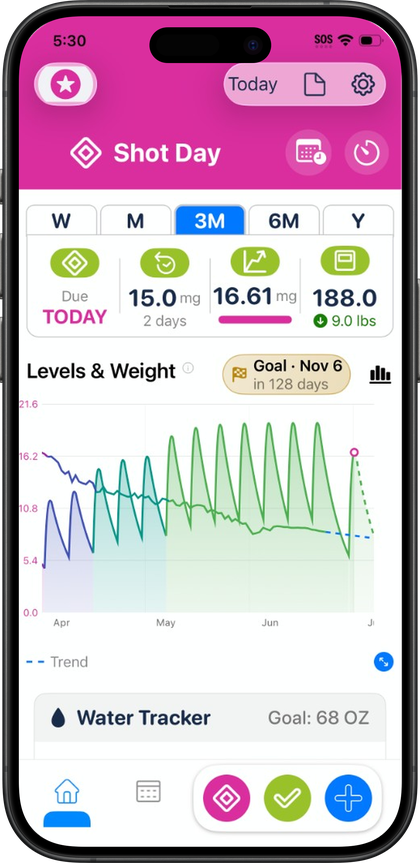
Shotsy vs Pokii: Both are dedicated GLP-1 trackers. Pokii targets iPhone and iPad (Android coming soon) with per-compound projected level charts, built-in food logging on Today's log, custom PK medications, and one-tap Shotsy JSON import for dose history. Shotsy adds Android today, broader language support, manual calorie/water fields, and features like Maintenance Mode—worth comparing if you need cross-platform today or Shotsy's specific charts.
Quick answer
- Stay on Shotsy if: You need Android today, want manual calorie/water fields in-app, or rely on Shotsy-only features (e.g. maintenance framing, side-effect vs level overlay—see Shotsy materials).
- Consider Pokii if: You're on iOS/iPad (or waiting for Android), want Per Compound level views, built-in food logging beside shots, injection-site map + PDF reports, or you're switching and can export Shotsy JSON (dose data imports; nutrition/exercise from Shotsy do not).
- Import reality: Pokii's Shotsy importer is documented in-app; Shotsy CSV is not verified compatible with Pokii's generic CSV importer.
- Neither is medical advice: Both plot estimated levels from published PK data, not blood tests.
What Shotsy does well
Shotsy has real scale and a real track record. Its live Apple App Store listing shows roughly 28,000 ratings at 4.8 stars, and its Google Play listing shows about 8,500 reviews at 4.7 stars with over 100,000 Android installs. Shotsy's own marketing claims more than 1 million downloads and a 4.9-star average, which doesn't exactly match the live store numbers, but that's most likely a sign the marketing copy is refreshed periodically rather than tied to a live feed. It was founded by Aja Beckett, a GLP-1 patient herself, with Eric Perakslis, a former FDA Chief Scientist and CIO and former Duke Clinical Research Institute leader, serving as Chief Science Officer. That's a credible team for this category.
On features, Shotsy covers a lot of ground. It supports Ozempic, Wegovy including the Wegovy Pill, Mounjaro, Zepbound, Rybelsus, Saxenda, Victoza, Trulicity, and custom medications, with the ability to track multiple medications at once. It plots estimated medication-level curves based on published clinical data across several timeframes, and it includes injection site rotation with a visual body map and a suggested next site. It logs side effects and markets a view that correlates those side effects against the estimated medication-level curve, though that specific correlation feature is described only in Shotsy's own marketing pages and hasn't been independently verified against the live app. Weight tracking includes dose-coded charts and a dedicated post-goal "Maintenance Mode" that recalibrates the dashboard once you've hit your target. Nutrition and water tracking are built in as manual entry, on top of automatic Apple Health syncing for weight, calories, protein, and water. Shotsy also offers a PDF export designed to hand to a provider, home screen widgets for medication level and next-dose countdown, support for 17 languages, and on Android, integration with Health Connect for weight, hydration, and nutrition data. Pricing is most consistently cited at $9.99 a month or $39.99 a year for the premium tier, though Apple's own in-app purchase listing shows a few additional unlabeled price points alongside those, so treat that figure as the best-supported one rather than a single confirmed price.
Where Pokii differs
Pokii is built for iPhone and iPad, with Android in active development. Shotsy also ships on Android and additional platforms if you need to track outside Apple's devices today.
The nutrition model differs in UI, not in whether Pokii logs food. Shotsy lets you manually type calories, protein, and water in addition to syncing from Apple Health. Pokii includes built-in meal and label scanning—nutrition label scanning is the recommended path for accuracy (AI macro estimates, edit before save)—with entries on Today's log next to shots and check-ins; nutrition totals also flow through Apple Health. If you prefer free-text macro fields over scan-first logging, Shotsy's manual rows may feel more familiar—but you do not need a second app for meals on Pokii.
On charts, Pokii's standard projected medication-level curve, including combined, per-medication, and per-compound display modes, is available in Pokii. Pokii also includes custom dose colors, coloring the chart by dose or by medicine, and simulated dose projections you can preview before logging a shot. That's worth noting because a third-party comparison (not Shotsy's own site, so treat it as moderate-confidence) states that Shotsy puts its medication-level chart behind its paid tier. Shotsy also has a named "Maintenance Mode" for after you reach a weight goal that Pokii doesn't have an equivalent for by name — Pokii's comparable tools are a weight trend line, a target weight line, and a goal-date projection, but not a dedicated mode with that framing. Similarly, Shotsy markets a chart that directly overlays side effects against its estimated medication curve; Pokii's daily check-in logs side-effect severity and notes tied to dose timing in your history and PDF reports, but Pokii's public materials do not describe an equivalent overlay chart, so treat that as a plausible Shotsy strength rather than a confirmed gap in Pokii. Language support is a similar case: Shotsy documents 17 languages, and Pokii does not publish a comparable language list on the App Store, so no claim should be made about Pokii being English-only or multilingual until that's confirmed. Pokii also includes built-in food logging that estimates nutrition from a capture and writes it to Apple Health on the same timeline as GLP-1 shots—nothing in the Shotsy sources reviewed describes a comparable in-app food flow, though that's an absence in marketing material, not proof the app lacks it entirely.
A platform claim worth double-checking
One inconsistency is worth flagging plainly rather than repeating uncritically. Shotsy's own website markets the app as available on "iPhone, iPad, Mac, and Android." But the live Apple App Store product page for Shotsy states "Only for iPhone" and "Designed for iPhone. Not verified for macOS." Those are two Shotsy-controlled sources that disagree with each other, and there's no independent confirmation of which is accurate, so it isn't fair to claim Shotsy definitively does or doesn't work well on iPad or Mac. What is confirmed is that Pokii is a universal iOS app with a purpose-built iPad layout, not a phone app stretched to fit a bigger screen. If you specifically want a native iPad experience and can't get a clear answer from Shotsy on that front, that's a real point in Pokii's favor. If you need Android today, Shotsy has a live, separately maintained app there; Pokii is on iPhone and iPad now with Android in active development.
Migrating from Shotsy: what actually transfers
Pokii is the one place in this comparison where a real import path exists, so it's worth being precise about its limits. Pokii has a dedicated "Import Shotsy JSON" feature that accepts a Shotsy export file with a.json or.shotsyjson extension and converts it into Pokii's own data model, with the in-app import screen documenting exactly which fields are supported. That importer focuses on dose and shot history documented in-app. After importing, Pokii runs automatic duplicate detection and cleanup so repeated entries can be reviewed and removed.
What it doesn't cover is just as important. Shotsy also offers a CSV export, referenced in its App Store release notes, but Shotsy doesn't publicly document that CSV's column structure anywhere, and Pokii's separate "Import CSV" feature is a generic, header-based importer that was not built or verified against Shotsy's specific CSV format. So while both features technically exist, there's no confirmed, field-level compatibility between them — don't treat "export Shotsy as CSV, import into Pokii" as a validated path. Shotsy also has its own local or iCloud backup and restore option referenced in its release notes, but there's no public confirmation of that backup file's format, so it can't be assumed to relate to the JSON import Pokii supports. And the migration only runs one direction: Pokii has no CSV export of its own, only its own Pokii JSON backup format via the share sheet, so there's no supported way to move data from Pokii back into Shotsy or into any other CSV-based tool.
In practical terms, this makes the switch most sensible for someone whose Shotsy history is mainly dose and shot data and who is fine re-establishing nutrition and exercise history going forward, or who relies on Apple Health for that anyway. If your Shotsy log is central to a detailed manual nutrition diary or exercise history you don't want to lose, that part won't come across, and it's worth checking Pokii's in-app import screen directly — it documents supported and unsupported fields more precisely than any public source about Shotsy's export format does.
Always follow your prescriber’s instructions for GLP-1 medications. Pokii helps you log and visualize your journey; it does not replace professional care.