Alternatives
Best GLP-1 Tracker Apps (2026)
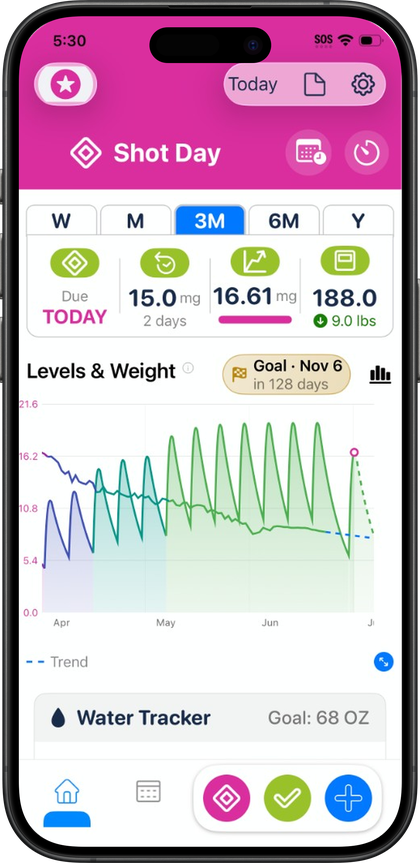
Best GLP-1 tracker apps in 2026 (dedicated dose trackers): Pokii, Shotsy, MeAgain, Glapp, and Pep. Pokii fits iPhone and iPad users (Android coming soon) who want projected medication levels, built-in food logging on Today's log, injection-site map, custom PK fields, and no ads or public social feed. Shotsy, MeAgain, Glapp, and Pep add Android today (and Glapp adds web and Apple Watch); diet apps like Noom or MyFitnessPal are a different category—they log food or coaching, not pharmacokinetic dose curves.
Quick answer
- Dedicated trackers (compare these first): Pokii, Shotsy, MeAgain, Glapp, Pep—all built around shots and dose history, not a food diary with a medication field bolted on.
- Pokii’s edge: Projected level chart (Combined / Per Medication / Per Compound), injection-site body map, custom medication PK fields, simulated doses on the scheduler, configurable PDF progress reports, iPad-native layout, built-in food logging on Today's log, no ads, no social feed—iPhone and iPad today; Android coming soon.
- Pick someone else if: You need Android, web, or Apple Watch (Glapp is the broadest; Shotsy and MeAgain cover Android too).
- Not the same thing: Noom, WeightWatchers, MyFitnessPal, Lose It, Cronometer, MacroFactor, and Cal AI—useful for coaching or nutrition, not a substitute for a dose-and-level tracker.
- Switching data: Pokii can import Shotsy JSON (dose history only, documented in-app). Most other apps have no verified export into Pokii.
What actually matters when evaluating a GLP-1 tracker
The core job of a dedicated GLP-1 tracker is logging doses accurately and helping you make sense of them over time, so the first thing to check is how a dose gets logged: does it record medicine, dose strength, date and time, injectable versus oral, and does it keep a full edit history? Pokii logs all of that, with a built-in library of 16 branded and compound GLP-1/GIP medications including Zepbound, Wegovy, Wegovy Pill, Mounjaro, Ozempic, compounded tirzepatide and semaglutide, Retatrutide, Saxenda, Rybelsus, and others, grouped by molecule where relevant.
The second thing worth checking is whether the app shows any kind of projected medication-level curve — a chart estimating how much of the drug is likely active in your system between doses, based on published pharmacokinetic data. This is a real differentiator: most diet-and-coaching apps don't attempt it at all, and it isn't automatic even among dedicated trackers. Related to that is whether custom medications support real pharmacokinetic fields (half-life, time-to-peak, bioavailability) rather than just a name and a dose amount, since that determines whether an off-list or compounded medication gets a real curve or just a log entry.
Third, look at injection-site tooling specifically: a visual front/back body map with rotation suggestions is a meaningfully different experience than a text field labeled "injection site." Fourth, check the privacy and data model — whether the app runs ads, has a public social or community feed, and how your health data is stored and shared, since GLP-1 logs are sensitive by nature. Finally, check platform coverage against what you actually own: iPhone, iPad, Android, Apple Watch, and web support vary a lot across this category, and no app in this comparison covers all of them.
The dedicated GLP-1 trackers
Four apps are built the same way Pokii is: single-purpose, dose-first trackers rather than diet platforms with a medication log bolted on. They're the closest real comparison, and each has genuine strengths worth naming plainly.
MeAgain is a full-featured, GLP-1-specific tracker with strong scale (roughly 24,000-25,000 App Store ratings at 4.8 stars, a claimed 500,000-plus users) and it covers both iPhone and Android, including Android Health Connect sync — real reach Pokii is still catching on (iPhone/iPad today, Android coming soon). MeAgain also has food logging via photo, barcode, voice, or search with AI-estimated macros, and a named Registered Dietitian Nutritionist shaping its nutrition guidance. Pokii counters with built-in nutrition label and meal scanning (label scanning recommended) on the same timeline as projected medication levels, plus custom-medication PK fields, configurable PDF reports, and an injection-site body map — and MeAgain's privacy policy discloses using health data for marketing and describes public community features, a contrast worth knowing if you want a closed, non-social app (Pokii runs no ads and has no public social feed).
Shotsy is one of the most established names in the category, with about 28,000 App Store ratings at 4.8 stars and a credible founding team, including a former FDA Chief Scientist as Chief Science Officer. It supports a broad medication list, a visual injection-site map, estimated medication-level charts, manual nutrition and water logging, PDF export, and both iOS and Android apps. Pokii includes its standard projected-level chart (Combined, Per Medication, and Per Compound modes), while a third-party comparison suggests Shotsy gates its chart behind its paid tier — that claim comes from a competitor's marketing page rather than Shotsy's own site, so treat it as moderate-confidence. Shotsy also markets a named "Maintenance Mode" for after you hit a weight goal and a side-effect-to-medication-level correlation view that Pokii doesn't have an equivalent of by name.
Glapp stands out for platform breadth — native iPhone/iPad, Android, a web app, and an Apple Watch companion, all syncing to one account — plus a distinctive "shot phases" concept mapping hunger and side-effect windows across the weekly cycle, and peer/clinical-trial benchmarking that lets you compare your own results against others on the same medication and dose. It also tracks vial and pen supply with beyond-use-date reminders. Several June 2026 Google Play reviews describe previously-free Glapp features moving behind a new "Glapp Max" subscription, which is worth knowing if pricing stability matters to you. Pokii has no equivalent supply-tracking or peer-comparison feature, and Glapp's public materials don't describe custom PK-parameter modeling or a configurable PDF report the way Pokii's does.
Pep is a solid, well-reviewed all-in-one logger (4.7 stars, 830 App Store ratings) available on iPhone, iPad, and Android, with an AI food-photo scanner, a FatSecret-powered food database, and support for 10 languages — genuinely broad localization that Pokii has not published a comparable list for. Pep's own materials don't describe a custom-medication PK builder, a projected medication-level chart, home screen widgets, or a PDF report, and its built-in medication list (six named drugs plus compounded tirzepatide/semaglutide) is smaller than Pokii's 16-entry library.
Across all four, the common thread is platform reach: MeAgain, Shotsy, Glapp, and Pep all cover Android in some form, and Glapp adds a web app and Apple Watch companion on top. Pokii doesn't match that breadth yet — it's on iPhone and iPad today with Android coming soon, and a native iPad layout built for a tablet screen rather than a stretched phone interface. What Pokii offers in return is a projected medication-level chart with three display modes, an injection-site body map with rotation suggestions, no ads, no public social feed, custom PK fields, a shot scheduler with simulated-dose previews, and configurable PDF reports. Which of these five fits best depends on whether you need Android or web today versus iPad-native layout, custom PK modeling, built-in food + dose on one timeline, and a closed, non-social data model—with Pokii's Android release narrowing the platform gap.
Diet and coaching apps: a different problem
Noom, WeightWatchers, MyFitnessPal, Lose It, Cronometer, MacroFactor, and Cal AI show up constantly in GLP-1 searches, but none of them are dedicated dose trackers, and it's worth being clear about why before comparing features head-to-head.
Noom and WeightWatchers are coaching-and-telehealth ecosystems, not trackers. Noom Med and WeightWatchers' Med+ program can evaluate, prescribe, and ship GLP-1 medication, paired with human coaching, behavior-change lessons, and community features — genuinely useful if you need a prescription and ongoing coaching, but that's a different job than what Pokii does, and both require an active paid subscription (Noom from roughly $17 to $279-plus a month depending on tier; WeightWatchers Med+ from $25-49 the first month, then $74-149 a month) to access their GLP-1 tools at all. Neither publicly documents a projected medication-level chart, an injection-site body map, or a per-shot pain slider; WeightWatchers does let members log injection medication, dose, and site as one small piece of its broader program, but with no confirmed chart or scheduler behind it.
MyFitnessPal, Lose It, Cronometer, MacroFactor, and Cal AI are food and nutrition loggers first. MyFitnessPal added a free "GLP-1 Support" log in April 2026 that captures brand, dose in milligrams only, date, and injection location, with an explicit disclaimer that it doesn't verify medication, doses, or timing — a basic log, not a pharmacokinetic tracker. Lose It, Cronometer, MacroFactor, and Cal AI have no GLP-1-specific dose tracking in any source reviewed; they're built around calorie and macro logging, with real strengths in huge item databases, micronutrient detail, or adaptive macro coaching. Pokii includes built-in food logging on the same timeline as GLP-1 shots, so many users use Pokii alone for dose, levels, and meals; diet apps matter when you want Cronometer-grade micronutrients or a legacy mega-database, not because Pokii lacks in-app food capture.
Migrating from any of these: the honest picture
If you're switching to Pokii from any app named on this page, the fair expectation is that you'll be starting your dose history fresh, with one partial exception. Pokii has a dedicated "Import Shotsy JSON" feature that accepts a Shotsy export file (.json or.shotsyjson) and converts dose and shot history into Pokii's data model; the in-app import screen documents which Shotsy fields carry over, focused on dose and shot history. Pokii also has a generic, header-based CSV importer, but it hasn't been verified against any specific competitor's export format, and none of the other ten apps covered here has a confirmed, documented export that's been checked against it.
For MeAgain, Glapp, and Pep, no self-service data export was found in any public source at all — Glapp and Pep can import from Shotsy into themselves, but neither appears to offer a way to get data back out. Noom and WeightWatchers both technically support a data-portability request under privacy law, but it's a manual request fulfilled by the company, not an in-app export button, and neither confirms whether medication or dose data is included in what you'd get back. MyFitnessPal, Lose It, and Cronometer do have real CSV exports, and MacroFactor has a spreadsheet export, but all four are food, weight, and exercise data — none of them ever captured GLP-1 dose history in the first place, so there's nothing to migrate on that front regardless of format compatibility.
None of this is a reason to avoid switching, and it isn't unique to Pokii — it's the current state of the entire category. If your priority is dose history specifically, re-entering it by hand in whichever app you land on is a short, one-time task, and most of these apps (Pokii included) are light enough to log a full medication history in a single sitting.
Pokii is a tracking and education tool. It does not provide medical advice, diagnosis, or treatment. Talk with your clinician about dosing, side effects, and any change to your plan.