Trackers by medication
Ozempic Tracker App
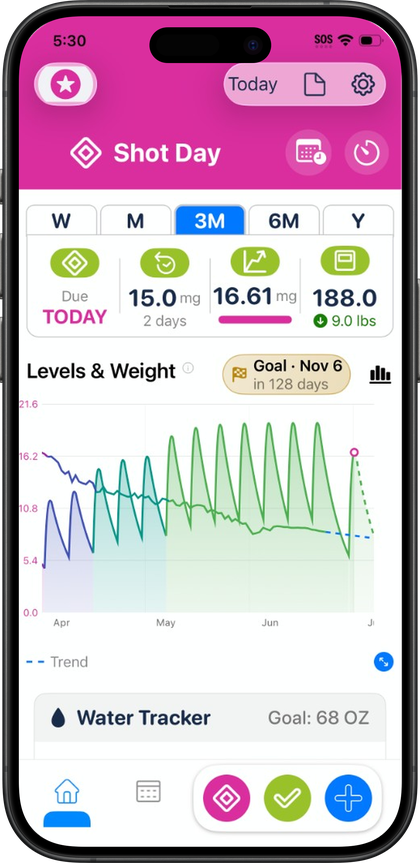
Ozempic is the brand name for semaglutide, a prescription GLP-1 receptor agonist made by Novo Nordisk. It is FDA-approved for adults with type 2 diabetes, not for weight loss on its own, which is a distinction worth getting right before anything else. Some people log Ozempic in Pokii for its approved diabetes, cardiovascular, and kidney effects; others track it off-label alongside their weight. Pokii is a GLP-1 shot tracker for iPhone and iPad that treats Ozempic as a built-in medication, with dose-titration charts, side-effect check-ins, and a weight overlay, so your own dosing history and check-ins sit next to each other over time without Pokii offering medical advice.
What Ozempic is approved to treat
Ozempic is available by prescription only and is FDA-approved for adults with type 2 diabetes for three purposes: improving blood sugar control alongside diet and exercise; reducing the risk of major adverse cardiovascular events (heart attack, stroke, or cardiovascular death) in adults with type 2 diabetes and known cardiovascular disease; and reducing the risk of worsening kidney disease, kidney failure, and cardiovascular death in adults with type 2 diabetes and chronic kidney disease, an indication the FDA added on January 28, 2025, making Ozempic the first GLP-1 receptor agonist approved for that specific combination.
In 2026, Ozempic's approved product line expanded beyond the injectable pen. The FDA approved Ozempic tablets, a 1.5 mg, 4 mg, and 9 mg oral semaglutide formulation, on February 4, 2026, with availability in US pharmacies starting May 4, 2026. The tablet is approved for blood sugar control in type 2 diabetes alongside diet and exercise, and for reducing the risk of major cardiovascular events in adults with type 2 diabetes at high risk for those events, a broader cardiovascular indication than the injection's, which requires an existing cardiovascular disease diagnosis. The tablet is a distinct product from Rybelsus, Novo Nordisk's earlier oral semaglutide sold in 7 mg, 14 mg, and 25 mg strengths; it is described as having improved bioavailability and carries the Ozempic name to signal the same molecule and core diabetes/cardiovascular use across the pen and the pill.
Neither Ozempic form, injection or tablet, is FDA-approved for chronic weight management, and there is no weight-loss indication on the Ozempic label. The FDA-approved semaglutide product for weight management is Wegovy, a separate injectable with its own approved dose range up to 7.2 mg per week, alongside a related oral weight-management product line. Ozempic, Wegovy, and Rybelsus share the same active ingredient but are distinct FDA-approved products with their own indications and dose ranges. Weight loss some people with type 2 diabetes experience while taking Ozempic is a secondary, observed effect of the drug class rather than an on-label claim, and using Ozempic specifically for weight loss, rather than for its diabetes, cardiovascular, or kidney indications, is off-label use. Pokii logs doses and weight as separate, clearly labeled data, so that distinction stays visible no matter why you're tracking it.
Labeled dosing schedule and device details
For the injectable pen, Ozempic's label describes a fixed titration pattern meant to ease the body into treatment; this is a factual description of the labeled schedule, not a recommendation, since actual dosing and pacing are set by a prescriber. Weeks 1 through 4 start at 0.25 mg once weekly, which the label describes as a treatment-initiation dose only, not intended to provide glycemic control on its own. Weeks 5 through 8 step up to 0.5 mg once weekly, the first maintenance dose. If additional glycemic control is needed, weeks 9 through 12 may increase to 1 mg once weekly, and week 13 onward may increase further to the maximum dose of 2 mg once weekly. Per the label, dose increases happen no more often than every 4 weeks, and a prescriber can slow or pause that schedule if gastrointestinal side effects are hard to tolerate.
The pen is a prefilled, disposable device, self-injected subcutaneously into the abdomen, thigh, or upper arm, with the injection site rotated each week. Needles are single-use, and pens are never shared, even with a new needle. Dosing is once weekly, on the same day each week, at any time of day, with or without food, though the injection day can be changed as long as the prior dose was at least two days earlier.
The new Ozempic tablet uses its own oral-specific titration across the 1.5 mg, 4 mg, and 9 mg strengths, taken on a separate schedule from the pen; it is a distinct formulation, not an oral version of a pen dose. The tablet's exact step-by-step titration wasn't independently confirmed for this article, so the specifics are best checked against its own prescribing information.
Common side effects and tracking dose changes
Per Ozempic's patient safety information, the most commonly reported side effects with the injection are nausea, vomiting, diarrhea, abdominal pain, and constipation, predominantly gastrointestinal, and reported more often when starting treatment or right after a dose increase. The tablet carries the same gastrointestinal list plus decreased appetite. Separately, Novo Nordisk flags less common but possible serious risks: thyroid tumors such as medullary thyroid carcinoma (contraindicated for anyone with a personal or family history of it or of Multiple Endocrine Neoplasia syndrome type 2), pancreatitis, diabetic retinopathy complications, hypoglycemia particularly alongside insulin or sulfonylureas, dehydration or kidney problems from GI fluid loss, gallbladder problems, serious allergic reactions, and aspiration risk during procedures requiring anesthesia. This isn't a complete safety listing; the full Prescribing Information and Medication Guide cover more.
Because gastrointestinal side effects tend to cluster around dose changes, seeing your own side-effect entries lined up against your actual dose history is useful context. Pokii's daily check-in lets you log side effects with an intensity rating per effect, along with appetite and mood, and those entries sit on the same timeline as your dose-titration chart and shot history, so you can see whether a rough week followed a step up in dose. Pokii's weight overlay works the same way: weight check-ins appear as points on your medication level chart, with a smoothed weight trend line and projected trajectory, so if you're among the people watching weight alongside an Ozempic prescription, you can view that trend next to your actual dosing rather than relying on memory. None of this is diagnostic. Pokii's projected medication-level curves are educational models, not lab results, and Pokii does not provide medical advice, diagnosis, or treatment.
What Pokii tracks for Ozempic specifically
Ozempic is one of Pokii's built-in medications, so it can be selected directly from Pokii's medication library instead of being set up as a custom drug profile. Because Pokii treats it as an injectable, Ozempic gets Pokii's injectable-specific logging: shot entries with date, time, dose, and notes and full edit history; an injection-site body map with rotation suggestions for the abdomen, thigh, and arm; and an optional pain slider on each logged shot. Ozempic doses also feed Pokii's projected medication-level chart, viewable in Combined mode across all your medications, Per Medication mode, or Per Compound mode, the last of which groups Ozempic with other semaglutide-based products, such as Wegovy or Rybelsus, under the same underlying molecule.
Pokii logs Ozempic with the standard projected-level chart, shot reminders, weight check-ins, weight points on the chart, dose-simulation and scheduler projections, full per-dose history, the weight trend line and projection, configurable PDF progress reports covering projected levels, weight, shots, injection sites, pain, and side effects together, and the Shot Progress home screen widget.
As with every medication in Pokii, it's worth being clear about what the app is and isn't: Pokii is a tracking and education tool, its projected medication-level curves are educational models rather than lab results, and it does not provide medical advice, diagnosis, or treatment.
Always follow your prescriber’s instructions for GLP-1 medications. Pokii helps you log and visualize your journey; it does not replace professional care.