Trackers by medication
Mounjaro Tracker App
Mounjaro is the brand name for tirzepatide, a prescription injectable that Eli Lilly first brought to market on May 13, 2022. It is a dual agonist of the GIP and GLP-1 receptors, and it is FDA-approved as an adjunct to diet and exercise to improve glycemic control in people with type 2 diabetes. Pokii is a shot-tracking app for iPhone and iPad built to help people on GLP-1 and GIP medications like Mounjaro log doses, follow a titration schedule, and keep a record of how their body responds over time, without offering medical advice.
What Mounjaro is approved to treat
As of the FDA label revised in January 2026, Mounjaro's indication covers adults and pediatric patients 10 years of age and older with type 2 diabetes mellitus, used as an adjunct to diet and exercise to improve glycemic control. That pediatric expansion is a recent change: it was added through Supplement 039, approved December 19, 2025. Before that update, Mounjaro's label applied to adults only. Mounjaro is not indicated for type 1 diabetes. The label also carries a boxed warning for the risk of thyroid C-cell tumors, based on findings in rodent studies whose relevance to humans has not been established, and Mounjaro is contraindicated in anyone with a personal or family history of medullary thyroid carcinoma or Multiple Endocrine Neoplasia syndrome type 2.
It is worth being precise about a common point of confusion: Mounjaro and Zepbound both contain tirzepatide as their active ingredient and are made by the same manufacturer, but they carry separate FDA approvals for different uses. Mounjaro is approved for glycemic control in type 2 diabetes. Zepbound is approved for chronic weight management in adults with obesity, or in adults who are overweight with at least one weight-related condition, and it is also approved for moderate-to-severe obstructive sleep apnea in adults with obesity. They are not interchangeable indications for the same molecule. Pokii reflects this distinction directly: Mounjaro, Zepbound, and Tirzepatide (Compound) are each listed as their own built-in medication, and because all three share the same active molecule, Pokii's Per Compound projected-levels display mode groups them together by molecule rather than by brand name when you want to see combined exposure across a switch.
Labeled dosing schedule and device options
The current FDA label specifies a fixed titration pattern for Mounjaro; this is informational and not a recommendation, since only a prescriber and the patient's own prescribing information should guide an individual's actual dosing. The label starts patients at 2.5 mg injected subcutaneously once weekly, a dose intended for treatment initiation and tolerability rather than for effective glycemic control. After 4 weeks, the label calls for an increase to 5 mg once weekly. From there, if additional glycemic control is needed, the label specifies further increases in 2.5 mg increments after at least 4 weeks on the current dose. The label sets different ceilings by age group following the December 2025 update: a maximum of 15 mg once weekly for adults, and a maximum of 10 mg once weekly for pediatric patients 10 years of age and older. Administration is once weekly, at any time of day, with or without meals.
On the device side, Mounjaro is a clear, colorless to slightly yellow, sterile solution supplied in three container types under the current label. Single-dose pens and single-dose vials are both available in six strengths — 2.5, 5, 7.5, 10, 12.5, or 15 mg per 0.5 mL. A newer multi-dose vial format is also on the label: a 2.4 mL vial delivering four doses, offered in six concentrations (10, 20, 30, 40, 50, or 60 mg per 2.4 mL) that each work out to four 2.5, 5, 7.5, 10, 12.5, or 15 mg doses at 0.6 mL per dose. The label specifies injection into the abdomen, thigh, or, if someone else is administering the shot, the back of the upper arm, with site rotation recommended for each weekly dose.
Common side effects and tracking dose changes
Per the FDA label, the most common adverse reactions reported in at least 5 percent of patients treated with Mounjaro are nausea, diarrhea, decreased appetite, vomiting, constipation, dyspepsia, and abdominal pain. The label also documents other warnings and precautions, including acute pancreatitis, hypoglycemia risk when Mounjaro is used together with an insulin secretagogue or insulin, serious hypersensitivity reactions such as anaphylaxis or angioedema, acute kidney injury related to volume depletion, severe gastrointestinal reactions (the label does not recommend Mounjaro in patients with severe gastroparesis), a risk of diabetic retinopathy complications progressing in those with an existing history of retinopathy, acute gallbladder disease, and a pulmonary aspiration warning during general anesthesia or deep sedation that was added in the December 2025 label update.
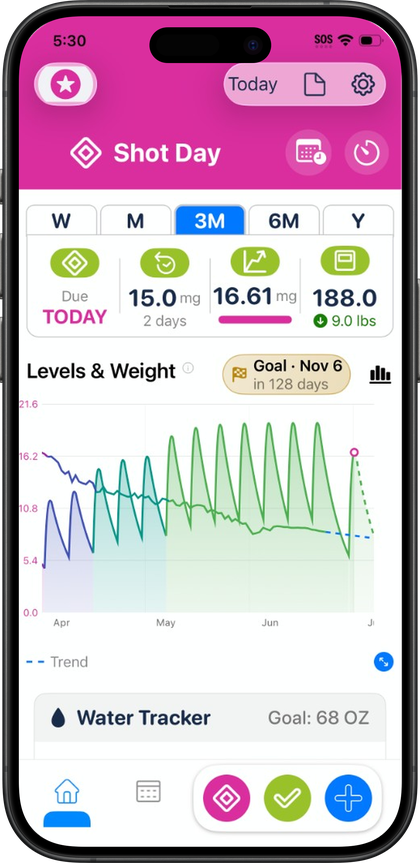
Because titration means the dose in use can change every few weeks, keeping the different strengths visually distinct over months of shots is genuinely useful. Pokii's charts support coloring by dose strength or by medicine, with user-chosen custom dose colors carried through to charts, widgets, and the dose picker, so a 2.5 mg starting phase looks visibly different from later 5, 7.5, or higher-strength weeks on the same timeline — this is a Pokii feature. Alongside that, Pokii's daily check-in includes a dedicated appetite slider next to mood and other optional side effects, with severity tracked per effect and notes attached; since decreased appetite is one of the label's commonly reported reactions, having it as its own check-in field rather than a generic tag makes it easier to see how it lines up with dose timing in your history. Appetite tracking itself is available in Pokii.
What Pokii tracks for Mounjaro specifically
Mounjaro is one of Pokii's built-in medications, so logging a shot means selecting it from the library rather than setting up a custom drug profile. Because it is injectable, Mounjaro shots get Pokii's injection site body map, showing front and back views with rotation settings and a suggested next site, plus an optional per-shot pain slider — oral medications skip these site and pain fields entirely. Shot tracking records date, time, medicine, dose, and notes with full edit history; per-medicine shot reminders; weight check-ins; the standard projected medication level chart for Mounjaro; and room-temperature timer presets with a countdown and alarm on the shot-day flow, which is relevant for a warmed pen like Mounjaro's before injecting.
You can follow Mounjaro alongside a second active medication during a switch to or from another GLP-1 or GIP treatment, with full per-dose dosage history, a shot scheduler with simulated-dose projections for planning ahead, and configurable PDF progress reports where you choose which sections to include — projected levels, shots, injection sites, pain, side effects, appetite, mood, and notes tied to Mounjaro's dose history. Throughout, Pokii's projected medication levels are described as an educational model rather than lab results, and Pokii's medical disclaimer is explicit that the app does not provide medical advice, diagnosis, or treatment. Mounjaro doses are logged in Pokii with iCloud sync.
Always follow your prescriber’s instructions for GLP-1 medications. Pokii helps you log and visualize your journey; it does not replace professional care.