Trackers by medication
Tirzepatide Tracker App
Tirzepatide is the active molecule behind Mounjaro and Zepbound, and it also shows up in compounded formulations from pharmacies and telehealth platforms. Because the same drug can arrive under several names and packaging, tracking it well starts with understanding what tirzepatide is, how the branded and compounded versions currently differ in availability, and how dosing and side effects tend to unfold over time. This page covers tirzepatide generically, across its forms, as background for anyone using Pokii to log shots, whichever version they're on.
What tirzepatide is
Tirzepatide is a synthetic peptide that works as a dual GIP/GLP-1 receptor agonist, meaning it activates both the glucose-dependent insulinotropic polypeptide (GIP) receptor and the glucagon-like peptide-1 (GLP-1) receptor. That dual mechanism sets it apart from single-target GLP-1 drugs like semaglutide or liraglutide. It's manufactured by Eli Lilly and dosed as a once-weekly subcutaneous injection.
The molecule has two FDA-approved branded forms, both made by Eli Lilly and using the identical active ingredient, sold under different names for different approved uses. Mounjaro was approved in May 2022 to improve blood sugar control in adults with type 2 diabetes, used alongside diet and exercise. Zepbound was approved in November 2023 for chronic weight management in adults with obesity, or who are overweight with at least one weight-related condition; an additional indication for moderate-to-severe obstructive sleep apnea was added in December 2024. Because Mounjaro and Zepbound share one active molecule, the dose strengths and injection mechanics behind them are structurally the same — they differ in labeled indication, not in how the drug works.
Tirzepatide also circulates in compounded forms, produced by compounding pharmacies rather than Eli Lilly. Whether a compounded version is currently available depends on a regulatory picture that has shifted substantially and is still moving.
Compounded tirzepatide: a narrower picture than it used to be
Compounded tirzepatide became widely available starting in late 2022, when Mounjaro and Zepbound were placed on the FDA's drug shortage list because demand outstripped Eli Lilly's supply. Under shortage conditions, compounding pharmacies and outsourcing facilities were permitted to produce copies of the drug to fill the gap.
That situation has changed. In October 2024, the FDA determined that Eli Lilly's supply could meet market demand and moved to resolve the shortage, a decision compounding-industry groups challenged. In December 2024, the FDA affirmed that decision, issuing a declaratory order and setting wind-down periods — roughly 60 days for state-licensed compounding pharmacies and physicians, about 90 days for larger 503B outsourcing facilities — to stop producing copies of the commercial product. Those deadlines have long since passed. Since early 2025, mass or routine compounding of tirzepatide as a copy of Mounjaro or Zepbound has not been broadly permitted; compounders generally cannot make essentially-copy versions once the reference drug is off the shortage list. What remains is a narrow, patient-specific exception, such as a documented allergy to an inactive ingredient in the FDA-approved product, or a need for a different dosage form.
The picture may narrow further still. On April 30, 2026, the FDA proposed permanently excluding tirzepatide, along with semaglutide and liraglutide, from the "503B Bulks List" — the list of bulk substances outsourcing facilities may use independent of shortage status, citing no clinical need for it. This is a proposal, not a final rule: the comment period closed June 29, 2026, and no final determination had been announced as of this writing. Reporting into mid-2026 indicates the FDA continues to scrutinize compounded GLP-1/GIP products on safety grounds, consistent with that proposal's direction.
The bottom line: tirzepatide is off the FDA shortage list, and routine compounding of it as a copy of Mounjaro or Zepbound isn't broadly permitted under current federal rules — only narrow, individualized exceptions remain, and even that pathway could tighten further depending on the pending 503B proposal. State rules and enforcement can vary, and this is a fast-moving area. Anyone using or considering a compounded tirzepatide product should check current status directly with a pharmacist or prescriber rather than assume availability, and discuss whether transitioning to FDA-approved Mounjaro or Zepbound makes sense for their situation.
Dosing patterns and common side effects
The following describes the general dosing structure listed in FDA labeling for the branded products. It's general product information, not a personalized recommendation — actual dosing should always follow a clinician's direction.
Mounjaro and Zepbound are both injected subcutaneously once weekly, on the same day each week, independent of meals. The labeled starting dose for both is 2.5 mg once weekly, which functions as an initiation step rather than an effective treatment dose. From there, dosing typically steps up in 2.5 mg increments no sooner than every four weeks, following a ladder of 2.5 mg, 5 mg, 7.5 mg, 10 mg, 12.5 mg, and 15 mg, up to a labeled maximum of 15 mg weekly. Of those, 5 mg, 10 mg, and 15 mg are studied and labeled as maintenance doses, while 2.5 mg, 7.5 mg, and 12.5 mg are escalation steps along the way. Prescribers can adjust the pace of titration based on how someone responds.
The most commonly reported side effects are gastrointestinal and tend to track dose changes: nausea, diarrhea, vomiting, constipation, abdominal discomfort, decreased appetite, injection site reactions, fatigue, and in some reports indigestion or belching. These are generally mild to moderate, most noticeable around dose increases, and tend to ease over time. FDA labeling also carries a boxed warning about thyroid C-cell tumors seen in rodent studies, with relevance to humans undetermined, and flags risks including pancreatitis, gallbladder problems, hypoglycemia (particularly alongside insulin or sulfonylureas), acute kidney injury often tied to GI-related dehydration, and hypersensitivity reactions. This isn't an exhaustive safety list; full prescribing information should be consulted for complete warnings.
Why pain-per-shot and dose projections matter during titration
Because side effects and injection experience often shift right around each dose increase, the weeks around a titration step are when small patterns are worth catching. Logging how much a given shot hurt, alongside where on the body it was injected, can surface patterns over several cycles — whether certain sites are consistently more uncomfortable, or whether pain trends up or down as the dose changes. That's harder to reconstruct from memory weeks later.
Simulated dose projections serve a related purpose: they let someone preview what an upcoming dose or dose change would look like on their projected medication-level curve before it's logged, useful for thinking through a planned titration step or a switch between products sharing the same molecule. Because the curve is an educational model rather than a measurement of anything happening in the body, it's a planning aid, not a substitute for guidance from a prescriber.
What Pokii tracks for tirzepatide
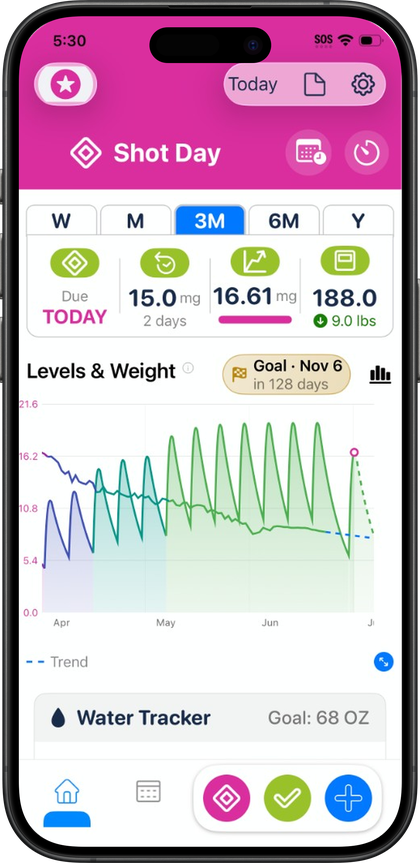
Pokii's built-in medication library treats tirzepatide's different forms as distinct entries — Mounjaro, Zepbound, and Tirzepatide (Compound) all appear separately, alongside other GLP-1 and GIP medicines. Because they share the same active molecule, Pokii's projected-levels chart includes a Per Compound display mode that groups all of them onto one curve, in addition to Combined and Per Medication views — useful for anyone who has switched between a compounded product and Mounjaro, or between Mounjaro and Zepbound.
For a compounded formulation or dose that doesn't match the built-in "Tirzepatide (Compound)" entry, You can add a custom medication profile with an oral or injectable toggle, half-life, Tmax, bioavailability, and a choice of whether to include it on the projected-level chart.
Standard tracking applies no matter which form someone is on: shot logging with date, time, dose, and notes; an injection site body map with an optional pain slider for injectable doses; shot reminders; room-temperature timer presets; daily check-ins for side effects, appetite, and mood; and weight tracking with a chart overlay. The calendar tab shows shots, check-ins, photos, weight, and other entries in month or list view, so a full titration cycle is visible at a glance. Custom medications, simulated dose projections, full chart customization, PDF progress reports, and full dosage history are built in — relevant for anyone tracking a transition between a compounded product and an FDA-approved one, since that involves two medication entries. As with all projected data in Pokii, medication-level curves are an educational model, not lab results, and Pokii doesn't provide medical advice, diagnosis, or treatment.
Always follow your prescriber’s instructions for GLP-1 medications. Pokii helps you log and visualize your journey; it does not replace professional care.