Trackers by medication
Compounded Semaglutide Tracker
Compounded semaglutide is a version of semaglutide prepared by a compounding pharmacy rather than manufactured by the original drugmaker, typically dispensed as a multi-dose vial rather than a pre-filled pen. During the 2022-2024 nationwide shortage of injectable semaglutide, pharmacies could compound near-copies of the drug under FDA shortage exceptions, and compounded product became widely available. That legal basis has since narrowed considerably, and anyone using or considering a compounded product should understand where things stand today before assuming it is available the way it once was. This page covers the current regulatory picture, the practical tracking differences between a compounded vial and a branded pen, the reported side effects, and how Pokii's custom-medication tools handle the messier logging that vial-based dosing involves.
Where things stand today
The FDA determined that the injectable semaglutide shortage was resolved on February 21, 2025. Once a drug is no longer on the FDA's shortage list, pharmacies generally lose the shortage-based exception that let them compound near-copies of it. The FDA set grace periods to wind down compounding after that determination, and those grace periods expired April 22, 2025 for state-licensed 503A compounding pharmacies and May 22, 2025 for 503B outsourcing facilities.
The rules have tightened further since then. On April 30, 2026, the FDA proposed removing semaglutide, tirzepatide, and liraglutide from the 503B bulks list entirely, a step that would close off large-scale outsourcing-facility compounding of these drugs. A public comment period on that proposal ran through June 29, 2026, and as of this writing the FDA had not issued a final determination.
Under longstanding FDA guidance, 503A pharmacies, meaning state-licensed pharmacies compounding for an individual named patient with a prescription, are not blanket-banned from compounding semaglutide, but they generally may not compound a drug that is essentially a copy of a commercially available product except in narrow, documented cases, such as a verified allergy to an inactive ingredient in the FDA-approved product or a clinically justified dose or form the commercial product does not offer. Routine or bulk compounding simply because a shortage has ended is not permitted. Despite that, multiple 2026 reports describe compounded semaglutide and tirzepatide as still circulating through some 503A pharmacies and telehealth platforms, even though the broad legal basis that made mass compounding common in 2022-2024 has ended.
The practical takeaway is that compounded semaglutide is not broadly or routinely available the way it was during the shortage years. Where it remains legally available at all, it is generally limited to a 503A pharmacy compounding for a specific patient with a documented medical need, not simply cost or convenience, and the 503B pathway is actively being closed off pending the FDA's final rule. Availability varies by state, pharmacy, and prescriber, and the rules are still changing. Talk to your pharmacist or prescriber about current availability and whether a compounded product is appropriate and legal for your situation before starting or continuing one; this page is background information, not medical or legal advice.
Why a compounded vial tracks differently than a pen
FDA-approved semaglutide pens, like Ozempic and Wegovy, ship in fixed, pre-set dose increments, so you dial or click to a set amount and the tracking is simple. Compounded semaglutide is typically dispensed differently, as a multi-dose vial at a pharmacy-specific concentration, meaning the patient or caregiver draws up a specific volume with a syringe for each injection.
That setup creates tracking realities a pen user never deals with. Concentration varies by pharmacy and batch, so there is no single standard strength, and the same milligram dose can correspond to a different injection volume depending on where it was compounded. Dosing itself is calculated rather than pre-set, since patients typically convert a prescribed milligram amount into a syringe unit or milliliter volume based on the vial's labeled concentration, which introduces room for error. The FDA has specifically flagged dosing-error adverse events tied to this exact workflow. On top of that, titration schedules for compounded regimens are often custom, following non-standard steps rather than the fixed dose ladder built into an FDA-approved pen.
Because of all this, logging the exact dose taken rather than just noting that a shot happened, and being able to define a custom medication profile, matter more for someone using a compounded product than for someone on a fixed pen dose.
Common side effects
Compounded semaglutide is intended to deliver the same active molecule as FDA-approved semaglutide products such as Ozempic, Wegovy, and Rybelsus, so the commonly reported side-effect profile is generally similar: nausea, vomiting, diarrhea, constipation, decreased appetite, abdominal pain, and injection-site reactions are the most frequently reported. Because compounded formulations are not FDA-reviewed for safety, quality, or effectiveness, and may contain different salt forms, added ingredients such as vitamin B12, or impurities compared with the approved product, individual experience can differ and is not guaranteed to match clinical-trial data for the branded drug. This is general background rather than a personalized safety assessment, so discuss any symptoms with your prescriber.
What Pokii tracks for compounded semaglutide
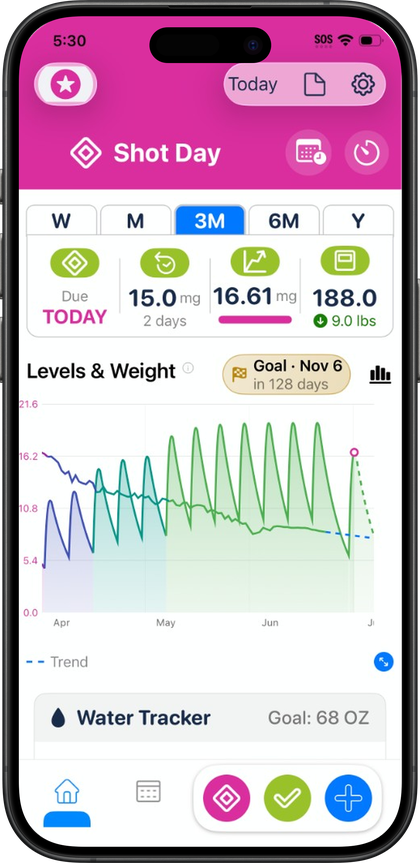
Pokii includes Semaglutide (Compound) in its built-in medication library alongside Tirzepatide (Compound) and branded GLP-1 and GIP medicines, so it is selectable without manual setup for the patients who do have a legitimately prescribed compounded product. On Pokii's projected-levels chart, a Per Compound display mode groups branded and compounded entries by molecule, so you can see a compounded semaglutide entry modeled alongside how the same active ingredient behaves under brand names.
For a compounded product that does not match the built-in profile, such as a different concentration, titration schedule, or formulation from your pharmacy, Pokii lets you add a custom medication with its own half-life, Tmax, bioavailability, an oral toggle, and a choice of whether it appears on the level chart. That flexibility exists specifically for cases where a compounding pharmacy's formulation does not map cleanly to a standard entry. Every shot, whatever the medication, is logged with date, time, medicine, dose, and notes, with full edit history, which supports the exact-dose logging that calculated, vial-based dosing requires. Injectable compounded semaglutide logs also get the same injection-site body map and optional pain slider as branded injectables.
If you are switching from another tracking method, Pokii supports CSV import as well as import from Pokii JSON backups and Shotsy exports, so existing dose history does not have to be re-entered by hand. You can track multiple active medications at once, including custom medications, dose simulation, and full dosage history. As with every entry in Pokii, projected levels for a compounded semaglutide medication are an educational model based on user-entered or default PK parameters. Pokii does not verify a compounding pharmacy's actual formulation, potency, or purity, and it does not verify legal availability or prescription validity. It is a tracking tool for a dose you have already been prescribed and dispensed, not a way to find or obtain compounded product.
Always follow your prescriber’s instructions for GLP-1 medications. Pokii helps you log and visualize your journey; it does not replace professional care.