Trackers by medication
Semaglutide Tracker App
Semaglutide is the active molecule behind several FDA-approved medications sold under different brand names, plus a narrower category of pharmacy-compounded versions. Whether you're on Ozempic, Wegovy, Rybelsus, one of the newer oral tablets, or a compounded formulation prescribed by your provider, you're taking the same underlying drug at different doses and in different forms. Pokii is a GLP-1 shot and wellness tracker built to follow you across all of them, so this page covers what semaglutide is, where compounded versions currently stand legally, how dosing typically works across the branded products, and what Pokii specifically tracks for semaglutide users.
What semaglutide is and its FDA-approved forms
Semaglutide is a GLP-1 (glucagon-like peptide-1) receptor agonist developed by Novo Nordisk. It mimics the incretin hormone GLP-1, which slows gastric emptying, increases insulin secretion, and reduces appetite. As of mid-2026, semaglutide is sold in the U.S. under five distinct FDA-approved brand names, all containing the same molecule but differing by dose, route, and indication.
Ozempic is a once-weekly subcutaneous injection approved for type 2 diabetes glycemic control and to reduce cardiovascular risk in adults with type 2 diabetes at elevated risk. Wegovy is a once-weekly subcutaneous injection approved for chronic weight management and cardiovascular risk reduction; in 2026 the FDA also approved a higher-dose Wegovy HD (7.2 mg) injection under an accelerated review pathway for patients who have already tolerated the standard 2.4 mg maintenance dose. Rybelsus is the original oral tablet, approved since 2019 for type 2 diabetes, and is being phased out in favor of a newer product, though it may still be prescribed during the transition. That newer product is Ozempic (semaglutide) tablets, a next-generation, higher-bioavailability oral tablet approved by the FDA in February 2026 and available nationwide since May 2026, which Novo Nordisk has said is replacing Rybelsus for type 2 diabetes going forward. Separately, the Wegovy pill, an oral 25 mg formulation approved in December 2025 and launched in early 2026, became the first oral GLP-1 receptor agonist approved for chronic weight management, distinct in dose and indication from both the injectable Wegovy and the Ozempic/Rybelsus tablets. This is a meaningful shift from the pre-2025 landscape, when Ozempic, Wegovy, and Rybelsus were the only three branded forms.
Compounded semaglutide: the current, narrower reality
Compounded semaglutide, prepared by licensed pharmacies rather than manufactured by Novo Nordisk, was widely available during the 2022 to 2024 nationwide shortage. That landscape has changed significantly, and it's worth understanding where things actually stand rather than assuming compounded semaglutide is still a routine, broadly available option.
The FDA determined the semaglutide injection shortage was resolved on February 21, 2025. That started the clock on ending the shortage-based exemptions that had allowed broad compounding. The enforcement-discretion period that had let state-licensed 503A pharmacies and physicians compound copies of semaglutide ended April 22, 2025, and the corresponding period for 503B outsourcing facilities ended May 22, 2025. As of the FDA's April 1, 2026 update, semaglutide does not appear on either the drug shortage list or the 503B bulks list, meaning outsourcing facilities generally cannot lawfully compound it from bulk material for general distribution. The regulatory door is tightening further: on April 30, 2026, the FDA formally proposed excluding semaglutide, along with tirzepatide and liraglutide, from the 503B bulks list altogether, citing no clinical need for bulk compounding. That proposal's public comment period closed June 29, 2026, and as of this writing the FDA has not issued a final determination.
Narrow exceptions remain. State-licensed 503A pharmacies can still compound semaglutide for an individual patient with a valid prescription in limited circumstances, chiefly when a prescriber documents a genuine clinical difference from the commercial product for that specific patient, or in small volumes. Combination products, such as semaglutide paired with B12, may still be treated as an impermissible copy of an approved drug if they're within 10% of the approved strength and use the same route of administration. The FDA has also issued warning letters to telehealth companies and compounding pharmacies over marketing that implies equivalence between compounded and FDA-approved semaglutide. In short, mass-market compounded semaglutide is no longer broadly legal the way it was during the shortage; narrow, individualized compounding may still be available in specific documented cases, and the rules are continuing to evolve. If you're considering a compounded product, check current availability and legality with a pharmacist or your prescriber rather than assuming it works the way it did a few years ago.
Dosing patterns and common side effects
Dosing details below reflect FDA-approved labeling and public dosing guides; they describe how these products are generally titrated, not a recommendation for any individual. Ozempic injections start at 0.25 mg once weekly for four weeks as an initiation dose, then typically increase to a 0.5 mg maintenance dose, with further increases to 1 mg or 2 mg weekly spaced no more often than every four weeks. The new Ozempic oral tablets are dosed once daily at 1.5 mg, 4 mg, or 9 mg, with lower absolute numbers than Rybelsus reflecting the reformulation's improved absorption. Rybelsus itself starts at 3 mg daily for 30 days, then steps up to 7 mg and, if needed, 14 mg daily. Wegovy injections titrate from 0.25 mg weekly up through 0.5 mg, 1 mg, and 1.7 mg to a 2.4 mg maintenance dose over roughly 16 weeks, and Wegovy HD can escalate further toward a 7.2 mg weekly dose for patients who've already tolerated 2.4 mg for at least four weeks. The Wegovy pill follows its own once-daily titration up to a 25 mg maintenance dose. Across every branded form, titration exists mainly to improve gastrointestinal tolerability, and the specific schedule is set by the prescriber against the current label.
The most commonly reported side effects across all semaglutide forms are gastrointestinal: nausea, vomiting, diarrhea, constipation, and abdominal discomfort, with frequency generally rising at higher doses. All semaglutide products carry an FDA boxed warning for thyroid C-cell tumor risk seen in rodent studies, and the drug is contraindicated for anyone with a personal or family history of medullary thyroid carcinoma or Multiple Endocrine Neoplasia syndrome type 2. Other labeled risks include pancreatitis, gallbladder problems, acute kidney injury, diabetic retinopathy complications, and hypoglycemia when combined with insulin or sulfonylureas. This is general labeling information, not medical advice; the current prescribing information for your specific product is the reference for a complete list.
Why tracking matters when forms and strengths vary
Because semaglutide now spans five distinct branded products, plus compounded variants, at different strengths, routes, and titration schedules, it's easy to lose track of exactly what you took, when, and how your dose has changed, especially if you've switched products, such as moving from Rybelsus to Ozempic tablets or from a standard injectable to a higher-strength version. Titration schedules also mean your dose changes over the first several weeks or months, which makes a simple log of "current dose" less useful than a running history tied to dates. Side effects can shift as doses increase, so a record that lines up symptoms with the specific dose and product you were on at the time helps you and your prescriber see patterns rather than relying on memory.
What Pokii supports for semaglutide
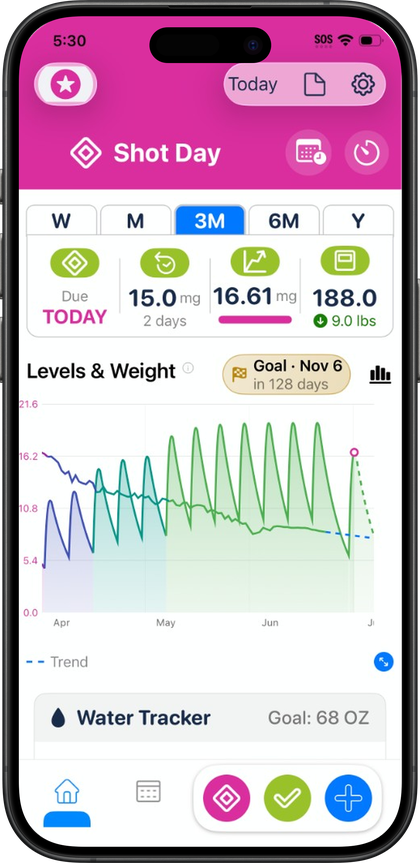
Pokii's built-in medication library lists semaglutide-molecule products as separate, named entries rather than one generic "semaglutide" item: Wegovy, Wegovy Pill, Ozempic, Rybelsus, and Semaglutide (Compound) for compounded or generic tracking. Pokii's projected-levels chart offers a Per Compound display mode, alongside Combined and Per Medication views, which groups these separate brand entries by their shared underlying molecule so you can see semaglutide as one continuous picture even if you've switched brands or forms along the way.
For products not yet reflected as distinct built-in entries, such as Wegovy HD or a personalized compounded formulation, you can add custom medications with their own pharmacokinetic fields, including half-life, Tmax, bioavailability, and an oral toggle, plus the option to show them on the chart. You can track multiple semaglutide products at once, useful if you're switching from Rybelsus to Ozempic tablets or tracking a compounded product alongside a branded one. Shot tracking, reminders, and injection-site mapping apply to injectable forms like Ozempic and Wegovy, while oral forms such as Rybelsus, the Wegovy pill, and Ozempic tablets skip injection-site and pain fields since they don't apply. Daily check-ins log side effects, appetite, and mood alongside your dose history, and reminders help you stay on schedule as your titration changes over time. As with all Pokii charts, projected semaglutide levels are an educational model, not a lab result or medical advice.
Pokii is a tracking and education tool. It does not provide medical advice, diagnosis, or treatment. Talk with your clinician about dosing, side effects, and any change to your plan.