Trackers by medication
Compounded Tirzepatide Tracker
Compounded tirzepatide is a pharmacy-prepared version of the same active molecule sold under the brand names Mounjaro and Zepbound, made by a compounding pharmacy or outsourcing facility rather than by the manufacturer, Eli Lilly. Its legal footing has changed a lot since the 2022–2024 shortage years that made it widely available, and as of mid-2026 it is only lawfully available to a much narrower group of patients under specific medical-necessity circumstances. This page lays out where things currently stand, factually and conservatively, and then focuses on what Pokii actually offers: for the people who do have a legitimately prescribed compounded product, custom-medication tracking that handles the vial concentrations, custom draw volumes, and non-standard dosing schedules a compounded product involves — tracking needs that a fixed-dose branded pen simply doesn't have.
Where compounded tirzepatide stands today
Tirzepatide is FDA-approved only as Mounjaro (type 2 diabetes) and Zepbound (chronic weight management), sold as pre-filled pens and, in limited strengths, single-dose vials. Compounded tirzepatide is a different, unapproved product. Mass compounding of it was only ever legal on a temporary basis, while tirzepatide sat on FDA's official drug shortage list, which began in December 2022.
In its December 19, 2024 Declaratory Order, the FDA determined that the tirzepatide injection shortage was resolved and removed tirzepatide from the shortage list. Because litigation was pending, the FDA allowed a limited transition window: state-licensed 503A pharmacies and physicians could keep compounding tirzepatide through February 18, 2025, and 503B outsourcing facilities (which supply much of the compounding sold at scale, including many telehealth brands) through March 19, 2025. After those dates, the shortage-based legal basis that had allowed compounding a copy of an approved drug no longer applied.
As of July 2026, 503B outsourcing facilities have had no shortage-based basis to compound tirzepatide since March 2025, and on April 30, 2026 the FDA went further, proposing to formally exclude tirzepatide (along with semaglutide and liraglutide) from the 503B "bulks list" entirely, on a finding of no clinical need. If finalized, that would close off large-scale 503B compounding going forward; the public comment period ran through June 29, 2026, and it is not yet confirmed whether a final rule has been issued. 503A compounding pharmacies no longer have a shortage-based exemption either. What remains is a narrow, exception-based pathway: compounding tied to documented individual medical necessity, such as a verified allergy or intolerance to an inactive ingredient in the approved pen or vial, or another prescriber-documented clinical reason the approved product won't work for that specific patient. Compounding purely for cost, convenience, or because a particular dose isn't sold does not qualify under this framework.
In short, compounded tirzepatide has gone from broadly available during the shortage to narrow and exception-based today. Whether it's available to any given person depends on documented medical necessity, the pharmacy's licensing, state law, and the outcome of FDA's still-pending rulemaking. This is a fast-moving legal area — talk to your pharmacist or prescriber about current availability rather than assuming it based on how things worked in 2023 or 2024.
Why tracking a compounded dose looks different from tracking a pen
For the narrower group who do have a lawfully compounded product, it's typically dispensed very differently from Mounjaro or Zepbound. Branded pens are pre-filled and fixed-dose — 2.5 mg, 5 mg, 7.5 mg, and so on, set by the manufacturer and the pen mechanism, so there's nothing to calculate. Compounded tirzepatide, by contrast, is usually a multi-dose vial at a pharmacy-specific concentration, drawn up with a syringe to whatever volume corresponds to the intended dose.
Because concentration and fill volume aren't standardized across compounding pharmacies, the same numeric dose can mean a different injection volume from one vial or pharmacy to the next, and titration steps are often set individually by the prescriber or pharmacy rather than following a fixed manufacturer schedule. That's the core reason tracking needs to change for this group: what matters is logging the actual dose in milligrams, along with the specific vial and volume it came from, not just counting clicks on a pen. A tracker built only around fixed pen strengths misses the reality of vial-and-syringe dosing.
Side effects, and why injection-pain tracking matters more here
Compounded tirzepatide is intended to deliver the same active molecule as Mounjaro and Zepbound, so the general side-effect profile reported for the branded drugs is generally expected to apply: nausea, diarrhea, vomiting, constipation, injection-site reactions, decreased appetite, and other gastrointestinal effects. But compounded products aren't FDA-reviewed for a specific formulation, purity, or stability, and may include different inactive ingredients or additives — some marketed compounded blends add things like vitamin B12, glycine, or niacinamide. Because of that, the actual safety and side-effect profile in practice isn't guaranteed to match the approved product exactly. Discuss side effects and any additives with your prescriber or pharmacist; this page isn't medical advice.
Injection-site reactions and pain are part of that side-effect picture, and they're worth logging carefully for anyone drawing doses from a vial, where injection routine, needle handling, and site rotation can vary more than with a pen. Pokii's injectable shot logs include an optional pain slider and an injection-site body map, so you can see over time whether pain trends with a particular site, dose, or vial — useful context to bring to a prescriber if something feels off.
What Pokii tracks for a legitimately prescribed compounded product
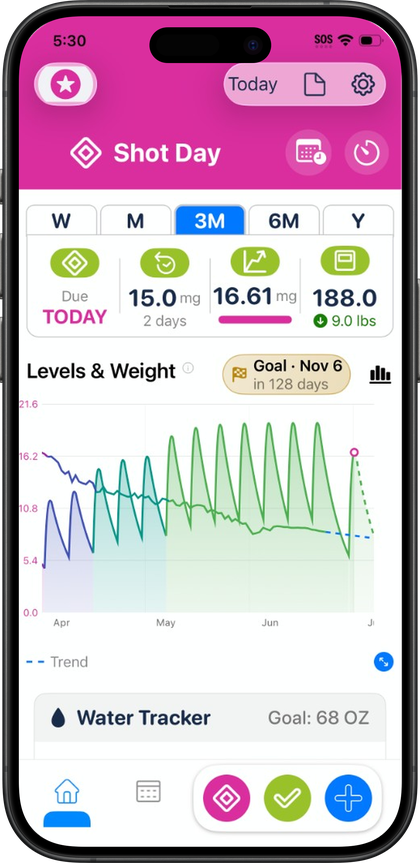
Pokii's medication library includes "Tirzepatide (Compound)" as a built-in entry, grouped with branded tirzepatide products like Zepbound and Mounjaro under Pokii's "per compound" chart mode, which shows projected levels by molecule rather than by brand name. For anyone whose compounded product needs more detail than that, Pokii's custom medications feature lets you set up a drug profile with its own pharmacokinetic fields — half-life, Tmax, bioavailability, an oral-vs-injectable toggle, and whether to include it on the projected-level chart — so a compounded formulation can be modeled on its own terms rather than assumed to behave exactly like the branded pen.
Every shot is logged with date, time, medicine, dose, and notes, with full edit history, which fits the variable-volume, non-pen reality of vial-based dosing better than a system built only around fixed pen clicks. Flexible shot schedules — per-medicine intervals or specific weekdays, per-weekday doses, and custom next-shot dates — accommodate a titration schedule that a compounding pharmacy or prescriber has set individually rather than a fixed manufacturer ladder. You can also assign custom dose colors and review full per-dose history, which is useful when a compounded dose changes as vial concentration or prescribed volume changes over time.
Pokii labels projected medication levels as an educational model, not a lab result — a distinction that matters even more for a compounded entry, since the underlying formulation and purity aren't FDA-verified the way a branded pen's are. Pokii doesn't verify, endorse, or guarantee the legality, safety, or sourcing of any compounded medication a user logs; it's a tracking and charting tool, and confirming that a specific compounded product is currently lawful and appropriate is between you, your pharmacist, and your prescriber.
Given how inconsistent compounded supply has become, keeping a reliable history matters more than it used to — if you switch pharmacies, concentrations, or products, your dose and side-effect log is what carries the continuity. Pokii's data syncs via iCloud, and you can also export a full backup as a Pokii JSON file or restore from a previous backup, so your history isn't tied to a single device or lost if your compounding source changes.
Pokii is a tracking and education tool. It does not provide medical advice, diagnosis, or treatment. Talk with your clinician about dosing, side effects, and any change to your plan.