Trackers by medication
Retatrutide Tracker (Research & Custom Meds)
Retatrutide is one of the most closely watched drugs in obesity and metabolic research right now, but it's important to be clear from the outset: as of July 21, 2026, retatrutide is not FDA-approved. It remains an investigational medication being studied in Eli Lilly's Phase 3 TRIUMPH clinical trial program, with no approved brand name, no approved indication, and no legal prescription pathway in the United States outside of a clinical trial. Recent Phase 3 readouts have generated genuine excitement in the field, and Pokii already lists Retatrutide in its medication library so that people who are legitimately accessing it through research channels can track it alongside everything else in their routine. This page covers what the drug is, what the trial data actually shows, the real access picture, and how Pokii can help if you're already tracking it.
What retatrutide is, and why it isn't approved yet
Retatrutide is a once-weekly injectable drug that activates three separate hormone receptors at once: GIP, GLP-1, and glucagon. That "triple agonist" mechanism is what distinguishes it from single-target drugs like semaglutide (GLP-1 only) and dual-target drugs like tirzepatide, the active ingredient in Mounjaro and Zepbound. Researchers are studying whether adding a glucagon-receptor effect to the GIP/GLP-1 combination produces greater metabolic effects than a dual agonist alone, which is part of why retatrutide is often described as a potential successor to tirzepatide.
Retatrutide is being developed by Eli Lilly and is currently in Phase 3 testing under the TRIUMPH clinical trial program. It has no FDA approval, no approved brand name, and no approved use for weight loss, diabetes, or any other condition. Phase 3 trials have begun reporting positive topline results — TRIUMPH-4 in December 2025 and TRIUMPH-1 in May 2026 — but a positive topline readout is not the same as regulatory approval. Lilly still needs to complete its Phase 3 program, submit a New Drug Application to the FDA, and go through FDA review before retatrutide could become an approved, prescribable medication. None of that has happened yet.
The trial results so far: TRIUMPH-1 and TRIUMPH-4
TRIUMPH-1 (NCT05929066) enrolled 2,339 adults with obesity or overweight and at least one weight-related health condition, excluding people with diabetes. Topline results announced May 21, 2026 showed average weight loss at 80 weeks of 19.0% on the 4 mg dose, 25.9% on the 9 mg dose, and 28.3% on the 12 mg dose. In a 104-week blinded extension among participants with a starting BMI of 35 or higher, the 12 mg group averaged 30.3% weight loss, and 45.3% of that group lost at least 30% of their body weight — a level historically associated with bariatric surgery. These are meaningful numbers, but they came with dose-related side effects: nausea affected up to 42.4% of the 12 mg group versus 14.8% on placebo, along with diarrhea, constipation, and vomiting, and the rate of people stopping the drug due to side effects rose from 4.1% at the 4 mg dose to 11.3% at the 12 mg dose.
TRIUMPH-4 studied adults with obesity or overweight who also had knee osteoarthritis, again excluding people with diabetes. Its topline results, announced in December 2025, showed average weight loss of up to 28.7% — about 71.2 pounds, or 32.3 kilograms — at 68 weeks on the two highest doses tested, 9 mg and 12 mg. Participants also saw an average 75.8% reduction in WOMAC knee pain scores, along with improvements in cardiometabolic markers such as non-HDL cholesterol and systolic blood pressure. Lilly has said it expects up to seven more Phase 3 readouts across 2026 covering type 2 diabetes, cardiovascular disease, sleep apnea, chronic low back pain, and fatty liver disease, though none of those results had been reported as of this review.
It's worth underscoring that all of these figures come from manufacturer press releases and topline summaries, not from FDA-reviewed labeling or peer-reviewed publication — Lilly has indicated the detailed data is intended for presentation at a scientific conference rather than a published paper so far. Treat these as genuinely newsworthy research findings, not as a substitute for approved prescribing information, because no such information exists yet.
The access reality: clinical trials, not a pharmacy shelf
Because retatrutide has no FDA approval, no approved drug product, and no USP monograph, there is currently no legal pathway for a licensed U.S. pharmacy to compound it, and it does not appear on the FDA's list of bulk drug substances eligible for compounding. Industry reporting indicates the Alliance for Pharmacy Compounding has told member pharmacies that compounding retatrutide is not legally authorized.
In practice, products labeled "retatrutide" are sold online by peptide and research-chemical vendors, almost always marked "research use only" or "not for human consumption." These products are not manufactured under FDA current Good Manufacturing Practice standards, are not subject to FDA premarket safety, purity, or potency review, and are not dispensed by a licensed pharmacist against a valid prescription. Their actual contents, dosing accuracy, and sterility are unverified. This is a documented part of the retatrutide landscape, but it is not something this page encourages or provides guidance on — sourcing a self-injected compound this way carries meaningful, unquantified safety and legal risk.
The only clearly lawful ways to receive retatrutide today are enrollment in an active Lilly-sponsored clinical trial, or, in narrow circumstances, an FDA expanded-access pathway administered by the drug's sponsor. If neither applies to you, the honest answer is that there isn't yet a legitimate retail or prescription path to retatrutide in the United States — that depends on Lilly finishing its Phase 3 program and the FDA completing its review, a process that has not concluded.
What Pokii supports if you're already tracking retatrutide
For people who are legitimately accessing retatrutide, most often through participation in a clinical trial, Pokii already lists Retatrutide as a built-in medication in its library, alongside other branded and compound GLP-1/GIP entries like Zepbound, Wegovy, Mounjaro, Ozempic, and compounded tirzepatide and semaglutide. That means you can select it directly when logging a dose instead of building an entry from scratch.
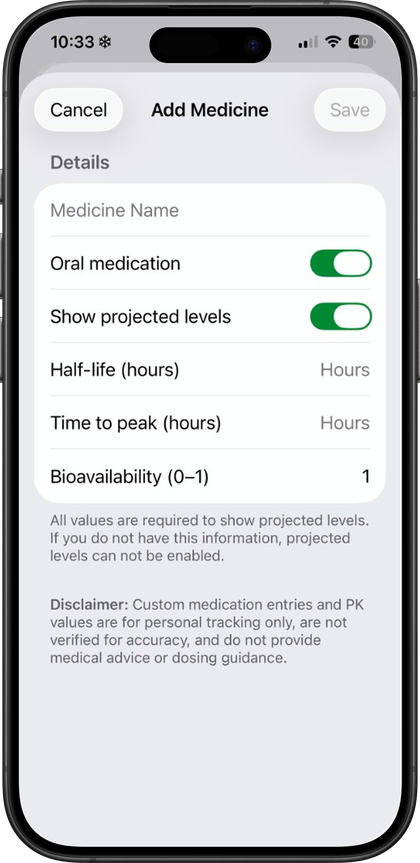
Because retatrutide sits outside the normal FDA-approved product landscape, Pokii's support for it fits into the app's broader custom and research medication tracking. Pokii lets you create fully custom drug profiles with an oral-versus-injectable toggle, half-life, Tmax, bioavailability, and a setting for whether the compound should appear on the projected medication-level chart — the same tools the app offers for compounded or research-sourced GLP-1 and GIP products generally.
Day to day, retatrutide works the same way in Pokii as any other medication: shot tracking with date, time, dose, and notes per dose, plus an injection site body map; a projected medication-level chart that models expected levels between doses as an educational tool, not a lab result; and daily check-ins for side effects, appetite, and mood, alongside weight tracking. Pokii is a tracking and education tool — it does not provide medical advice, diagnosis, or treatment, and it does not offer dosing guidance for retatrutide or any other medication. You can track multiple active medications and build full custom-PK medication profiles, including for research compounds like retatrutide.
Always follow your prescriber’s instructions for GLP-1 medications. Pokii helps you log and visualize your journey; it does not replace professional care.