Side effect guides
Injection Site Reactions and Pain Tracking
Redness, a little swelling, or soreness where you injected is one of the most common things people notice while starting a GLP-1 or GIP medication, and for most people it fades on its own within a day or two. Knowing what counts as ordinary irritation, why rotating your injection site matters, and when a reaction is worth a call to your prescriber can take a lot of the guesswork out of shot day. Pokii's injection site body map and pain-per-shot tracking are built to help you notice patterns at a glance, without trying to diagnose anything for you.
Common injection site reactions
Mild redness, swelling, and soreness or discomfort right at the injection site are described in manufacturer patient materials for GLP-1 and GIP injectables in general terms, and these reactions are typically mild and self-limiting. A little bleeding at the injection site can also happen; Novo Nordisk's official Ozempic patient guidance simply instructs pressing the area lightly with a gauze pad or cotton ball, and not rubbing it.
Mild bruising at the needle entry point is common and expected with subcutaneous injection generally. Zepbound's official Instructions for Use describes seeing a drop of liquid or blood on the skin after injecting as normal, which is consistent with the kind of light bruising many people notice after a shot.
Injection site reactions are also a recognized, labeled adverse reaction for this drug class, even though they aren't among the most frequently reported effects overall (gastrointestinal effects like nausea are more common). Mounjaro's FDA-approved prescribing information reports injection site reactions in 3.2% of Mounjaro-treated patients in placebo-controlled trials, compared with 0.4% on placebo, and notes these reactions were somewhat more frequent in patients who developed anti-tirzepatide antibodies (4.6% versus 0.7% in a pooled analysis). None of this means a reaction is expected every time you inject, but it's a useful reminder that some redness, swelling, or soreness after a shot is a known, generally mild occurrence rather than something unusual.
Why rotation matters
Manufacturer instructions across this medication class are consistent on one point: change, or rotate, your injection site with each dose rather than reusing the same spot. Ozempic's official side-effects guidance tells patients to change the injection site after each weekly injection and not use the same site each time. Zepbound's Instructions for Use similarly directs patients to rotate their injection site each week, noting you can stay within the same general area of the body as long as you choose a different specific spot. Mounjaro's prescribing information gives the same instruction: rotate injection sites with each dose.
The reason behind this guidance comes down to what repeated injections in the same small patch of skin can do to the tissue there. Cleveland Clinic explains that injecting into the same spot over and over can cause lipohypertrophy, a lump of fatty tissue that builds up under the skin from an accumulation of fat, protein, and scar tissue at that site. The area can start to feel lumpy, firm, or rubbery, and because lipohypertrophic fat cells are roughly twice the size of normal fat cells, these lumps can grow larger the longer the same spot keeps getting used. Cleveland Clinic also notes that injecting into an area affected by lipohypertrophy can change how a medication is absorbed, either more slowly or more quickly than expected, which is a core reason absorption-sensitive injectable regimens are built around rotating sites. Failing to rotate or change injection sites regularly is listed by Cleveland Clinic as one of the top risk factors for developing lipohypertrophy in the first place.
As a general, informational picture of standard practice (not personalized medical instruction — always defer to your own prescriber and the Instructions for Use that came with your medication), manufacturer materials describe rotating among a set of approved general areas: the abdomen, the front or outer thigh, and the back of the upper arm, which typically requires another person to administer. Within whichever area you use, the underlying idea is to pick a different specific spot each time rather than injecting in the same place back-to-back, so that no single patch of skin is used repeatedly and each area gets time to recover between doses.
When a site reaction warrants medical attention
Ordinary, mild, transient irritation — brief redness, minor swelling, mild soreness, or light bruising that eases within a day or two — is common and expected, and it's distinct from reactions that should be evaluated by a health professional. Cleveland Clinic's guidance on injection site skin health advises that a site should not be hot or warm to the touch, red, bruised, or painful, and that these signs can point to infection or another problem that needs medical attention. In practical terms, that means signs like spreading redness, noticeable warmth, worsening swelling, pus, or pain that isn't improving are reasons to have a site looked at rather than simply watched.
Separately from a local site reaction, it's important to recognize the signs of a serious allergic reaction. Novo Nordisk's official Ozempic safety information instructs patients to stop the medication and get medical help right away for symptoms such as swelling of the face, lips, tongue, or throat; trouble breathing or swallowing; severe rash or itching; fainting or feeling dizzy; or a very rapid heartbeat. These are a different category from ordinary site irritation and call for urgent attention.
As a general rule, manufacturer guidance encourages talking to a health care professional about any irritation or reaction at the injection site that bothers you or doesn't go away. This section reflects a summary of manufacturer and medical-institution information for general awareness. It isn't a substitute for a prescriber's individualized advice, and Pokii does not diagnose, triage, or interpret symptoms — it's a tool for noticing and recording what's happening so you have clear information if you do need to bring it to your prescriber.
What Pokii supports for this
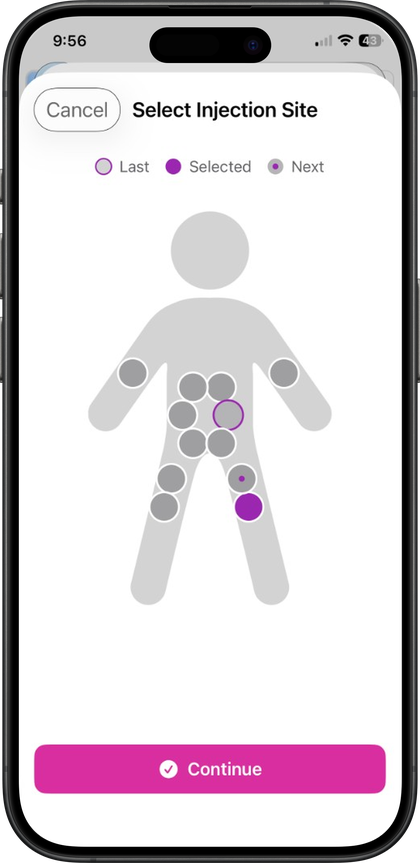
Pokii's injection site body map, available in Pokii, shows a front and back body map with rotation settings and a suggested next site, plus an optional auto-prompt when you log a shot. It's built to make the standard practice of rotating among approved injection areas easier to follow in practice, rather than trying to remember where your last few doses went.
Every injectable shot logged in Pokii also supports an optional pain slider, so you can note how a given injection felt at the time (oral medications skip site and pain fields, since they don't apply). Over time, that lets you spot whether a particular area or rotation pattern tends to feel more uncomfortable than others.
If you're on Pokii, injection sites and pain ratings can be included in your configurable PDF progress reports alongside shots, side effects, and other check-in data — useful for reviewing patterns yourself or sharing a clearer picture with your prescriber if you notice a site that seems to react more than the rest. Pokii's daily check-in and side effects tracking, with severity and notes per effect, can also be used alongside site and pain logging to capture things like redness or itching as part of that day's entry, tied to your dose history.
As with everything in Pokii, this is a tracking and education tool. It does not provide medical advice, diagnosis, or treatment, and projected medication levels shown elsewhere in the app are educational models, not lab results.
Always follow your prescriber’s instructions for GLP-1 medications. Pokii helps you log and visualize your journey; it does not replace professional care.