Your GLP-1 journey
GLP-1 for PCOS: Tracking with Pokii
GLP-1 medications such as semaglutide and tirzepatide are increasingly used off-label by people with polycystic ovary syndrome (PCOS) — a condition that, as of a May 2026 global consensus process, is also being renamed polyendocrine metabolic ovarian syndrome (PMOS) — largely because PCOS/PMOS so often overlaps with insulin resistance and excess weight. This page lays out where the research actually stands, an important ovulation and contraception consideration worth raising with a prescriber, and how Pokii's tracking tools fit into — and stop short of — that picture.
GLP-1 use in PCOS (also known as PMOS): the honest picture
No GLP-1 medication is FDA-approved specifically for PCOS or PMOS. As of mid-2026, semaglutide (Wegovy, Ozempic), tirzepatide (Zepbound, Mounjaro), and other GLP-1/GIP medications remain approved for type 2 diabetes and/or chronic weight management — not for PCOS/PMOS as an indication. Use in PCOS/PMOS is off-label, typically prescribed because obesity, overweight, and insulin resistance are so common alongside the condition, not because a GLP-1 has been approved to treat it.
Insulin resistance is considered a core feature of PCOS/PMOS in many patients, not just a coincidental comorbidity. Elevated insulin can drive the ovaries to overproduce androgens, associated with irregular cycles, acne, and excess hair growth. Because of that overlap, personalized dietary therapy and weight management are widely described as first-line approaches for PCOS/PMOS in people with overweight or obesity, often used alongside or ahead of medication. Modest weight loss — commonly cited as around 5% of body weight — has been linked in clinical literature to improvements in hyperandrogenism, insulin resistance, menstrual regularity, and fertility outcomes.
Research specific to GLP-1s in PCOS/PMOS is real but still early-stage. A 2025 meta-analysis published in Scientific Reports and a 2025 narrative review in Endocrine Connections both found that GLP-1 receptor agonists produced greater weight loss and better metabolic markers — such as A1C and insulin sensitivity — than metformin in women with PCOS, with some signal of improved menstrual regularity. These are meaningful findings, but they are not large, PCOS/PMOS-specific approval trials, and no formal guideline change has followed from them.
On terminology: the PCOS-to-PMOS renaming was published in The Lancet in May 2026, following a 14-year, 56-organization consensus process, and reflects an updated understanding of the condition as a multisystem endocrine and metabolic disorder rather than a primarily ovarian one. A transition period is underway, with full adoption expected by a 2028 international guideline update, so "PCOS" remains the more common term today — hence "PCOS (also known as PMOS)" throughout this page.
The ovulation and contraception conversation
This deserves to be stated plainly: weight loss and improved insulin sensitivity — whether from lifestyle changes or from a GLP-1 — can restore ovulation in people with PCOS/PMOS who were previously anovulatory or had irregular cycles. For someone trying to conceive, that can be a treatment goal. But it also means someone who was not ovulating, and therefore not at risk of pregnancy, may start ovulating again — sometimes without obvious symptoms — while still on a GLP-1.
The most notable PCOS/PMOS-specific research here is the ongoing RESTORE trial from CU Anschutz, investigating whether semaglutide can restore ovulation in adolescents and adults with PCOS/PMOS and obesity. An early proof-of-concept analysis, published in June 2026 in Fertility and Sterility, found that among participants who achieved at least 10% body weight loss, ovulatory cycles resumed in roughly half of previously anovulatory participants, with notably stronger results among those who were overweight rather than more obese. The researchers describe this explicitly as early, preliminary, proof-of-concept data — not confirmation of a durable benefit — and the trial is still enrolling and following participants.
This has real, practical contraception implications. Multiple clinical and patient-education sources note that clinicians should counsel patients about the possibility of unintended pregnancy as ovulation resumes during GLP-1 treatment and associated weight loss. Separately, some GLP-1/GIP medications can interact with oral hormonal contraceptives: tirzepatide specifically has been noted to slow gastric emptying enough to reduce absorption of oral contraceptive pills, and its prescribing information advises switching to a non-oral contraceptive method or adding a barrier method for a period after starting or increasing dose — commonly cited as around four weeks. Semaglutide does not appear to carry this same absorption interaction based on current sources, though the broader point about ovulation resuming still applies to it as well.
GLP-1 medications are also generally advised to be stopped well before attempting pregnancy — commonly cited guidance is around two months prior — and people who become pregnant while on a GLP-1 are advised to stop the medication and contact their clinician promptly. None of this is a guarantee in either direction: it's a genuinely two-sided consideration, and a specific, worthwhile conversation to have with a prescriber about contraception and pregnancy planning while on a GLP-1 for PCOS/PMOS, rather than something to assume based on past cycle history alone.
What Pokii tracks — and what it doesn't
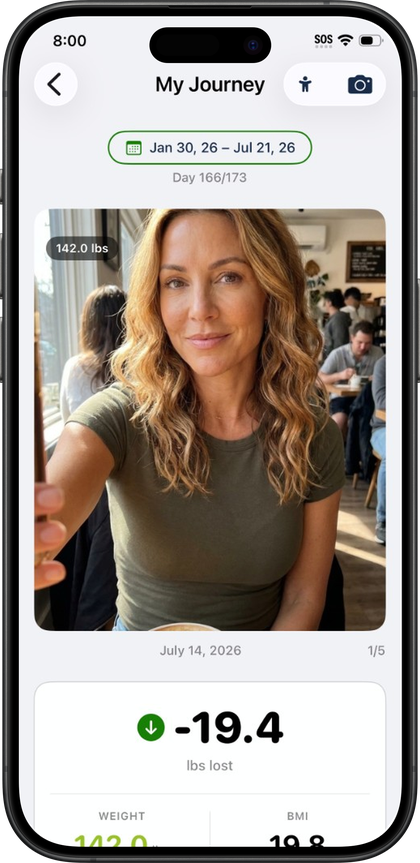
Pokii is built around tracking the day-to-day and month-to-month side of a GLP-1 journey: weight check-ins with a trend line and projection, body measurements — including waist, hips, chest, neck, arm, thigh, and ankle — with history and trends, and daily check-ins with dedicated appetite and mood sliders plus customizable side-effect tracking. Progress photos, shot and dosage history, and () PDF reports combining weight, measurements, side effects, appetite, mood, and shot history round out the picture. For someone navigating PCOS/PMOS alongside a GLP-1, that combination captures a meaningful part of the picture — how weight and waist measurements are trending, how appetite is changing, and how mood is holding up over time — useful context for a conversation with a clinician.
Pokii does not include a dedicated cycle tracker; for period or fertility tracking, use a purpose-built app alongside Pokii. Because Pokii's daily check-ins include free-text notes and a customizable side-effect list, some people choose to log cycle-related changes — like the start of a period — as a note or custom entry, purely as a personal reference point alongside weight, appetite, and mood data. That's a workaround for personal record-keeping, not a substitute for dedicated cycle or fertility tracking.
Why tracking over months — not single data points — helps these conversations
A single weight reading or one day's appetite rating doesn't say much on its own. Changes related to PCOS/PMOS and GLP-1 use — in weight, waist measurement, appetite, and mood — tend to show up as patterns across weeks and months, especially around dose changes. Pokii's trend lines and history views are built to show that longer shape rather than a single snapshot, and the PDF report packages weight, measurements, side effects, appetite, mood, and shot or dosage history into one document.
Because the ovulation, fertility, and contraception questions above are individual and time-sensitive, having a longer view of weight and related trends for an endocrinology or OB-GYN visit can give that conversation more to work with than a single visit's numbers would — alongside cycle information tracked through whatever separate method someone already uses.
What this page is — and isn't
Everything above is general background drawn from published research and clinical or patient-education sources current as of mid-2026, not medical advice, and it isn't a substitute for a conversation with an endocrinologist, OB-GYN, or prescriber who knows a person's full history. GLP-1 use for PCOS/PMOS remains off-label, the evidence base is still developing — including the ongoing RESTORE trial — and decisions about starting, stopping, or combining a GLP-1 with a contraception method, especially given the ovulation and pregnancy considerations above, should be made with a clinician. Pokii can help track and organize weight, measurements, appetite, mood, and side effects over time, and its reports can be useful at an appointment.
Always follow your prescriber’s instructions for GLP-1 medications. Pokii helps you log and visualize your journey; it does not replace professional care.