Your GLP-1 journey
GLP-1 for Menopause: Track Symptoms in Pokii
Weight management often gets harder after menopause, and it's rarely about hormones alone — muscle loss, a slower resting metabolism, and a shift in where the body stores fat all play a role. GLP-1 medications aren't a menopause-specific therapy; they're prescribed and used by postmenopausal women the same way they're used by anyone managing weight, though a few observations specific to this life stage are worth knowing. It's also worth knowing upfront that symptoms commonly blamed on menopause — hot flashes, fatigue, mood changes, sleep disruption — can also show up while taking a GLP-1, with no reliable way to tell which cause is which without a clinician. Pokii can't make that call, but its check-ins, custom side effects list, and weight trend tracking can help organize what you're noticing before that conversation.
Why weight management can get harder after menopause
According to Mayo Clinic, weight gain commonly starts a few years before menopause, during perimenopause, and tends to continue at roughly 1.5 pounds a year through a woman's 50s. Hormonal changes alone don't fully explain this — it's usually a mix of hormonal shifts, aging-related muscle loss, lifestyle factors, genetics, and sleep. Muscle mass declines with age, which slows resting metabolism and makes weight gain easier even without a change in diet, and Mayo Clinic notes women in their 50s may need roughly 200 fewer daily calories than in their 30s and 40s just to maintain weight. Hormonal changes are more strongly linked to where weight settles — more around the abdomen, less around the hips and thighs — than to how much is gained overall. Hormone therapy may help redistribute abdominal fat and can indirectly support weight management by improving sleep, but it has not been shown to directly cause weight loss on its own.
GLP-1 medications such as semaglutide and tirzepatide are FDA-approved for type 2 diabetes and chronic weight management, not as a menopause treatment, so their use here is best understood as general weight-management use by women who happen to be postmenopausal. RAND's 2025 American Life Panel survey found GLP-1 use highest among women 50 to 64, at around 20% reporting current or past use — the highest of any group surveyed. Research cited by RAND indicates GLP-1s are similarly effective for weight loss in postmenopausal and premenopausal women, though it stresses this population is understudied, with open questions on body composition, bone density, and effects on menopause symptoms.
One finding worth knowing, with a clear caveat: a Mayo Clinic-led observational study in The Lancet Obstetrics, Gynaecology, & Women's Health found postmenopausal women using menopausal hormone therapy (MHT) lost about 35% more weight on tirzepatide than women on tirzepatide alone, over 12+ months in 120 participants, and earlier semaglutide research suggested a similar pattern. The senior author was clear this was observational, not a randomized trial, so it cannot establish hormone therapy caused the extra weight loss — differences in baseline habits, or better sleep and quality of life from symptom relief, were raised as plausible alternative explanations, and a randomized trial is planned. Separately, whether GLP-1s interact with MHT/HRT itself is not established: no hospital-system or peer-reviewed source documents an official contraindication, and a theoretical concern that slowed gastric emptying could affect oral HRT absorption appears only in lower-confidence consumer sources, unconfirmed elsewhere. Combined use is a conversation for a prescriber, not something settled by research so far.
Don't assume it's "just menopause" — or "just the medication"
Several symptoms commonly attributed to menopause overlap substantially with symptoms sometimes reported by people taking GLP-1s, creating a real risk of guessing wrong about the cause. Hot flashes during GLP-1 treatment aren't well established as a direct drug effect — proposed explanations include weight loss itself, metabolic changes, blood sugar swings, sleep disruption, or concurrent perimenopause — and direct evidence either way is limited. Fatigue is separately documented as a GLP-1 side effect and is also a common menopause symptom tied to sleep disruption and hormonal changes; since reduced intake or dehydration from a GLP-1 can compound fatigue from either cause, there's no reliable way to self-attribute it to one source. Mood evidence with GLP-1s is mixed — some research suggests improved mood alongside weight loss, other research flags increased risk of depression or anxiety — while menopause is independently associated with worsening mood, and nothing in the research separates the two for an individual. Sleep disruption is linked to both menopause and GLP-1 use independently, and GLP-1s may have some unstudied effect on obstructive sleep apnea risk, which already increases sharply during this life stage on its own.
A hot flash, a tired week, a low mood, or a rough night's sleep could come from menopause, from a GLP-1, from both at once, or from something unrelated — figuring out which isn't something a reader should resolve alone, or something Pokii is built to resolve. That distinction is a conversation for a prescriber, informed by a clear record of what's actually been happening rather than a guess based on one particular day.
Building a pattern with check-ins and custom side effects
Consistent tracking matters more than any single day. Pokii's daily check-in includes dedicated appetite and mood sliders rather than a generic tag, plus optional side effects with an intensity rating per effect and a notes field showing relative-to-last-check-in hints, so a rough day shows up in context next to the entries around it. The side effects list is configurable, so symptoms like hot flashes, sleep disruption, or specific mood notes can be added as custom entries and tracked alongside standard GLP-1 side effects like nausea or fatigue, in the same daily log.
Individual entries add up over time. Pokii's Today's log section and Calendar tab bring shots, check-ins, weight, photos, and measurements into one timeline instead of scattering them across screens, making it easier to notice whether symptom reports cluster around dose timing or appear independent of it. Pokii's configurable PDF progress reports can pull side effects, appetite, mood, notes, weight, and the daily log into one document — a more organized starting point for a prescriber conversation than recalling the last few weeks from memory. Hot flashes, sleep changes, or other symptoms can be logged through notes or custom side-effect entries alongside dose timing in check-ins and PDF reports.
Weight trends alongside everything else
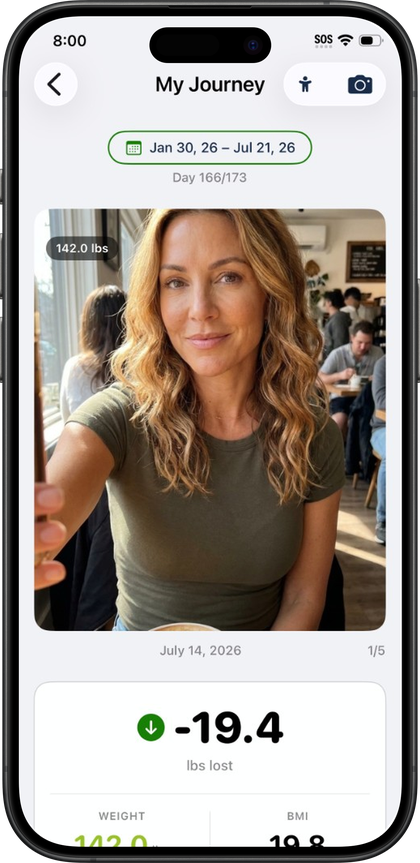
Weight check-ins in Pokii are free to log manually and can sync with Apple Health when enabled, giving a simple running record without extra setup. Pokii also includes a smoothed weight trend line with a projected trajectory, making it easier to see the overall pattern of change over the menopausal transition alongside medication dosing, rather than reacting to normal day-to-day scale fluctuation. Because hormonal changes around menopause are more closely tied to where weight settles — commonly toward the abdomen — than to total weight gained, Pokii's body measurement tracking for waist, hips, chest, neck, arms, thighs, and ankles can capture a change the scale alone won't show, with its own history and trend.
None of this replaces a conversation with a prescriber, and Pokii isn't interpreting the trend for you — it's keeping weight, measurements, check-ins, and side effects in one place so the pattern is visible when you need it, instead of reconstructed from memory after the fact.
Always follow your prescriber’s instructions for GLP-1 medications. Pokii helps you log and visualize your journey; it does not replace professional care.