Your GLP-1 journey
Period Changes, Hot Flashes, and Fatigue on GLP-1
People starting a GLP-1 medication sometimes notice changes to their menstrual cycle, report hot flashes, or feel more tired than usual, and it's natural to wonder whether the drug is responsible. The honest answer differs for each. Cycle changes have some limited, hedged research behind them, mostly tied to weight loss itself rather than the medication's pharmacology. Hot flashes are not a recognized side effect in FDA or UK regulatory labeling, and more likely explanations point elsewhere. Fatigue is documented in clinical trial data, though as a secondary effect well behind gastrointestinal symptoms. This page walks through what's actually known about each, and how Pokii's check-in tools can help someone log what they're noticing, even though Pokii has no dedicated period or cycle-tracking feature.
Menstrual cycle changes: what the limited data actually shows
Menstrual regularity depends on a functioning hypothalamic-pituitary-ovarian axis, and that axis is sensitive to energy availability, not just body weight on its own. Adipose tissue is hormonally active — it's involved in converting androgens into estrogen — so a significant change in body fat, whatever the cause, can plausibly shift cycle patterns. Rapid or substantial weight loss can suppress the pulsatile hormone signaling that drives ovulation, and one narrative review notes that losing roughly 10% or more of body weight is associated with a higher risk of amenorrhea, periods stopping altogether. At the same time, obesity itself is linked to roughly double the odds of irregular cycles compared with non-obese women, so moving toward a healthier weight range can improve regularity for some people rather than disrupt it. In short, meaningful weight change in either direction is an established general cause of cycle changes — this is true regardless of what caused the weight loss, not something specific to GLP-1 pharmacology.
Semaglutide's FDA prescribing information and the UK Summary of Product Characteristics do not list menstrual or hormonal changes as a reported effect, and no research reviewed here shows GLP-1 receptor agonists acting directly on estrogen, progesterone, or other reproductive hormones. The one area with actual clinical data is PCOS: a small 2023 study of 27 women with obesity and PCOS on low-dose semaglutide found that among those who lost at least 5% of body weight, most saw cycle length normalize after three months — a small, short, uncontrolled study specific to PCOS that shouldn't be generalized to everyone on a GLP-1. Separately, a 2026 self-reported survey by Natural Cycles of 1,754 users currently or previously on GLP-1 medication found that 27% noticed some change to their cycle (43% among those with PCOS), most commonly more predictable, more frequent, or shorter periods — a trend toward more regularity for many respondents, not less. The survey flags its own limitations: it isn't a controlled study, and more than half of respondents had lost over 10% of their body weight while also making lifestyle changes like eating differently or exercising more, which makes it hard to separate the medication's role from weight loss and lifestyle changes happening at the same time. Taken together, the evidence is consistent with cycle changes being explained by weight loss and its downstream hormonal effects, not by the drug acting directly on the reproductive system.
Hot flashes: not an established GLP-1 side effect
Hot flashes are not listed as a side effect of semaglutide in FDA prescribing information or in UK regulatory documentation (the SmPC and MHRA-approved patient information). A UK pharmacy source that reviewed the SmPC directly states that hot flushes are not officially recognized as a direct side effect of Ozempic in UK regulatory documentation, and that their absence from official adverse-effect listings suggests clinical trials didn't identify a statistically significant link. That's a meaningfully different evidence status than fatigue, which does appear in labeling with specific reported rates.
Where people do report hot-flash-like symptoms while on a GLP-1, the more plausible explanations point away from a direct drug effect. Many people starting GLP-1 therapy are in an age range where perimenopause or menopause is also common, so the two can simply coincide, making it easy to attribute a naturally-timed hot flash to the new medication instead. Significant fat loss can alter circulating estrogen in ways that could theoretically influence someone already near a menopausal transition, but sources describe this as an indirect, theoretical pathway rather than a demonstrated mechanism. Rapid blood sugar swings, particularly in people also taking insulin or a sulfonylurea, can produce sweating and warmth that feel like a hot flash but are more accurately a glycemic event. Thyroid dysfunction and other medications are also flagged as established alternative causes worth ruling out. One source looking specifically at GLP-1s and hot flashes describes increased heat sensitivity reports as anecdotal and not supported by research, with no established evidence that GLP-1s directly cause, or relieve, hot flashes.
Fatigue, briefly
Fatigue has a different evidence status than hot flashes: it is documented in FDA labeling for semaglutide products, though it sits behind nausea, vomiting, diarrhea, and constipation as the headline effects. Reported rates were about 11% for Wegovy versus 5% for placebo in trials, fewer than 5% for Ozempic, and fatigue wasn't reported at all in Rybelsus trials. It tends to be more noticeable when starting or increasing a dose and often eases over time. Pokii has a dedicated guide, Fatigue on GLP-1s, that covers contributing factors and when it's worth flagging to a prescriber in more depth than this page will repeat.
Tracking these patterns in Pokii, and when to loop in a doctor
Pokii does not have a dedicated period, menstrual cycle, or hot-flash tracking feature. A full check of Pokii's feature set for anything related to periods, cycles, or menopause turns up only the Shot Progress widget's "cycle progress" language, which refers to a medication dosing cycle, not a menstrual one. Anyone wanting a purpose-built cycle calendar or ovulation predictor will need a separate app for that.
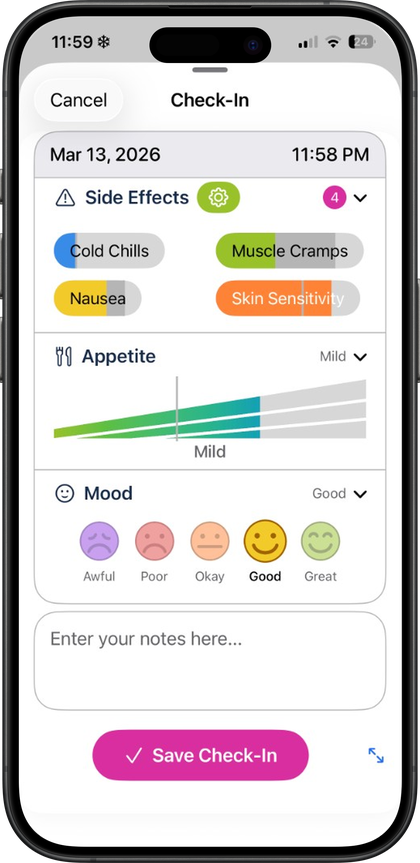
What Pokii's existing tools can do is give someone a consistent place to log what they're noticing alongside their medication timeline. The daily check-in's custom side effects list means entries like "hot flashes" or period-related notes can be added and tracked for intensity over time, right alongside the built-in mood and appetite sliders. The free-text notes field can hold day-to-day observations about cycle timing or symptoms that don't fit a preset category. Because side effect entries carry severity and notes and connect to dose timing in Pokii's history and PDF reports, patterns between dose timing and self-logged symptoms become easier to spot over weeks or months. The dashboard's Today's log and the Calendar tab's month and list views bring check-ins, shots, and weight together on one timeline, and Pokii's configurable PDF reports can package side effects, mood, appetite, and notes into something to bring to an appointment.
New or unexpected menstrual and vasomotor changes have many possible causes beyond a GLP-1 medication, and medical evaluation rather than self-attribution to the drug is the consistent recommendation across sources reviewed for this page. Missed periods can reflect significant weight loss, but pregnancy and other causes need ruling out first. Bleeding between periods or unusually heavy bleeding isn't an established GLP-1 effect and warrants evaluation for other causes. Periods stopping for an extended stretch, or cycles becoming significantly irregular, is worth a clinical conversation, particularly after rapid or substantial weight loss. New hot flashes are worth evaluating for perimenopause or menopause, thyroid function, blood sugar patterns, or other medications, rather than assuming the GLP-1 is responsible. Any of these symptoms alongside severe pain, chest pain, palpitations, shortness of breath, or signs of low blood sugar calls for prompt medical attention. Pokii is a tracking and education tool, not a diagnostic one — it doesn't explain or rule out the cause of any symptom, and decisions about medical evaluation belong with a healthcare provider.
Always follow your prescriber’s instructions for GLP-1 medications. Pokii helps you log and visualize your journey; it does not replace professional care.