Your GLP-1 journey
GLP-1 for Perimenopause with Pokii
Perimenopause is a transition, not a fixed state — hormones fluctuate for months or years before periods stop altogether, which can make weight, appetite, mood, and energy feel like they're changing on their own unpredictable schedule. Some women in this stage are also taking a GLP-1 medication for weight management or type 2 diabetes, which adds another set of changes into an already-moving picture. Pokii doesn't diagnose perimenopause or sort out what's causing any particular symptom; it's a shot and check-in tracker that can help someone organize what they're noticing so it's easier to bring a clear picture to a prescriber conversation.
A moving target, not a steady baseline
Perimenopause itself is defined by change. According to Mayo Clinic, weight gain commonly starts a few years before menopause — during perimenopause — and tends to continue at roughly 1.5 pounds a year through a woman's 50s. Mayo Clinic is explicit that hormones alone don't explain this: it's typically a combination of hormonal shifts, age-related muscle loss (which slows resting metabolism), lifestyle factors, genetics, and sleep. Hormonal change during this stage is more associated with where weight settles — more around the abdomen than the hips and thighs — than with how much total weight is gained.
RAND Corporation's 2025 research commentary describes perimenopause as a period of fluctuating estrogen and declining ovarian function, alongside a cluster of changes that can show up together: increased cardiovascular risk, higher risk of obstructive sleep apnea, declines in bone density and muscle mass, weight gain, poor sleep quality, mood changes, and cognitive fog sometimes called "menofog." Because these shifts aren't linear — a good week can be followed by a rough one for no obvious reason — it's harder to tell whether a change in weight, appetite, or energy reflects perimenopause on its own, a GLP-1 medication, or both at once.
It's worth being clear about what GLP-1 medications are and aren't. Semaglutide, tirzepatide, and related medications are FDA-approved for type 2 diabetes and/or chronic weight management — not as a treatment for perimenopause or its symptoms. RAND's 2025 survey data found GLP-1 use is especially common among women in this age range: women 30 to 49 were more than twice as likely as similarly aged men to report current or past use, and women 50 to 64 had the highest reported use of any group surveyed, at about 20%. That overlap in timing doesn't mean the medication is doing anything specific to perimenopause itself.
When a symptom could be either one
Perimenopause and GLP-1 medications share a frustrating amount of overlap in the symptoms they can produce, and it's worth taking that seriously rather than glossing over it. Hot flashes are a good example: the sources reviewed for this page do not establish hot flashes as a well-documented, direct effect of GLP-1 medications. Proposed explanations for hot flashes reported during GLP-1 treatment include weight loss itself, metabolic changes, blood sugar swings, disrupted sleep, and perimenopause happening at the same time — with direct evidence connecting GLP-1s to hot flashes described as limited either way.
Fatigue is documented as a GLP-1 side effect in its own right, and it's also one of the most commonly reported perimenopause symptoms, often tied to disrupted sleep and hormonal change. Because both can independently cause fatigue — and reduced calorie intake or dehydration from a GLP-1 medication can compound it — there's no reliable way to know which one is behind a tired stretch without talking to a prescriber.
Mood is similarly tangled. Evidence on GLP-1 medications and mood is mixed: some research suggests mood may improve alongside weight loss, other research flags a possible increased risk of depression or anxiety. Perimenopause is independently associated with mood and anxiety changes for many women. Sleep disruption follows the same pattern — both perimenopause and GLP-1 use are associated with it in the sources reviewed, and RAND notes a possible but unstudied link between GLP-1 use and obstructive sleep apnea risk, which itself rises during perimenopause.
Because perimenopause symptoms are often already unpredictable before any medication enters the picture, adding a GLP-1 medication on top makes self-diagnosis even less reliable. A hot flash, a flat mood, or a wiped-out afternoon could be perimenopause, the medication, both together, or something else entirely — and sorting that out is a conversation for a prescriber, not something this page or Pokii can resolve on anyone's behalf.
Turning single days into a pattern worth discussing
Pokii doesn't diagnose anything, including perimenopause or the cause of a symptom. What it can do is help someone keep a consistent, dated record instead of relying on memory for a conversation that might happen months from now.
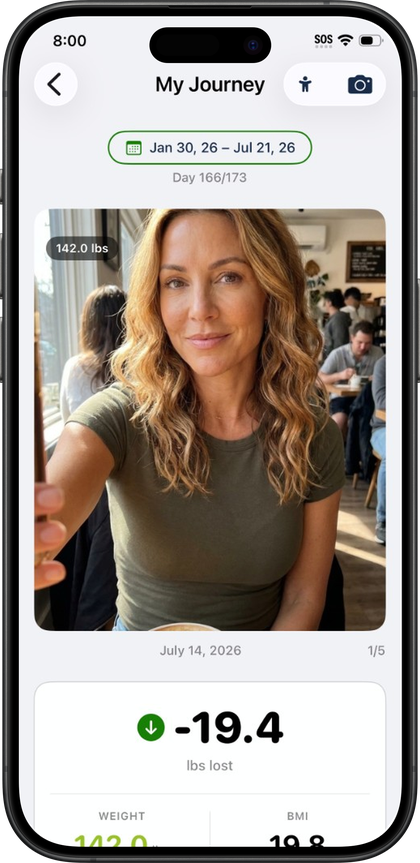
Pokii's daily check-in includes dedicated appetite and mood sliders, plus optional side effects with an intensity rating for each one, and a notes field that shows relative-to-last-check-in hints. Because the side effects list is customizable, someone could add hot flashes, sleep disruption, or specific mood notes as custom entries and track them alongside standard GLP-1 side effects in the same dated log as shots and weight.
The value of this isn't any single entry. One rough day doesn't mean much on its own, especially in perimenopause, where symptoms were already coming and going before a GLP-1 medication was part of the picture. What starts to be useful is the pattern across several weeks or months — whether a symptom clusters around dose days and tapers off, or whether it comes and goes on its own schedule, unrelated to the injection. Pokii's Today's log and Calendar tab lay out shots, check-ins, weight, and notes on a unified daily timeline, making that comparison easier than scrolling back through memory. A configurable PDF progress report can pull side effects, appetite, mood, notes, and weight into one document to bring to a clinician — a way to organize what's been noticed, not a substitute for a clinician's read on it.
Hydration: one steady habit in an unsteady stretch
Perimenopause doesn't hand out a stable baseline, and adding a GLP-1 medication's own appetite and digestive changes on top of that can make it hard to know what to focus on day to day. Hydration is one of the few habits in this mix that's simple, measurable, and doesn't depend on first figuring out what's causing anything else.
Pokii's water tracker lets someone log water with quick glass-based additions toward a daily goal, with an optional confetti moment when the goal is hit. It's built into Pokii, syncs with Apple Health, and — for You — can send smart, pattern-based reminders and sit in a combined dashboard module alongside nutrition. None of this diagnoses or treats anything; it's simply a way to keep one input consistent while everything else — hormones, sleep, appetite, mood — is doing its own unpredictable thing during the transition. Building that one steady habit doesn't answer whether a symptom is perimenopause or medication, but it becomes a concrete data point sitting alongside the rest of the log, and one less thing to think hard about on a day that already feels like a lot.
Always follow your prescriber’s instructions for GLP-1 medications. Pokii helps you log and visualize your journey; it does not replace professional care.