Your GLP-1 journey
Semaglutide vs Tirzepatide: Track Both in Pokii
Semaglutide and tirzepatide are both once-weekly injectable GLP-1-class medicines used for type 2 diabetes and weight management, but they aren't the same molecule and they aren't dosed the same way. This page lays out what the two research files behind Pokii's medication library actually document about each drug, then shows how Pokii's charting tools handle tracking one or the other, or a switch between them, without telling you which one is right for you.
The core mechanism difference
Semaglutide is a GLP-1 (glucagon-like peptide-1) receptor agonist. It mimics a single incretin hormone, GLP-1, which slows gastric emptying, increases insulin secretion, and reduces appetite. It's the active molecule in Ozempic, Wegovy, Wegovy HD, the newer Ozempic oral tablets, Rybelsus, and the Wegovy pill.
Tirzepatide works differently. It's a synthetic peptide built as a dual GIP/GLP-1 receptor agonist, meaning it activates both the glucose-dependent insulinotropic polypeptide (GIP) receptor and the GLP-1 receptor at the same time. That dual-receptor action is what distinguishes it from single-target GLP-1 drugs like semaglutide. Tirzepatide is the active molecule in Mounjaro and Zepbound, both made by Eli Lilly and both dosed as a once-weekly subcutaneous injection.
In plain terms, semaglutide engages one incretin pathway, and tirzepatide engages two. Both are once-weekly injectables (excluding semaglutide's newer oral tablet forms), both use gradual dose escalation to improve tolerability, and both come with an FDA boxed warning for thyroid C-cell tumor risk based on rodent studies, with the same contraindication for a personal or family history of medullary thyroid carcinoma or Multiple Endocrine Neoplasia syndrome type 2. Neither drug's research file references a head-to-head efficacy trial directly comparing the two molecules, so no such comparison is made here.
Approval history and dosing, side by side
Semaglutide has a longer and more fragmented approval history in the U.S. Ozempic (injectable) was approved for type 2 diabetes and cardiovascular risk reduction. Wegovy (injectable) followed for chronic weight management, later joined by a higher-dose Wegovy HD (7.2 mg) under an accelerated review pathway. Rybelsus was the original oral tablet for type 2 diabetes, and as of this review it's being phased out in favor of new, higher-bioavailability Ozempic oral tablets (1.5 mg, 4 mg, 9 mg) approved in February 2026. A separate oral product, the Wegovy pill (25 mg), was approved in December 2025 as the first oral GLP-1 receptor agonist for weight management. That's five distinct branded semaglutide products across two oral options and two injectable dose tiers.
Tirzepatide's approval history is simpler: two branded forms, both from Eli Lilly. Mounjaro was approved in May 2022 for blood sugar control in type 2 diabetes. Zepbound followed in November 2023 for chronic weight management, with an obstructive sleep apnea indication added in December 2024.
Dosing cadence is once weekly for both molecules across their injectable forms, but the numbers differ. Ozempic starts at 0.25 mg weekly for four weeks before increasing, with maintenance doses of 0.5 mg, 1 mg, or 2 mg. Wegovy titrates from 0.25 mg up through 0.5 mg, 1 mg, and 1.7 mg to a 2.4 mg maintenance dose over about 16 weeks, with Wegovy HD escalating further toward 7.2 mg for patients who've tolerated the standard dose. Tirzepatide's ladder is different in scale: both Mounjaro and Zepbound start at 2.5 mg weekly, stepping up in 2.5 mg increments no sooner than every four weeks (2.5 → 5 → 7.5 → 10 → 12.5 → 15 mg), with 5 mg, 10 mg, and 15 mg recognized as the studied maintenance doses.
Neither research file supports a claim that one drug is more effective or better tolerated than the other, and this page isn't making one. Which medication is appropriate, and at what dose, is a decision between a patient and their prescriber based on individual health history, response, and the current FDA labeling for each product — not something a tracking app can or should determine.
Tracking a switch or comparing your own response
People move between these medications for plenty of reasons: a prescriber changes a treatment plan, insurance coverage shifts, a compounded product transitions to a branded one, or someone simply wants to see how their own body responded to one drug versus the other over time. Pokii's built-in medication library lists semaglutide- and tirzepatide-molecule products as separate, named entries rather than a single generic listing — Wegovy, Wegovy Pill, Ozempic, and Rybelsus for semaglutide; Mounjaro, Zepbound, and Tirzepatide (Compound) for tirzepatide, alongside a Semaglutide (Compound) entry and other GLP-1/GIP medicines in the same catalog.
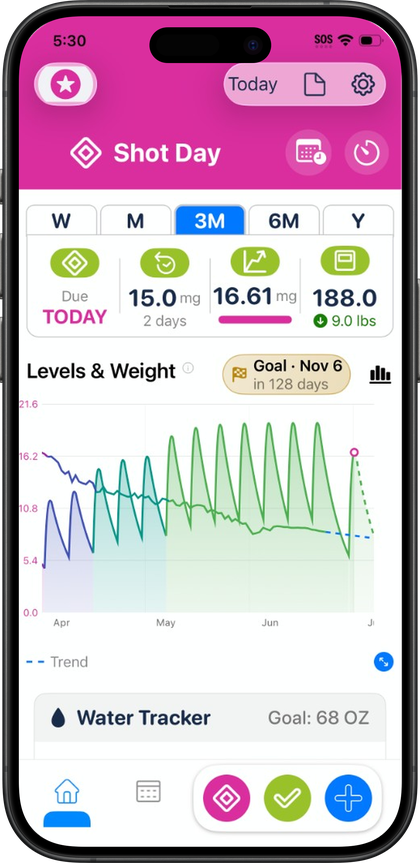
Because those branded and compound entries share an underlying molecule, Pokii's projected-levels chart includes a Per Compound display mode that groups them together by molecule, in addition to Combined and Per Medication views. That's the feature built for exactly this situation: someone who switched from Mounjaro to Zepbound, or from a semaglutide product to tirzepatide, can see how each compound's projected levels line up on the same timeline rather than as disconnected entries. Chart coloring by dose or medicine and customizable dose colors make it easier to visually tell doses and medications apart on the same chart when more than one is being tracked. You can track multiple semaglutide or tirzepatide products simultaneously, or switch between them with both entries visible on the same timeline.
As with all of Pokii's charts, projected medication levels are an educational pharmacokinetic model, not a lab result — useful for seeing patterns in your own logged data, not for diagnosing or predicting outcomes.
Using custom medications for formulations not in the built-in list
Pokii's built-in library doesn't yet have a distinct entry for every current formulation — for example, Wegovy HD (7.2 mg) and the new Ozempic oral tablets aren't reflected as their own built-in entries at this time, and the same gap can apply to newer or less common tirzepatide formulations. For those cases, You can add a custom medication with its own pharmacokinetic fields: an oral or injectable toggle, half-life, Tmax, bioavailability, and whether to include it on the projected-levels chart.
This is also the path for personalized compounded formulations of either molecule that don't match the standard Semaglutide (Compound) or Tirzepatide (Compound) entries, letting the dose and timing be logged accurately rather than approximated against a different product's profile. Whether logged through a built-in entry or a custom one, shot tracking, reminders, and injection site mapping apply to injectable forms of either drug, while oral forms skip the injection-site and pain fields, consistent with how Pokii treats oral and injectable medications throughout the app.
Always follow your prescriber’s instructions for GLP-1 medications. Pokii helps you log and visualize your journey; it does not replace professional care.