Your GLP-1 journey
GLP-1 Postpartum: Logging Safely in Pokii
GLP-1 and GIP medications raise some of the highest-stakes questions in this entire category once pregnancy, breastfeeding, or the postpartum period enter the picture, and the honest answer to most of them is "it depends" — on the specific drug, the specific formulation, and your own health history. This page walks through what current FDA labeling and research actually say, but it is not a substitute for a conversation with your OB-GYN, prescriber, or a board-certified obesity medicine specialist. Pokii is a tracking and education tool. It does not provide medical advice, diagnosis, or treatment, and the projected medication levels in the app are educational models, not lab results — a distinction that matters even more here than anywhere else in the app.
This is a conversation for your prescriber, not a general article
Every decision covered on this page — whether to plan a pregnancy while on a GLP-1, whether to breastfeed while taking one, or when it might make sense to resume therapy postpartum — depends on which molecule you're taking, whether it's injectable or oral, and factors specific to your own health and your baby's. A general article, however carefully sourced, can't weigh those factors for you. Nothing on this page is meant to tell you to start, stop, or continue any medication; it's meant to help you ask better questions at your next appointment, and to show how Pokii's logs can make that appointment more useful.
Pregnancy: what the labels say, and where semaglutide and tirzepatide differ
The current FDA label for semaglutide (Wegovy) is specific and unambiguous on timing: because of the potential for fetal harm, it instructs discontinuing the medication at least 2 months before a patient plans to become pregnant, specifically to account for semaglutide's long half-life. That "at least 2 months" figure appears in the label itself, not as a secondhand estimate, and it's worth bringing up by name with a prescriber when pregnancy is being planned.
Tirzepatide (Zepbound and Mounjaro) is different, and the difference matters. Its FDA label does not specify an equivalent fixed pre-conception window. Instead, it instructs discontinuing tirzepatide when a pregnancy is recognized, without a stated number of weeks or months to stop beforehand. Some secondary sources suggest an informal window by analogy to semaglutide, but that figure isn't verified in tirzepatide's own label, and this page won't repeat it as though it were an official instruction. If a specific pre-conception timeline matters for your situation, that's a question to bring directly to a prescriber rather than one this page can answer for you.
Beyond the timing question, both drug classes are treated similarly in one respect: neither is recommended during pregnancy. Both labels state that intentional weight loss offers no benefit to a pregnant patient and may pose risk to the fetus, both instruct discontinuation once a pregnancy is recognized, and both note that human pregnancy data remain insufficient to establish or rule out risks like major birth defects or miscarriage, even though animal studies have shown fetal effects at certain doses. Manufacturers also maintain pregnancy exposure registries for both Wegovy and Zepbound, which prescribers can use to report exposures and which reflect how incomplete the human data still is.
Breastfeeding: the guidance depends on the drug and the formulation
Breastfeeding guidance for GLP-1 medications isn't one-size-fits-all, and flattening it into a single yes-or-no answer would misrepresent the labels. For injectable semaglutide (Wegovy and Ozempic), the current FDA label states there are no data on whether the drug appears in human milk, affects a breastfed infant, or affects milk production — it frames the decision as a benefit-risk conversation, not a blanket prohibition. Injectable tirzepatide (Zepbound and Mounjaro) is labeled similarly: no lactation data available, framed as an individualized discussion with a prescriber rather than an outright "don't."
Oral semaglutide tablets are a distinct case and are treated more restrictively. Their FDA label explicitly states that breastfeeding is not recommended during treatment, because the absorption-enhancing ingredient in the tablet formulation does appear in breast milk and infants may not clear it as efficiently as adults. That distinction between injectable and oral forms is easy to lose in general conversation about "GLP-1s and breastfeeding," but it's a meaningfully different label instruction.
There is also newer research worth being aware of, without overstating what it means. NIH's LactMed database and a small peer-reviewed study have reported that subcutaneous semaglutide and tirzepatide were largely undetectable or present only in trace amounts in breast milk among small groups of nursing mothers studied so far, and a specialty lactation research center has published similarly reassuring early findings on tirzepatide, while noting that reduced maternal calorie and nutrient intake from appetite suppression may matter more for a nursing infant than direct drug exposure. None of this amounts to an FDA label update, and as of this writing no GLP-1 medication carries a revised "safe during breastfeeding" indication — some clinical sources still describe the practical guidance as generally not recommended during breastfeeding given the limited data. Treat emerging research as a reason to ask your prescriber more informed questions, not as grounds to make the call yourself.
Restarting therapy postpartum
Whether and when to resume a GLP-1 after childbirth is also not something with an official, one-size-fits-all guideline. These medications aren't specifically FDA-approved for postpartum weight management, so any use in this window is off-label, and no major professional body — including ACOG — currently has a published position statement on GLP-1 use specifically in the postpartum or lactation period.
Some patient-education sources, citing individual obesity medicine specialists rather than a formal clinical guideline, describe a general pattern of roughly 6 to 12 weeks postpartum before a prescriber might consider restarting therapy for a parent who isn't breastfeeding, dependent on individual healing and recovery. For breastfeeding parents, the pattern described across sources is that this conversation more typically happens once breastfeeding has fully ended or with formula-feeding, given the lactation considerations above — though a prescriber may weigh individual circumstances differently. Treat any specific number you see, including the ones in this paragraph, as general patient-education framing rather than a guideline to follow on your own; the right timing for you is a question for the person who knows your full history.
How Pokii can support these conversations, not replace them
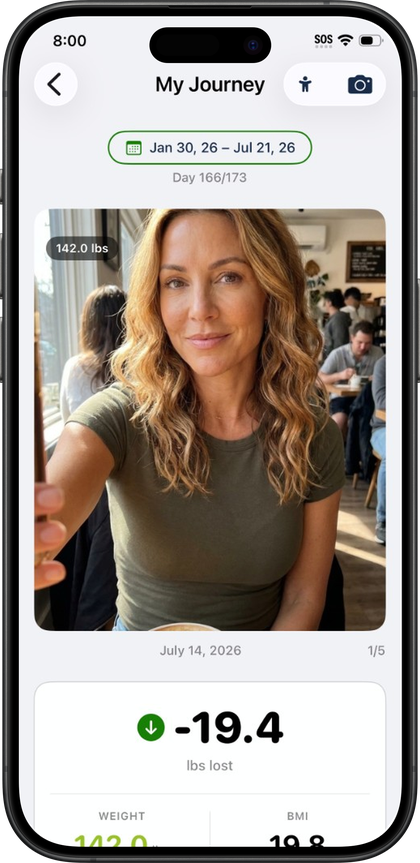
Pokii has no menstrual cycle, fertility, ovulation, or pregnancy-tracking feature, and it doesn't log breastfeeding or pumping sessions directly. What it can do is help you bring an organized, dated record to the appointments where these decisions actually get made. Progress photos sit in a dated carousel alongside your logged weight, which some parents find useful simply as a personal record of postpartum body changes over time, separate from any before-and-after framing. Body measurements — waist, hips, chest, neck, arm, thigh, and ankle — build their own history and trend lines alongside that.
The feature most worth highlighting here is Pokii's configurable PDF progress report, available in Pokii. It can combine weight and target-weight trends, shot and dosage history, side effects, appetite and mood check-ins, and body measurements into a single document, which is the kind of consolidated record that's genuinely useful to hand to an OB-GYN or prescriber ahead of a conversation about conception timing, breastfeeding, or restarting therapy. Daily check-ins that track appetite and GI side effects can also help surface exactly the kind of nutrition-adjacent signals that sources flag as relevant for breastfeeding parents, giving a prescriber more to work with than memory alone.
None of this changes the core guidance on this page: Pokii can organize what you've logged so a conversation with your prescriber is more informed, but it can't tell you when to stop, start, or resume a GLP-1 around pregnancy or breastfeeding. That decision belongs with the person who has your full medical picture.
Always follow your prescriber’s instructions for GLP-1 medications. Pokii helps you log and visualize your journey; it does not replace professional care.