Alternatives
Cal AI Alternative: Pokii Food Scanning
Cal AI shows up in a lot of GLP-1 forums because photo-based calorie counting feels like a natural fit for anyone tracking food on a medication that changes appetite. Cal AI is a general calorie-counting app, not a GLP-1 tracker; Pokii includes built-in food logging on the same timeline as shots. Here's what each app does, where Cal AI wins as a diet app, and where Pokii wins on medication depth.
What Cal AI is genuinely good at
Cal AI's core pitch is fast, low-friction logging: snap a photo of your meal and the app uses your phone's depth sensor to help estimate food volume, scan a barcode, or describe a meal in text, and it returns a calorie and macro breakdown. App Store reviewers corroborate this as a real strength over manual-entry apps, with reviews describing point-and-click photo logging as noticeably faster than typing everything into a traditional food diary. Behind that, Cal AI backs its photo estimates with a food database the app describes as 2 million-plus items and a barcode scanner, so you're not limited to the camera when you want a precise number.
Cal AI also has real scale and reach that Pokii doesn't try to match. It's currently ranked around #6 in the Health & Fitness category, carries a 4.8-star average across roughly 343,000 ratings, and the developer's own site describes it as "loved by 5M users." It runs across a much wider range of devices than Pokii today: iPhone, iPad, Apple Watch, Mac on Apple Silicon, Apple Vision, and Android via Google Play, compared with Pokii on iPhone and iPad now with Android in active development.
None of that means Cal AI is flawless, and it's worth being fair about that too. A number of its own App Store reviews call out real accuracy misses, particularly on micronutrients like sodium and fiber, and occasional calorie estimates on photos that are noticeably off. It's also an ad-supported product: its App Store privacy disclosure lists third-party advertising and device-level ad identifiers as a data-use category, which is a real, sourced difference from Pokii's no-ads model, even though it has nothing to do with GLP-1 tracking specifically.
AI food scanning isn't the reason to choose Pokii
Here's the part that's easy to overstate and shouldn't be: Pokii includes built-in food logging—nutrition label scanning (recommended) and meal capture—with AI macro estimates on the same timeline as GLP-1 shots, written to Apple Health. Cal AI's headline feature, snap a photo and get calories, overlaps that job. Cal AI is still the more mature diet-only product, with a much bigger searchable database and heavy cross-platform reach (Watch, Mac, Vision, Android). The reason to pick Pokii over Cal AI is not photo logging—it's that Cal AI has no GLP-1 dose tracking: no medication library, no projected-level chart, no injection-site map, and no visit-ready PDF built around shots.
Where Pokii actually covers that gap
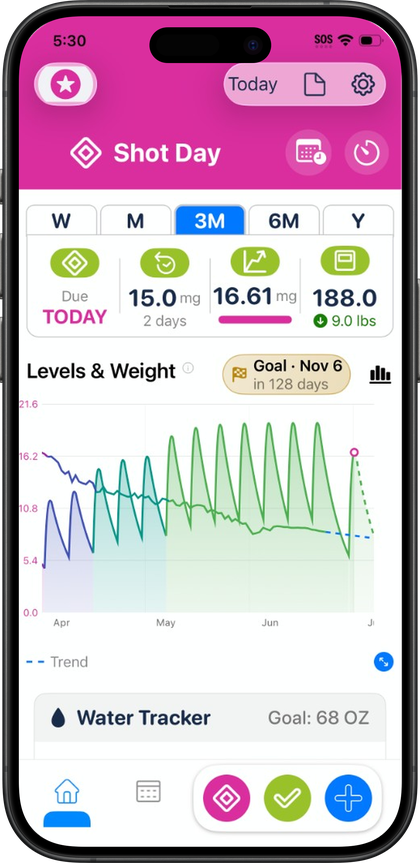
Pokii's entire core is built around GLP-1 tracking, with food scanning sitting alongside it rather than being the main event. Shot tracking with full edit history is free, and it's backed by a built-in library of 16 branded and compound medications, including Zepbound, Wegovy, Wegovy Pill, Foundayo, Mounjaro, Ozempic, Tirzepatide and Semaglutide compounds, Retatrutide, Saxenda, Rybelsus, Victoza, Trulicity, CagriSema, Bydureon, and Tanzeum, with flexible per-medicine schedules for interval or specific weekdays. Every logged dose feeds an educational projected medication-levels chart, viewable as a combined total, per medication, or per compound, something Cal AI has no equivalent of since it has no concept of medication levels to chart at all.
Pokii also has a injection-site body map, front and back, with rotation suggestions and an optional auto-prompt when you log a shot, plus an optional pain slider on injectable logs. None of that has a counterpart in Cal AI, which has no injection concept whatsoever. On top of that, Pokii's daily check-in covers side effects with per-effect intensity, appetite, and mood, tied to dose timing in your history and in PDF reports, which is a different kind of tracking than Cal AI's general food-and-medication diary entry. Pokii also includes a dose scheduler with simulated doses previewed on the chart, custom medications with your own half-life, Tmax, and bioavailability for compounded products, a room-temperature pen timer, weight trend and target-date projection, and configurable PDF progress reports built around your shot and side-effect history—capabilities aimed at GLP-1 dose tracking rather than Cal AI's food-diary-first design.
Switching, or using both: the honest picture
If you're thinking about moving your data from Cal AI to Pokii, it's worth knowing upfront that there's no clean, ready-made path. Cal AI's own privacy notice doesn't describe a self-service export button inside the app. Instead, it documents a request-based right to data portability: you can email privacy@calai.app (or go through its EU representative) to request a copy of your data "in a portable and, to the extent technically feasible, readily usable format," without specifying exactly what format that will be. A third-party blog from a competing calorie-tracking app claims Cal AI's in-app export is limited to thin daily summaries, often as a PDF rather than clean CSV, but that's a competitor's marketing content, not an official Cal AI statement, so treat it as a secondary and potentially biased data point rather than a confirmed fact.
Even setting the export question aside, there wouldn't be much to migrate on the medication side, because Cal AI never tracked GLP-1 doses in the first place. Pokii's import options are a Pokii JSON backup, iCloud restore, Shotsy JSON import, and a generic header-based CSV importer built around Pokii's own backup schema, none of which is a verified adapter for Cal AI's food and weight export format. At best, a manually requested Cal AI weight-history export could theoretically be hand-reformatted into Pokii's generic CSV importer, but that hasn't been tested or confirmed to work.
Given that, the recommendation depends on what you actually want. If a legacy mega-database and broader platform reach (Android, Apple Watch, Mac) matter most, and your GLP-1 dose is informal or untracked, Cal AI on its own can cover calories. If you want medication tracking with projected levels, injection sites, scheduling, built-in food logging, and PDF progress reports, that's Pokii—and many users don't need Cal AI for meals once Pokii is logging food beside shots.
Pokii is a tracking and education tool. It does not provide medical advice, diagnosis, or treatment. Talk with your clinician about dosing, side effects, and any change to your plan.