Product
Compare GLP-1 Tracking Apps
How to compare GLP-1 tracker apps: Judge dose logging (structured, editable history), a projected medication-level chart (not just a list of past shots), injection-site tooling, built-in food logging on the same timeline as shots, privacy (ads and social feeds), and which devices you actually use. Pokii is on iPhone and iPad today (Android coming soon) with all of the above; for a live matrix against Shotsy and MeAgain, use compare.html. Named competitor guides on this site go deeper on one app at a time.
Quick answer
- Must-haves for a real GLP-1 tracker: Medicine, dose, date/time, injectable vs oral, edit history; optional multi-medication; PK-style level chart with more than one view mode when you take more than one drug.
- High-signal extras: Body-map injection rotation, pain per shot, simulated doses before you log, PDF reports for clinicians, import from Shotsy JSON if you're switching.
- Privacy: No ads and no public social feed matter for injection logs—check each app's policy, not just the feature list.
- Platforms: Many trackers are Android-capable; Pokii is on iPhone and iPad today (native iPad layout), with Android coming soon.
- Row-by-row comparison: Use the site's interactive compare tool rather than guessing from App Store screenshots.
What actually matters when comparing GLP-1 tracker apps
Start with dose logging itself, since it's the foundation everything else is built on. Does the app record medicine, dose strength, date, and time, and distinguish injectable from oral medications, with a full edit history so a correction doesn't erase the original entry? Can you run more than one medication at once? These sound like basics, but plenty of apps in this space treat dose logging as a single free-text field rather than structured data you can chart or report on later.
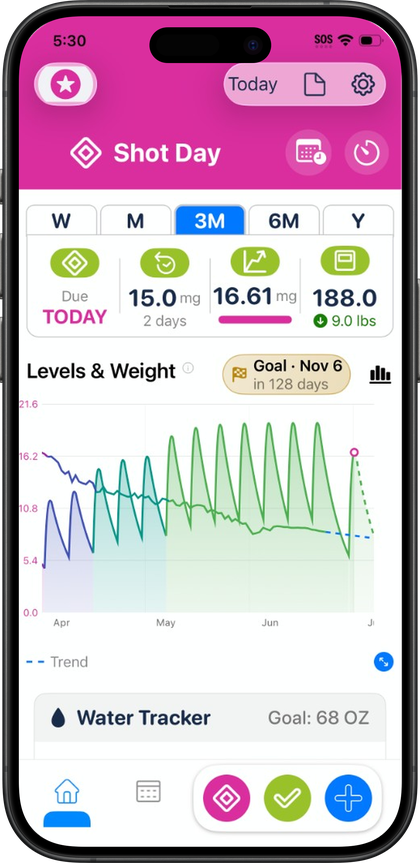
Next, look at how the app models medication levels over time. A projected-level chart estimates how much of a drug is likely active in your system between doses, based on published pharmacokinetic data — half-life, time to peak concentration, and bioavailability. This is a real differentiator: it's the difference between a log of past events and a tool that helps you understand where you are in your dosing cycle right now. Worth checking specifically: does the chart support more than one display mode, can you zoom through history, and if you take a compounded or off-list medication, can you enter your own half-life and bioavailability so it gets a real curve instead of just a plotted dot?
Injection-site tooling is easy to overlook until you're four months into a rotation and can't remember which side you used last. A visual body map with rotation suggestions is a meaningfully different experience than a text field labeled "site," and a pain rating tied to each shot turns scattered impressions into a pattern you can see over time.
Privacy and data model deserve real scrutiny given how sensitive this data is. Does the app run ads against your health information? Is there a public or social feed where activity might be visible to others? Where does your data actually live, and who besides you and the app maker can see it? These questions matter more for a GLP-1 log than for most other health apps.
Finally, check platform coverage against what you actually own. iPhone, iPad, Android, Apple Watch, and web support vary widely across this category — there's no universally right answer, only what fits your own devices.
Where to find the details
This page intentionally stays at the level of what to look for, not a row-by-row scorecard, because that kind of detail goes stale fast and reads better as a living tool than a static article. If you want a direct, feature-by-feature matrix comparing Pokii against specific named alternatives, there's a dedicated comparison tool elsewhere on this site built exactly for that job, kept current as features change.
If you're weighing Pokii against one particular competitor, look for that app's own dedicated guide rather than expecting this page to cover it — there are separate, in-depth write-ups for the major named alternatives that go into pricing, platform support, and feature-by-feature detail for that one app specifically, rather than summarizing an entire category in a paragraph. Those guides are the right place to check claims about any individual competitor, since this page deliberately doesn't restate competitor-specific facts.
How Pokii approaches these criteria
On dose logging, Pokii records medicine, dose, date, time, and notes for both injectable and oral medications, with a full edit history. The built-in medication library covers 16 branded and compound GLP-1/GIP entries — Zepbound, Wegovy, Wegovy Pill, Mounjaro, Ozempic, compounded tirzepatide and semaglutide, Retatrutide, Saxenda, Rybelsus, and others — grouped by molecule where relevant. You can track multiple active medications at once, including custom medication profiles with real pharmacokinetic fields (half-life, time-to-peak, bioavailability) so an off-list or compounded drug gets a real projected curve, not just a log entry.
Pokii's medication-level chart is built in from the start, with three display modes — combined totals, per medication, and per compound, which groups branded drugs by their underlying molecule. The chart supports panning, pinch-zoom, and a full-screen view with drag or snap tooltips along the curve. Worth being explicit: this is an educational model based on published pharmacokinetics, not a lab result, and Pokii states that plainly rather than implying any clinical measurement. Pokii also includes chart coloring by dose or medicine, customizable dose colors, a shot scheduler that previews simulated doses on the chart before you log them, a weight trend line with projection, and a lean body mass overlay read from Apple Health.
Injection-site tooling in Pokii includes a front-and-back body map with rotation settings and a suggested next site, plus an optional pain slider on injectable logs that can appear in PDF reports. On privacy, Pokii runs no ads and has no public or social feed; structured data syncs through your personal iCloud account, and progress photos sync via iCloud Drive. Platform coverage: Pokii is a native iPhone and iPad app with a dedicated tablet layout, and Android is in active development. If you need Apple Watch or a web client today, weigh that against how much of your week you spend on iOS (or hold for the Android release if that fits your timeline better).
Migration reality: what actually happens when you switch
Here's the honest version, not the marketing version: most GLP-1 tracking apps, Pokii included, don't offer a clean, complete data export you can hand to a different app and expect a full migration. Pokii's own export is a JSON backup file generated through the share sheet — used for manual or scheduled backups and for restoring your own data on a new device or after a reinstall — not a structured CSV built for moving data into a competitor's app. That's a deliberate design choice common across the category, not a Pokii-specific limitation, and it means the realistic expectation when switching trackers is that you'll be starting your dose history fresh in the new app.
Pokii's import path is the one place this gets a partial exception: it can read a Shotsy export file (.json or.shotsyjson) and convert dose and shot history into Pokii's own data model,; the import screen documents which fields carry over, focused on dose and shot history. Pokii also has a generic, header-based CSV importer for cases where you can export your history into that format yourself. Either way, imported data runs through a duplicate-detection pass so you can review and clean up before anything is finalized. Beyond that, don't assume any other specific app's export will map cleanly into Pokii or vice versa — verify it for your own case rather than taking a marketing claim at face value.
If dose history is the main thing you're worried about losing, the practical reality is that re-entering it by hand is usually a short, one-time task rather than a real barrier. Most trackers, Pokii included, are light enough that logging a full medication history in a single sitting is realistic.
Always follow your prescriber’s instructions for GLP-1 medications. Pokii helps you log and visualize your journey; it does not replace professional care.